Boom and arm trouble rarely arrives as a dramatic failure. It starts as a hairline crack at a weld toe, or as a pin that develops free play nobody measures, and it ends months later as a folded arm or a boss worn so far out of round that a new bushing has nothing left to seat in. The technical team at Guangzhou Shenyue Machinery Technology Co., Ltd. quotes boom and arm repair parts every week, and the difference between a cheap repair and a scrapped fabrication almost always comes down to when the wear was caught.
Where Kobelco boom and arm cracks actually start
On the SK range, cracks cluster in predictable places, and knowing them shortens every inspection:
- Weld toes around the boss plates on the boom foot and arm foot, where the thick machined boss meets the thinner fabricated box section.
- The boom cylinder lug area, especially on machines that work a breaker or a shear, where impact loads cycle the structure far harder than digging does.
- Repairs done before — a previous weld that was never preheated or never ground back to sound metal acts as a crack starter.
- Bottom edges and drain holes on the arm, where trapped material and corrosion thin the plate from inside.
Catch a crack while it is a surface line and the repair is a weld. Catch it after it runs across a plate and the question becomes whether the boss has moved out of alignment — at which point the price multiplies.
The wear chain: pin, bushing, boss
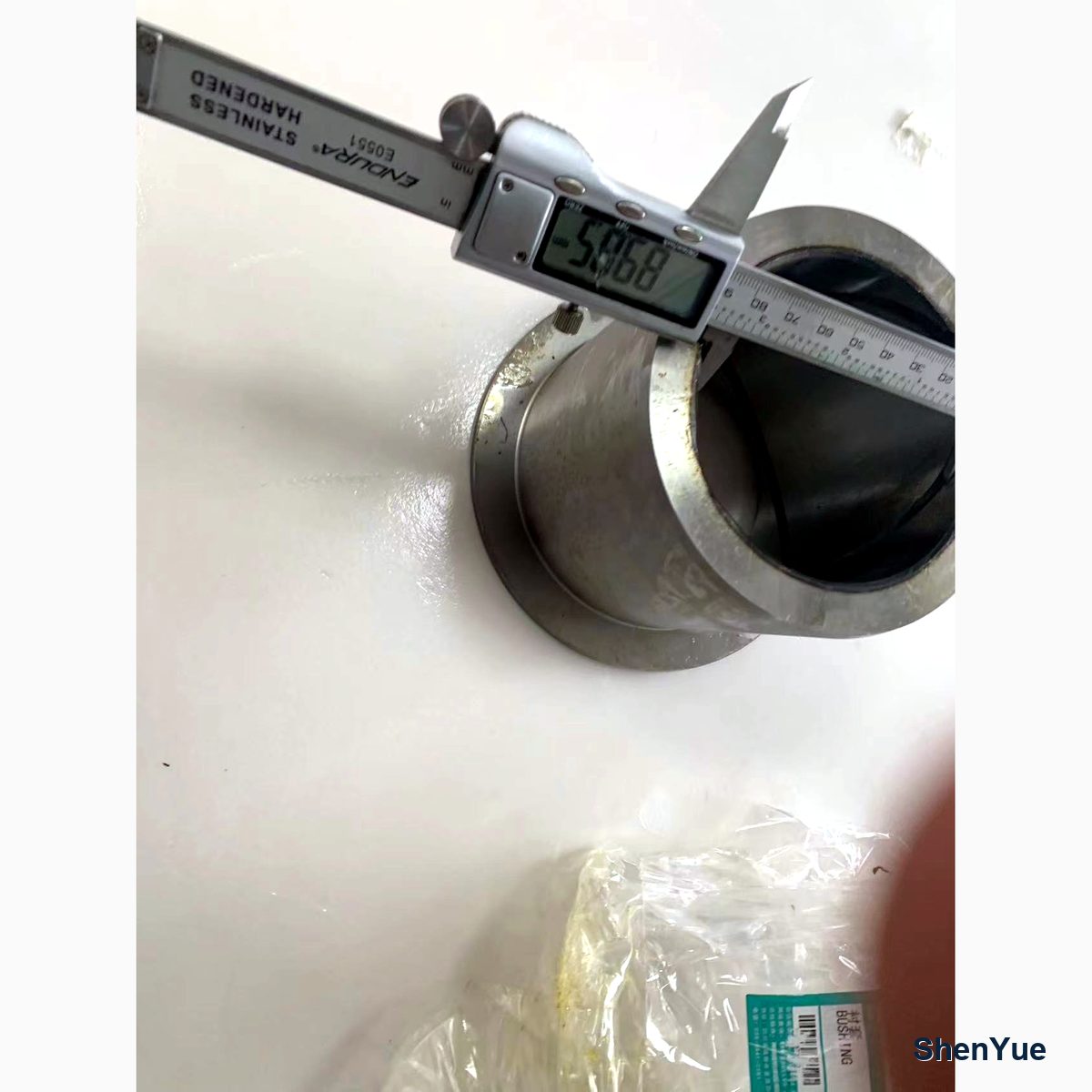
Bosses do not wear on their own. The sequence is always pin-to-bushing clearance first, then bushing-to-boss, then the boss itself. That is why measuring the bushing matters more than eyeballing the pin. On our bench we measure incoming arm bushings with a caliper before quoting a set — the photograph on this page shows bushing LC12B02199P1 being checked at 58.68 millimeters, and that number decides whether it seats correctly in a sound boss or merely fills a worn one.
| What you find | What it means | What to quote |
|---|---|---|
| Pin turns freely, no visible play, bushing bore in spec | Normal wear stage | Pins and bushings at next planned service |
| Play at the pin, bushing bore oversize, boss still round | Bushing has given up | Bushing set plus pins; press out and press in |
| Boss oval or bell-mouthed | Boss machined material lost | Line boring, then oversize or standard bushings |
| Crack plus play at the same joint | Structure and wear together | Weld repair and boring sequenced by one shop |
Weld repair, boring or replace — the honest decision order
A crack in the plate is weldable by any competent workshop that preheats, uses the right electrode class, grinds back to sound metal and drills crack-stop holes at each end first. A misaligned or oval boss is not a welding job: it needs line boring to restore the bore centerline, and the bushing is then matched to the finished bore. Replace the complete boom or arm only when a crack has crossed the section, when several bosses are oval at once, or when the cost of boring approaches a good used or new fabrication.
Ordering the wear parts that go back in
The parts themselves are straightforward once the machining route is fixed: pins matched to bushings, bushings matched to the bored bore, and fresh O-rings and plugs for the grease galleries. Arm-end bushings for the SK200 class such as LC12B02199P1 are stock items in Guangzhou; longer sections and larger classes quote per machine. Do not mix suppliers across one joint — a pin from one hardness class running in a bushing from another wears both out early.
Guangzhou Shenyue Machinery Technology Co., Ltd. supplies the full SK range from SK60 to SK850LC, and because the same bosses appear across model families, we confirm the fit by serial number rather than by model name alone. The cylinder side of the same joints lives on our undercarriage and cylinders page, the pin and bushing wear progression is covered in detail in our pin and bushing wear guide, and model-level specs sit on the SK200 model page. For the machines themselves, Kobelco's own service documentation lists the inspection points the factory expects dealers to follow.
Make the inspection a habit, not an event
Five minutes with a bar and a caliper at every 250-hour service catches boss wear a year before it catches you. Measure pin clearance at the bucket, arm and boom in that order — bucket joints wear fastest — and photograph any reading that grows between services. A bushing set shipped in time costs a fraction of a line-boring mobilization, and a fraction of that again compared with a folded arm; that arithmetic is why Guangzhou Shenyue Machinery Technology Co., Ltd. would rather quote a bushing set today than a boom assembly next year.
Frequently Asked Questions
Can a cracked Kobelco boom be welded safely?
Yes, if the crack is caught early, stopped with drilled end holes, preheated, and welded to sound metal by a qualified shop. A crack that has crossed the section or shifted a boss usually justifies replacing the fabrication. Guangzhou Shenyue Machinery Technology Co., Ltd. quotes replacement sections with the serial number as reference.
What is arm bushing LC12B02199P1 for?
It is the arm-end bushing we stock for the SK200 class, supplied by Guangzhou Shenyue Machinery Technology Co., Ltd. as genuine, OEM or aftermarket. We confirm bore and length against your machine serial and the removed part before dispatch, because revisions exist within the same model family.
How do I know if the boss needs line boring?
Measure the bushing bore with a caliper. If the bore is oval, bell-mouthed, or clearly oversize with a new bushing fitted, the boss has lost material and needs line boring before new bushings are pressed in. New bushings in a worn boss fail within weeks.
Which parts should I order together for a boom repair?
Pins, bushings, O-rings and grease-gallery plugs for every joint you open, quoted as one matched set. Guangzhou Shenyue Machinery Technology Co., Ltd. supplies matched pin-and-bushing sets for the SK range and marks each item genuine, OEM or aftermarket on the quotation.