A clamshell turns a Kobelco into a bulk material handler for sand, gravel, coal, sludge and loose scrap. It is also the attachment that fails most often for reasons that have nothing to do with the grab: undersized hoses, a relief set for a breaker, a rotation motor draining into a loaded return. Guangzhou Shenyue Machinery Technology Co., Ltd. supplies both the grab hardware and the hydraulics behind it, and this is our checklist for a grab that will not close squarely.
What a grab asks of the machine
A plain clamshell needs one double-acting circuit: pressure to the piston side closes, pressure to the rod side opens. Two hoses, and any Kobelco with a standard auxiliary line will run it. A rotating grab is different. The rotation motor is bidirectional, so it needs its own pressure pair plus a case drain that returns to tank at low pressure rather than into a line already carrying the bucket circuit. In practice that means three to five lines at the boom foot, and most 20-tonne machines leave the factory with two.
A selector valve at the boom foot is the usual workaround, and it works, but it costs a control function and adds two more chafe points.Sizing the grab before the hydraulics
Grab capacity is quoted in cubic metres, and cubic metres of what matters enormously. Dry sand sits near 1.6 tonnes per cubic metre, wet gravel closer to 2.0. Multiply shell volume by material density and compare it with the lift chart at the radius you actually work at, not at the pin; a grab hangs further out than a bucket, so the same load sits on a worse part of the chart.
The second limit is flow: a grab sized for a 30-tonne machine closes slowly on a 20-tonne one, which operators read as a worn grab. If the shells stop short of meeting, measure closing pressure first.
The circuit: relief, sequence and rotation
Breaker circuits are set high and dry: high pressure, modest flow, relief near the top of the auxiliary range. A grab wants the opposite balance, more flow at a lower setting, because the shells are large-area cylinders and the shock of slamming shut is taken by the relief. Set the auxiliary relief to the grab maker's figure, not to whatever the breaker left behind; a relief 40 bar too high is the usual cause of split shell welds.
Where the wear actually is
The shell lip takes the abrasion and is normally a bolt-on strip. Teeth are replaceable and should be replaced, because a grab with worn teeth rakes instead of biting. The shell-hinge pins and bushings decide whether the shells meet evenly: once the hinge is oval, one shell leads and the grab digs crooked, so we quote those pins from measurements.
The rotation motor fails from the outside in: its shaft seal sees mud and grit, and once it leaks the gearbox fills with water. A motor weeping at the shaft is a seal job; one that has run with water inside usually needs the gear set too. Cylinder rods bend when operators use the closed grab as a rake.
Hose routing is the part everyone ignores
The hoses at the boom foot bend through a tight arc twice per cycle, and that is where a grab installation fails first. Give the assembly a slack loop long enough to absorb full stick travel without loading the fitting, and clamp often enough that the hose cannot whip. The sizes we hold are the YN52V01016R620 / R610 / R100 family, YN52S00023P1 / YN52S00012P1, YR50V00004P1P and YY52V01006P1, each quoted with end fittings.
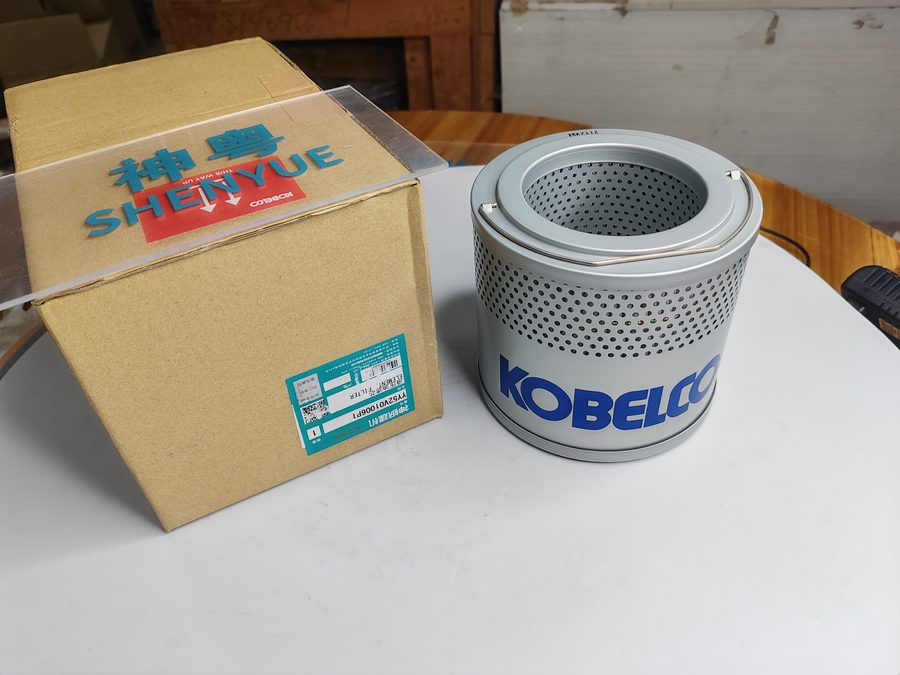
If a hose has already burst, do not simply fit another: a burst line pulls air and grit in, and the oil afterwards carries it through the rotation motor. Change the return filter and treat the first twenty hours as a flush.
What to send us for a quote
Send the machine model and serial, the grab maker's plate if there is one, pin diameters and ear widths at the head bracket, and photographs of the hose route. With those we price the hydraulic side from stock, three thousand part types on the shelf and over one hundred thousand part numbers available to order through original supply channels, every line marked genuine, OEM or aftermarket. Attachment fitment dimensions sit alongside the coupler sizes at corbayparts.com, our export brand partner site. Kobelco publishes auxiliary flow and pressure per model at kobelco.co.jp, and the attachment flow matching guide covers the breaker and shear side. Start from the hydraulic components range or send photographs through the contact page.
Guangzhou Shenyue Machinery Technology Co., Ltd. is an independent supplier of Kobelco parts, not affiliated with Kobelco Construction Machinery Co., Ltd. We supply genuine parts through original channels alongside quality OEM and aftermarket alternatives at distributor-level prices.
Frequently Asked Questions
Can I run a rotating grab on a Kobelco with only two auxiliary lines?
Only with a selector valve switching the auxiliary circuit between the cylinders and the rotation motor, or by plumbing a third line along the boom. Rotation needs a pressure pair plus a low-pressure case drain, so two lines will close the shells but will not rotate. Guangzhou Shenyue Machinery Technology Co., Ltd. quotes the selector, hoses and fittings as one kit.
How do I know a clamshell is too big for my machine?
Multiply shell volume by the density of the material you handle and compare the result with the lift chart at your working radius. Above roughly half of rated capacity at that radius the grab is too big, and the machine will also struggle to close it because the auxiliary circuit cannot deliver the flow.
Why does my grab close fast but open slowly?
Usually the rod side is restricted: a kinked or undersized hose, a collapsed fitting, or a return filter loading up. Less often the piston seal bypasses, which shows as slow opening with no external leak and a warm cylinder. Measure both sides before ordering, and check the boom-foot hose first.
Do you supply clamshell pins, bushings and teeth?
Yes, these are commonly quoted items, but grab hardware varies by maker and year, so the nameplate and the measured pin diameter are the authority rather than the machine model. Send pin diameter, ear width and centre distance and we match from stock or through original supply channels.