A second-hand machine arrives on site, the operator climbs in, pulls back on the left lever and the boom rises instead of the stick. Nothing is broken. The machine is simply set to the other control pattern, and the question is how to change it properly. Guangzhou Shenyue Machinery Technology Co., Ltd. supplies the pilot valves and fittings behind both patterns, and a changeover done carefully takes an hour; done casually, it can put an operator in genuine danger.
The two patterns in one table
| Lever | ISO pattern | SAE (JSA) pattern |
|---|---|---|
| Left lever, fore and aft | Stick (arm) | Boom |
| Left lever, left and right | Swing | Swing |
| Right lever, fore and aft | Boom | Stick (arm) |
| Right lever, left and right | Bucket | Bucket |
Only boom and stick swap between the two patterns; swing and bucket stay put. That is why a machine set one way feels workable to an operator trained the other way, until the first precise lift, and why the pattern must be labelled in the cab whatever it is set to.
Where the pattern is decided
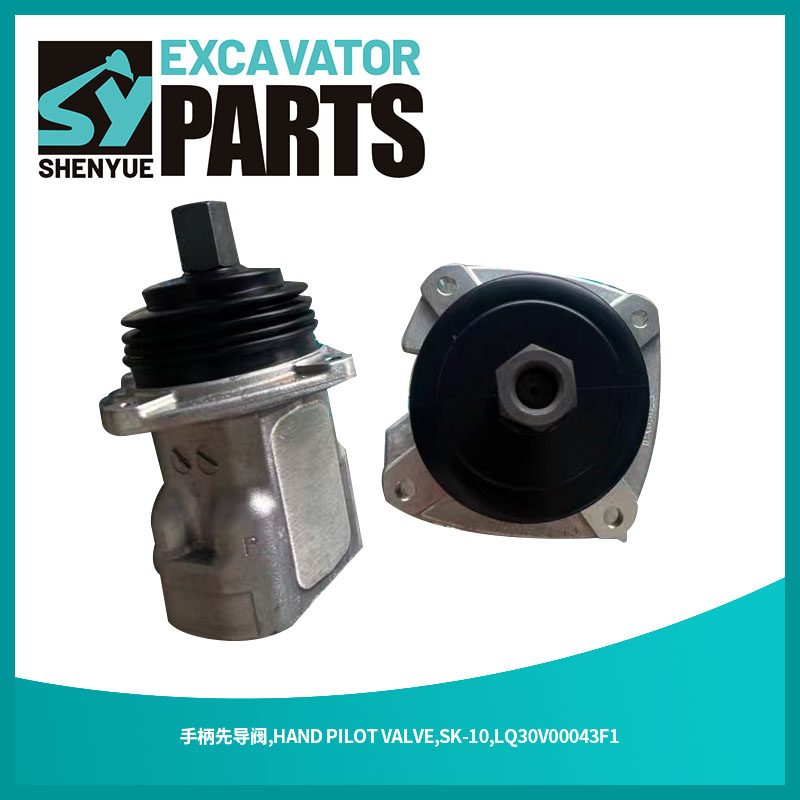
The joysticks are only handles; the pattern is decided in the pilot plumbing between each hand pilot valve and the main control valves. A machine changed permanently has its pilot lines re-plumbed in a documented pattern; a machine changed often carries a pattern changer valve, a small dedicated spool that swaps the pilot feeds to boom and stick in one movement. Both routes achieve the same swap, and both depend on the same heart: the hand pilot valve assembly, YN30V00111F1 across the SK-6 to SK-9 classes, LQ30V00043F1 on the SK-10 generation, and PX30V00043F4 on compact machines such as the SK75-8.
How a careful changeover runs
First, confirm what the machine actually has: a changer valve, or fixed plumbing. Second, work with the machine cold and shut down, and photograph every pilot connection before anything moves. Third, make one change at a time and function-test slowly at low engine speed with the area clear, because a single crossed pair will swap two functions in a way that feels almost right and is entirely wrong at height. Finally, label the cab plate to match the result.
Why the question keeps coming back
Patterns travel with machines. A Kobelco bought new in one market may be set to that market's habit, then sold, exported and re-sold into a fleet trained on the other, and the changeover history rarely follows the machine on paper. Rental fleets add another layer: the same machine goes to two contractors in one month, each trained differently, so the changeover is a weekly event rather than a one-time job. Treat the pattern as a configurable state of the machine, with a label, a record and an owner, and the surprises stop.
What to check when the pattern is right but the feel is wrong
A correctly plumbed machine that responds slowly or drifts has a pilot problem, not a pattern problem. Pilot supply pressure, a tired pilot valve seal kit, or a clogged pilot filter will make one pattern feel worse than the other simply because the operator works different valves harder in each. Test the pilot pressure before replacing anything; the sequence and the test points are in the pilot pressure test guide, and valve-level faults are in the hand pilot valve faults guide.
Control and pilot components are matched to the machine serial rather than the model year, so send both through the contact page. Guangzhou Shenyue Machinery Technology Co., Ltd. holds three thousand part types on the shelf and over one hundred thousand part numbers available to order through original supply channels, each marked genuine, OEM or aftermarket. Machine control data is published by the manufacturer at kobelco.co.jp.
Guangzhou Shenyue Machinery Technology Co., Ltd. is an independent supplier of Kobelco parts, not affiliated with Kobelco Construction Machinery Co., Ltd. Genuine parts are supplied through original channels alongside quality OEM and aftermarket alternatives at distributor-level prices.
Frequently Asked Questions
What is the difference between ISO and SAE control patterns?
Only boom and stick swap: on the ISO pattern the left lever runs the stick and the right lever the boom; on the SAE pattern it is the reverse. Swing and bucket are the same in both. Guangzhou Shenyue Machinery Technology Co., Ltd. recommends labelling whichever pattern the machine is set to.
How do I change the control pattern on a Kobelco?
Either re-plumb the pilot lines in a documented sequence, or move a fitted pattern changer valve, with the machine shut down and every connection photographed first. Then function-test slowly at low engine speed. The change is decided in the pilot circuit behind the joysticks, not at the joysticks.
Which pilot valve fits my machine for a pattern change?
YN30V00111F1 covers the SK-6 to SK-9 classes, LQ30V00043F1 the SK-10 generation, and PX30V00043F4 compact machines such as the SK75-8. Confirm against the machine serial before ordering.
The pattern is right but the controls feel slow. Why?
That is a pilot circuit issue, not a pattern issue: check pilot supply pressure, the pilot filter and the hand pilot valve seal kit. Test the pressure before replacing parts, since low pilot pressure mimics a valve fault in either pattern.