Most parts ordered against a fault code are ordered twice. The first controller or sensor goes on, the fault returns, and the second attempt starts with a better description of the symptom. The gap is almost never the code itself — it is everything that should have been written down beside it. Guangzhou Shenyue Machinery Technology Co., Ltd. quotes electrical parts every day, and the enquiries that get the right part first all contain the same six pieces of information.
Why a code is not a diagnosis
Modern Kobelco controllers monitor circuits, not components. A code that says a sensor signal is out of range can be produced by the sensor, by the wiring to it, by a poor ground, by low system voltage or by a genuine mechanical fault the sensor is faithfully reporting. The controller has no way to tell those apart, and neither does a supplier reading only the code. What separates them is context: when the fault appears, what the machine is doing, and what else changes at the same moment.
The six things to write down
| Item | Why the supplier needs it |
|---|---|
| Model, serial and hour meter | Generation changes the part number; hours indicate wear-related versus early failure |
| Exact code text and whether it is active or stored | Stored history codes can be months old and unrelated to today's complaint |
| When it appears | Cold start, hot, under load, during travel, during swing — each narrows the circuit |
| What the operator feels | Derate, limp mode, single function lost, gauge flicker |
| Recent work on the machine | A pressure wash, a welding job, a new battery or a harness repair explains a surprising number of faults |
| Battery voltage and ground condition | Low voltage produces codes that disappear when the charging system is fixed |
Getting the codes out of the monitor
Depending on generation, codes are read from the cab monitor's service or diagnostic screen, or with a service tool through the diagnostic connector. The procedure differs between series and is documented in the workshop manual for that machine — follow it rather than a sequence remembered from another model, because entering the wrong menu on some panels changes settings. Record the code as it is displayed, including any sub-code, then record the same screen again after the fault has been reproduced. A code that only appears in one condition is worth more than ten codes read at idle.
Do not swap the controller first
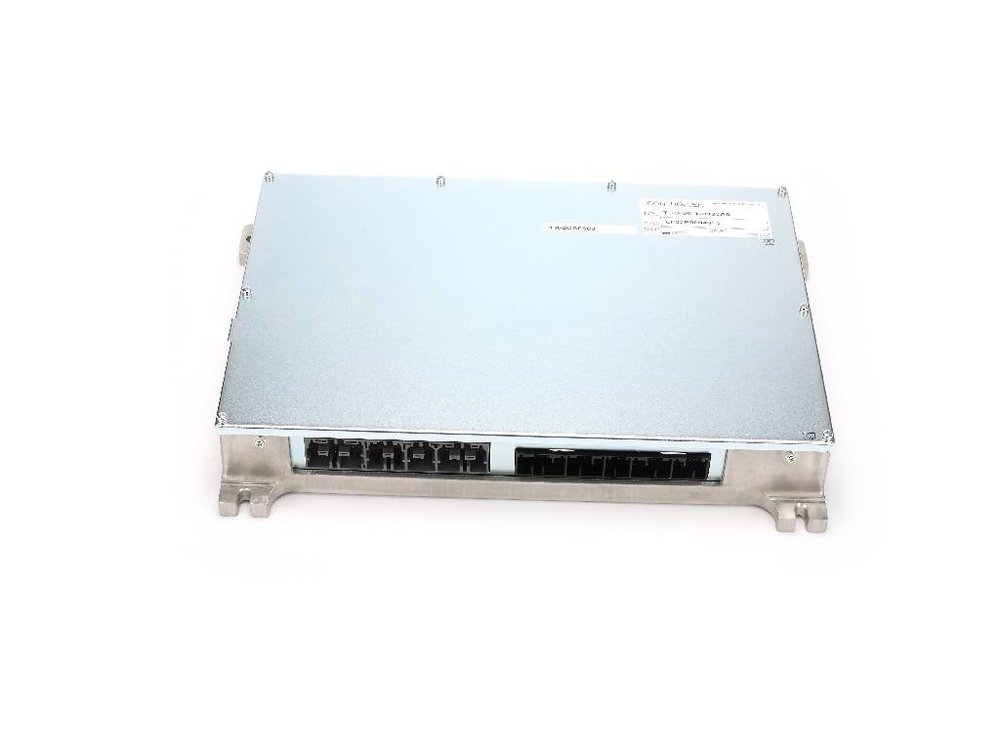
The controller is the most expensive part in the circuit and the least likely to be the cause. Before replacing one, confirm battery voltage under load and at the controller plug, check the main grounds at the frame, inspect the connector pins for corrosion or a pushed-back terminal, and look for a harness that has been chafed by a panel or pinched by a cover. Our records hold YN22E00193F5 as an ECU controller, YN22E00694F8 as a CPU controller and LC22E00336F8 with LC22E00323F8 quoted together — each is a specific fitment, and a controller from a different generation will not simply learn its way into the machine. Guangzhou Shenyue Machinery Technology Co., Ltd. asks for the controller number, the machine serial and a photograph of the label before quoting one. The monitor itself is a separate part: YN10M00001S013 and YN14E01102P4 are gauge assemblies, and a blank or flickering display is a monitor question, not a controller question.
Photograph, do not transcribe. A photo of the monitor with the code visible, plus one of the machine plate, removes most of the ambiguity in an enquiry. Guangzhou Shenyue Machinery Technology Co., Ltd. can then check the number against 3,000+ part types on the shelf and 100,000+ part numbers available to order instead of guessing at a description.
The symptom log that pays for itself
Keep a small book in the cab. Date, hour meter, code, condition, what was done, what changed. When the machine eventually needs a part, that log turns a three-week diagnostic conversation into one email. It also protects the owner: a fault that was reported three times and never fixed is a maintenance decision, not a sudden failure. The electrical parts range and the SK200-8 electrical faults guide cover the common components; the monitor and switch guide covers the display side. For non-Kobelco machines in a mixed fleet, the same discipline applies — corbayparts.com handles those enquiries. Kobelco's published service literature at kobelco.co.jp remains the reference for procedure.
Frequently Asked Questions
What do Kobelco fault codes mean?
Code definitions differ by series and controller generation, and a code usually describes a circuit condition rather than a failed component. Use the workshop manual for the specific machine to interpret it. Record the exact text, whether it is active or stored, and the conditions in which it appears — that combination is what identifies the part.
Should I replace the controller when a code points to it?
Not first. Confirm battery voltage under load, grounds, connector pins and harness routing before replacing a controller. The controller is the most expensive and least frequently failed part in the circuit, and a controller from another generation will not adapt to the machine. Guangzhou Shenyue Machinery Technology Co., Ltd. verifies the exact number before quoting.
Where are fault codes read on a Kobelco excavator?
On most machines through the cab monitor's service or diagnostic screen, or with a service tool at the diagnostic connector. The procedure is generation-specific and documented in the workshop manual. Record the screen before and after reproducing the fault, because history codes read at idle often mislead.
What information should I send with an electrical parts enquiry?
Model, serial, hour meter, the exact code and its active or stored state, when the fault appears, what the operator feels, recent work on the machine, and battery voltage. A photo of the monitor and the machine plate removes most ambiguity. Our monitor records include YN10M00001S013 and YN14E01102P4.