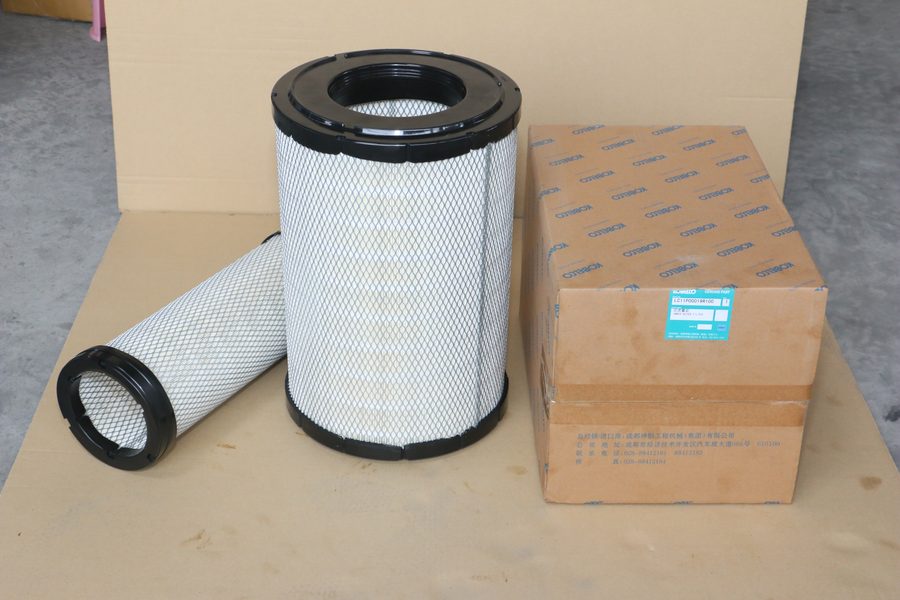
Every filter on a Kobelco is a sample of what is circulating inside the machine, captured and stored until someone opens it. Most filters are replaced and discarded without being read, which throws away the cheapest diagnostic evidence available. A return filter with bronze flakes, an engine oil filter with silver paste, a fuel filter with black slime: each points at a different component and a different repair. Guangzhou Shenyue Machinery Technology Co., Ltd. supplies filters by the box, and the useful conversation usually starts when the customer describes what came out of the old one.
Four filters, four stories
The return filter sits in the hydraulic tank and sees everything the circuit sends back, so it is the best single indicator of hydraulic wear. The drain or case-drain filter sees leakage flow from pumps and motors and is more sensitive to a single failing unit. The pilot filter is fine enough to catch the small particles that jam a solenoid or score a spool, and it is often the first filter to show a pilot pump problem. The suction strainer is coarse and protects the pump from large objects; a blocked strainer shows up as cavitation, not as debris.
On the engine side, the oil filter carries bearing and ring material, the fuel filter carries tank contamination, and the water separator carries what the fuel filter was not meant to see. Treat each as a separate sample with its own meaning.
How to open a filter properly
Drain the can overnight, then cut the body open with a filter cutter or an angle grinder well below the seam, not through the element. Spread the pleats in a clean tray, look at the dirty side, and work from the outside in. Wipe a section of pleat on white cloth, then run a magnet over the debris and photograph both the magnet and the cloth. Label the sample with machine, hours and date. A filter read without hours is a rumour; a filter read against the previous filter is a trend.
| What is on the pleats | Most likely source | Next test |
|---|---|---|
| Fine grey paste, even, first service after rebuild | Normal running-in | Continue normal interval, recheck next service |
| Bronze or copper-coloured flakes | Pump or motor valve plate and slipper wear | Case drain flow test on pump and motors |
| Hard steel chips, magnetic | Gear, bearing or piston shoe failure | Stop the machine, inspect the unit before restarting |
| Rubber crumbs or seal lips | Hose or seal breakdown, sometimes a failed suction line | Check suction hoses and cylinder seals |
| Sand or grit with no metal | Ingress through breather, filler or a torn boot | Inspect breather, filler cap and tank top |
What the magnet can and cannot tell you
A magnet separates steel from everything else, and that is all it does. Ferrous chips mean gears, bearings, pins or cylinder bores. Non-magnetic debris means bronze, brass, aluminium or seal material, which points at pump and motor wear surfaces or at bushings. A filter full of non-magnetic flakes on a machine with low hours is a more urgent finding than a little grey paste on a machine just out of overhaul, because the parts that make bronze flakes are the expensive ones.
Trend beats any single sample
A dirty filter proves something wore once. Three filters in a row with rising debris proves a component is failing. Keep the photographs with the service record, note the hours, and compare. Where oil analysis is available, use it alongside the filter reading: particle counts show how clean the oil is, spectroscopy shows which elements are present, and the filter shows what the particles look like. The three answers together are worth more than any one of them.
Keep the filter, keep the evidence. Guangzhou Shenyue Machinery Technology Co., Ltd. holds 3,000+ part types on the shelf, including engine oil filter LC11P00019R100, fuel filter VH23304EV360 and water-fuel separator assembly LG21P01003F2, with 100,000+ part numbers available to order. When a customer reports debris, we ask for the filter number and the hours first, because the filter identity tells us which circuit the debris came from.
Turning a reading into an order
A filter reading decides whether the next step is a service, a test or a teardown. Grey paste: service and recheck. Bronze flakes with slow cycle times: case drain test before buying anything. Steel chips with a noise: stop, because running the machine to "see if it settles" turns a rebuildable unit into scrap. Once a test points at a unit, Guangzhou Shenyue Machinery Technology Co., Ltd. quotes the assembly and its internal parts together, because a repaired pump with a worn regulator is a second failure waiting to happen. Our hydraulic cleanliness guide covers the flush that should follow any contaminated repair, and the SK-8 service point and filter element guide lists which element belongs to which circuit.
Where to start
If you are unsure which filter number fits your machine, the filters and lubricants page groups them by circuit, and our part number search confirms the number against the serial. Service intervals by machine series are published at kobelco.co.jp. Reading a filter costs ten minutes; replacing a pump because nobody looked costs far more.
Frequently Asked Questions
What does bronze-coloured debris in a Kobelco hydraulic filter mean?
Bronze or copper-coloured flakes are usually valve plate and slipper material from a pump or travel motor. The next step is a case drain flow test on the pump and each motor to find which unit is losing flow, before anything is replaced.
How often should I cut open a filter instead of just replacing it?
At every service on a machine with a known problem, and at least at every second or third service on a healthy fleet machine. The value comes from comparison: one filter read alone is a single data point, while three consecutive filters with hours recorded show whether debris is rising or stable.
Can I tell a failing hydraulic pump from the filter alone?
You can tell the type of wear, not the exact unit. Bronze flakes point at pump or motor wear surfaces, steel chips at gears or bearings, rubber at hoses and seals. A case drain test then identifies the unit. Guangzhou Shenyue Machinery Technology Co., Ltd. asks for the filter number, hours and a photograph before quoting parts.
Which Kobelco filters are worth keeping on the shelf?
At minimum the engine oil filter, fuel filter and water separator, plus the hydraulic return and pilot elements for the models you run. Our records include oil filter LC11P00019R100, fuel filter VH23304EV360 and separator LG21P01003F2.