Most hydraulic injuries are not caused by a burst hose. They are caused by energy that was still stored somewhere in the system when a fitter opened a connection, or by a pinhole leak that was investigated with a bare hand. Both are entirely predictable, and both are avoided by a fixed sequence rather than by experience. Guangzhou Shenyue Machinery Technology Co., Ltd. supplies hydraulic parts to workshops in more than thirty countries, and the questions we get about relief settings and test ports are usually followed by a description of how the last injury happened.
Stored energy comes from three places
The first is the load itself. A boom held up by a cylinder is a raised mass sitting on oil, and that oil is at pressure with the engine off. The second is the accumulator, which stores pressure deliberately and holds it after shutdown; it is the reason a machine can still move a function minutes after the key is turned off. The third is thermal expansion, which can leave a closed line pressurised overnight simply because it warmed up.
None of these announce themselves: a hose that looks slack can hold 200 bar behind a closed valve, and a machine parked for a week can still have a charged pilot circuit.
The pinhole leak: never use a hand
A high-pressure pinhole leak is almost invisible. It does not spray in a fan; it comes out as a needle-thin jet that can penetrate skin at close range without pain at the moment of injury. Oil injected into tissue causes necrosis and needs a hospital, not a bandage.
Find leaks with a piece of cardboard or a dry plank held at arm's length, with the system at operating temperature. Wear gloves and eye protection, and never run a finger along a hose or a fitting to feel for wetness. Any suspected injection injury goes to hospital immediately, with the oil type written down for the treating team.
Depressurising in the right order
Park on level ground, lower the attachment to the floor, stop the engine, and then work every lever through its full travel several times with the key on and the engine off. That releases pressure trapped in the pilot circuit and in the main lines. Open the hydraulic tank filler cap slowly to release tank pressure, and only then connect a gauge to the test port to confirm zero before cracking a fitting.
If the machine has a pilot accumulator, allow the specified bleed time after shutdown before touching a pilot line. Cap every open port immediately; grit is what turns a seal replacement into a pump rebuild.
Block it, do not hold it
Hydraulics are not a support. Before working under a raised boom, arm or blade, lower it onto rated stands or timber blocking placed on firm ground, and check that the load is actually resting on the blocking before reaching underneath. Do not use bricks or hollow blocks. A travel motor or a cylinder hanging on a sling is also a load: chock it, and do not rely on the crane staying pressurised.
| Task | Main hazard | Control |
|---|---|---|
| Cracking a hose or fitting | Trapped pressure, oil to the face | Engine off, levers cycled, gauge at zero, cap the port |
| Finding an external leak | Pinhole injection injury | Cardboard at arm's length, gloves, eye protection, no hands |
| Working near a pilot accumulator | Stored pressure after shutdown | Full bleed time, verify at the test port |
| Working under a raised front | Load drop | Rated stands or timber on firm ground, load resting |
| Adjusting a relief valve | Hot oil, unexpected movement | Cold machine where possible, one turn at a time, gauge fitted |
Hose whip and hot oil
A pressurised hose that separates whips with enough force to break bone. Hold the hose when cracking a fitting, keep bystanders out of the arc, and never stand in line with a hose end. Hot oil at 80 degrees causes a deep burn in seconds; long sleeves, gloves and a face shield are normal workshop kit for this work.
Parts and settings
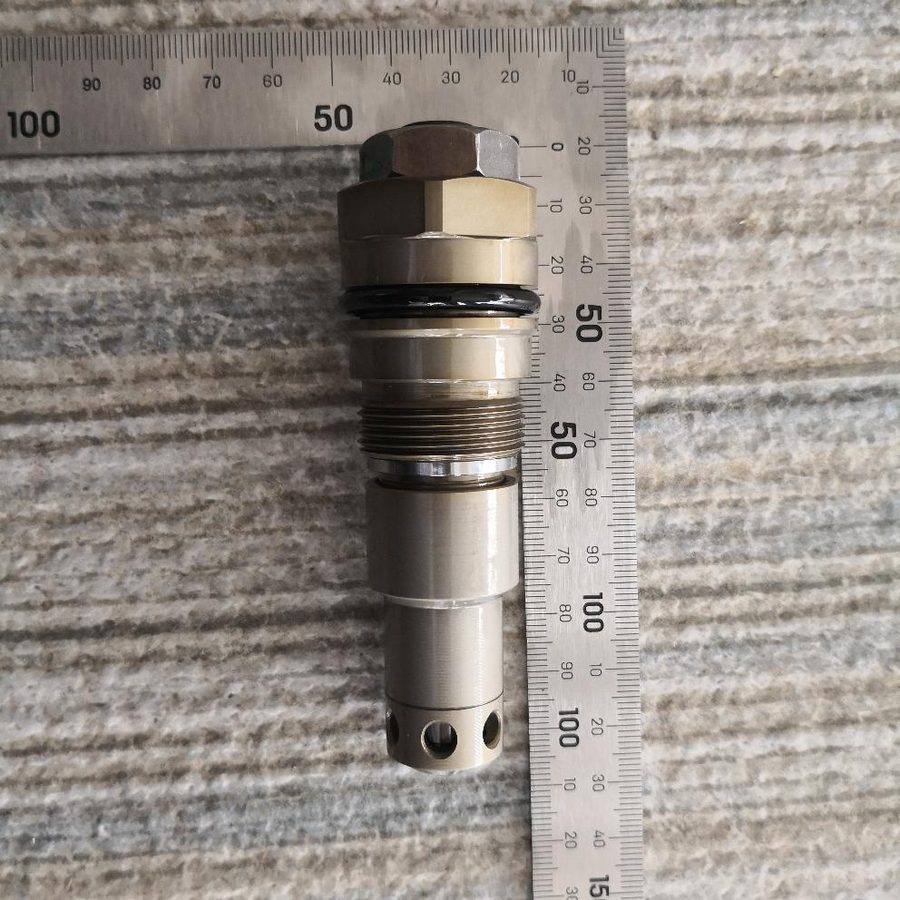
Relief valves, seals, hoses and test fittings are regular lines for us: three thousand part types on the shelf and over one hundred thousand part numbers available to order through original supply channels, each marked genuine, OEM or aftermarket. Quote the relief cartridge number rather than the machine model where possible; the V9510318049-T, LP22V00001F1 and YN22V00004F1 grouping is one example of several numbers pointing at the same assembly. The pilot pressure test guide covers gauge work, the hydraulic components range covers valves and seals, and quotes start at the contact page.
Guangzhou Shenyue Machinery Technology Co., Ltd. is an independent supplier of Kobelco parts, not affiliated with Kobelco Construction Machinery Co., Ltd. Genuine parts are supplied through original channels alongside quality OEM and aftermarket alternatives at distributor-level prices. Seal material data for hydraulic components is published at nok.co.jp.
Frequently Asked Questions
How long does pressure stay in a Kobelco hydraulic system after shutdown?
It depends on the circuit. Pilot accumulators hold pressure for the specified bleed time after the key is off, and a raised boom holds main-line pressure indefinitely because the load is still there. Lower the attachment, cycle every lever, then confirm zero on a gauge.
Is a hydraulic injection injury serious if it does not hurt?
Yes. A pinhole jet can penetrate skin at close range with little pain at the time, and the oil causes tissue necrosis over the following hours. It is a surgical emergency. Go to hospital immediately and say which oil was involved. Find leaks with cardboard, never with a hand.
Do I need to block a raised boom if the cylinder holds pressure?
Always. Hydraulics are not a support, and a leaking cylinder seal or a drifted valve can drop the load slowly while someone is underneath. Lower the front onto rated stands or timber on firm ground and confirm the load is resting before reaching under it.
What should I check before adjusting a relief valve?
Fit a gauge, know the specified setting, and work on a cool machine where possible. Turn in small increments and re-check, because a relief set too high is what splits seals, cooler cores and hose crimps. Quote the cartridge number so the replacement matches.