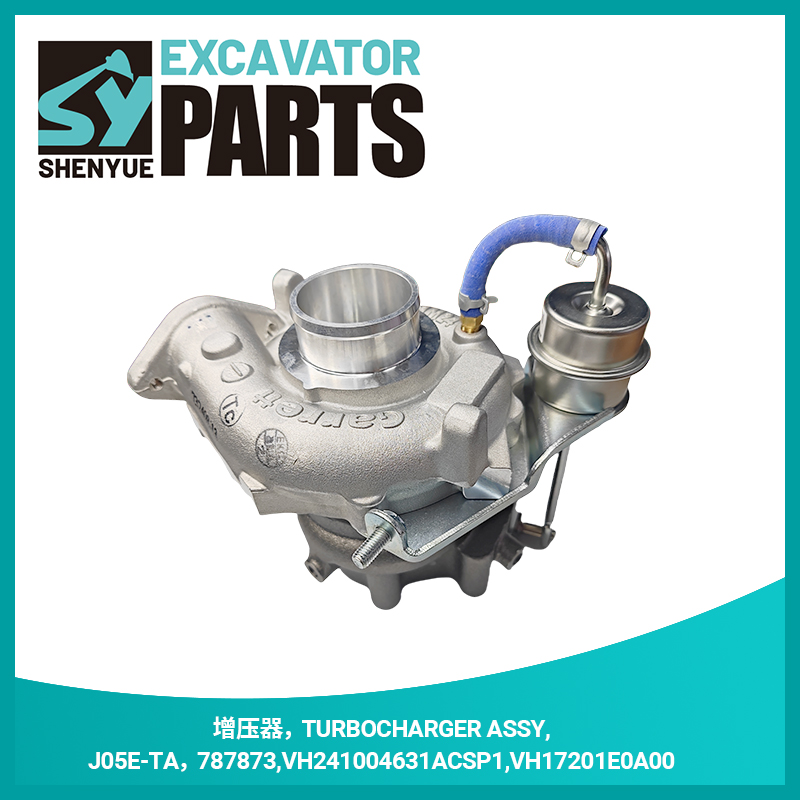
An excavator that has lost its pull, smokes black under load and drinks fuel is usually diagnosed as a failed turbocharger — and often the turbocharger is the one part on the machine that is still working. The far more common cause is a leak on the intake or boost side, a path that lets the air the turbo has just compressed escape or lets unmetered air in, and it costs a fraction of a turbo to find. Guangzhou Shenyue Machinery Technology Co., Ltd. has supplied Kobelco engine parts since 2007, and this guide sets out how to prove the leak before the turbo is condemned.
What a boost leak actually does
The controller sets fuel delivery against the air it expects the engine to receive. When boost pressure is lost the engine gets less air than the injected fuel demands, so the mixture goes rich: power falls, the exhaust turns black or grey, exhaust temperature climbs, and fuel consumption rises for the same work. Caught early the symptom is a slightly flat machine; left alone, the same rich running raises combustion temperatures far enough to damage pistons and valves. None of that requires the turbocharger to have failed, because a leak downstream of the compressor produces exactly the same complaint.
Where the leak hides
The boost path runs from the compressor outlet, through the charge pipe and the aftercooler, into the intake manifold. Every joint along that path is a candidate, and the failures cluster in a short list.
| Location | Typical failure | What you see |
|---|---|---|
| Charge hoses and elbows | Torn or perished coupling hose | Oil mist, whistling under load |
| Clamps and joints | Loose or corroded clamp | Hose displaced, soot trail at the joint |
| Aftercooler | Perforated core or cracked tank | Power loss with no external mark |
| Intake manifold gasket | Blown gasket | Black soot streak at the flange |
| Air filter and housing | Restricted element or poor seal | Low boost on an otherwise clean machine |
Prove it before you buy a turbo
Three checks, in order, settle almost every case. First, measure boost pressure against the specification at rated speed and under load, because a machine that cannot reach specified boost has proved there is a delivery problem without yet proving where it is. Second, inspect the charge path with the engine stopped: squeeze the hoses, check the clamps, and examine each joint for the soot trail escaping air leaves behind. Third, check the air filter element and the housing seal, because a restricted element produces a low-boost reading with a sound charge path and it is the cheapest of all the possibilities. Only when boost is low, the charge path is sound and the element is clean should the turbocharger itself be examined. Our filters and lubricants range covers the intake elements, and the SK200 page sets out the class in which most of these machines are found.
Let the sensor tell you the truth
Modern Kobelcos monitor boost pressure directly, and our stock carries the air boost pressure sensors VH893901080ACT and VHS893901080 / 0798005890. That sensor is a diagnostic instrument, not merely a fault-code source: comparing its live reading against a gauge on the same port separates a real boost loss from a drifting sensor, which mimics a boost fault so well that it is regularly misdiagnosed. If the gauge reads correctly and the sensor does not, the problem is the sensor. Both sit in the engine parts range alongside the turbocharger assemblies themselves; the SK200-8 J05E machine quotes its turbo under 787873-5001S / VH241004631A / CSP1VH17201E0A00 / VH17201E0523, and the J05E turbo guide covers the turbo side in detail.
Parts that fix it, and parts that do not
The consumables that repair a boost leak are hoses, clamps, gaskets and the intake element — all inexpensive and all in stock. The parts that do not fix it are a new turbocharger fitted to a machine whose charge hose was torn, and a new boost sensor fitted to a machine with a blown manifold gasket. Both mistakes come from skipping the pressure measurement. Where a number cannot be confirmed from our records it is quoted as commonly quoted, with the nameplate treated as the authority. Fleets that need the equivalent intake and boost parts for other machines will find them in the export catalogue at corbayparts.com, the same company's international trade site.
How we supply
Guangzhou Shenyue Machinery Technology Co., Ltd. has specialised in Kobelco since 2007, with 4 warehouses over 1000 m² in Guangzhou, 3,000+ part types on the shelf and 100,000+ part numbers available to order through original supply channels. Shenyue is an independent supplier and is not an authorized dealer of Kobelco Construction Machinery Co., Ltd.; for Kobelco, Hino, Isuzu, Yanmar, Cummins, Kawasaki, Nabtesco, KYB and KPM we supply genuine parts ordered through original supply channels alongside quality replacement alternatives, at prices close to agent level, and the five brands we hold formal authorization for — Mitsubishi, Garrett, TONGMYUNG, Marusan and NIKURA — are named on every quotation. Turbocharger identification and technology guidance is published by Garrett Motion, one of the five brands we hold authorization for.
Frequently Asked Questions
Does black smoke always mean the turbocharger has failed?
No. Black smoke under load means the engine is receiving less air than the injected fuel demands, and a boost or intake leak downstream of the compressor produces exactly the same result. Measure boost pressure and inspect the charge hoses, clamps and gasket before condemning the turbocharger.
How do I test for a boost leak on a Kobelco?
Measure boost pressure at rated speed under load against the specification, then inspect the charge path from the compressor outlet to the intake manifold with the engine stopped, looking for a soot trail at joints and oil mist on hoses. Check the air filter element and the housing seal at the same time.
Can a faulty boost pressure sensor cause low power?
Yes. A drifting sensor misreports boost, so the controller under-fuels or de-rates the machine while the mechanical boost is correct. Compare the sensor's live reading against a gauge on the same port — our stock includes the air boost pressure sensors VH893901080ACT and VHS893901080 / 0798005890.
Which parts actually repair a boost leak?
Charge hoses, clamps, the intake manifold gasket and the air filter element — all inexpensive and all in stock. Guangzhou Shenyue Machinery Technology Co., Ltd. prices them as one package with each line's grade declared, so a small leak is never treated as a turbocharger failure.