Two numbers decide every lift a Kobelco makes: the rated capacity printed in the load chart, and the pressure at which the hydraulics stop pushing. Owners read the first, ignore the second, and then wonder why a machine that lifted a load last month refuses it today. Guangzhou Shenyue Machinery Technology Co., Ltd. supplies lift-circuit parts for the SK200-8, SK210-8 and SK330-8 classes, and most lifting questions we receive come back to those two numbers.
What a load chart actually measures
The chart is kilograms against radius, and radius is measured on the ground from the centre of the swing circle to the centre line of the load. It assumes level firm ground, a stationary machine, a stated boom and arm, a stated counterweight and a stated bucket. ISO 10567 practice rates the machine at the lower of 75 per cent of the tipping load and 87 per cent of hydraulic lifting capacity, so every printed figure already carries a margin. Change one assumption and the chart no longer describes your machine.
What lift mode changes, and what it cannot
Lift mode raises the relief ceiling in the boom circuit, so the hydraulics keep pushing at a radius where a standard setting would stall. That is the whole effect. It does not strengthen the boom, the rod, the pins or the swing bearing, and it does not move the tipping line. On most Kobelco -8 and later machines the selection sits in the monitor; the label differs between builds, and the decal on your own machine is the authority.
Three limits, in the order they bite
| Limit | What sets it | How it shows up first |
|---|---|---|
| Stability | Counterweight, track gauge, ground bearing | Machine goes light at the far track, tilt increases |
| Hydraulic capacity | Relief setting, pump and regulator condition | Function stalls, engine pulls down, relief whistles |
| Structure | Boom, rod, pins, swing bearing | Cracks or a bent rod, usually after the event |
Stability gives the first warning, because the machine goes light at the far track before anything bends. Hydraulic capacity announces itself with a stalled function. Structural failure gives no warning at all, which is why the first two limits are worth respecting.
Reading the chart for the machine you have
Charts are published per model and per front. A machine with a long front, a three-piece boom, a heavier counterweight or an attachment piping kit does not use the standard chart. Confirm model code, serial, counterweight configuration and front from the plate, then use the chart issued for that combination. If the chart is missing, the specification sheet for that serial is the authority, not a chart found online for a similar model.
Where lift mode goes wrong in practice
Three habits account for most of the lifting damage we see. Lifting on the bucket teeth and calling it a rated load adds the bucket's own weight and moves the load centre further out. Turning up the main relief so a tired pump feels stronger pushes hydraulic capacity past the structural and stability limits the chart was drawn around. Lifting on a slope, or on ground that has already failed once, ignores the chart altogether.
The parts that decide lifting performance
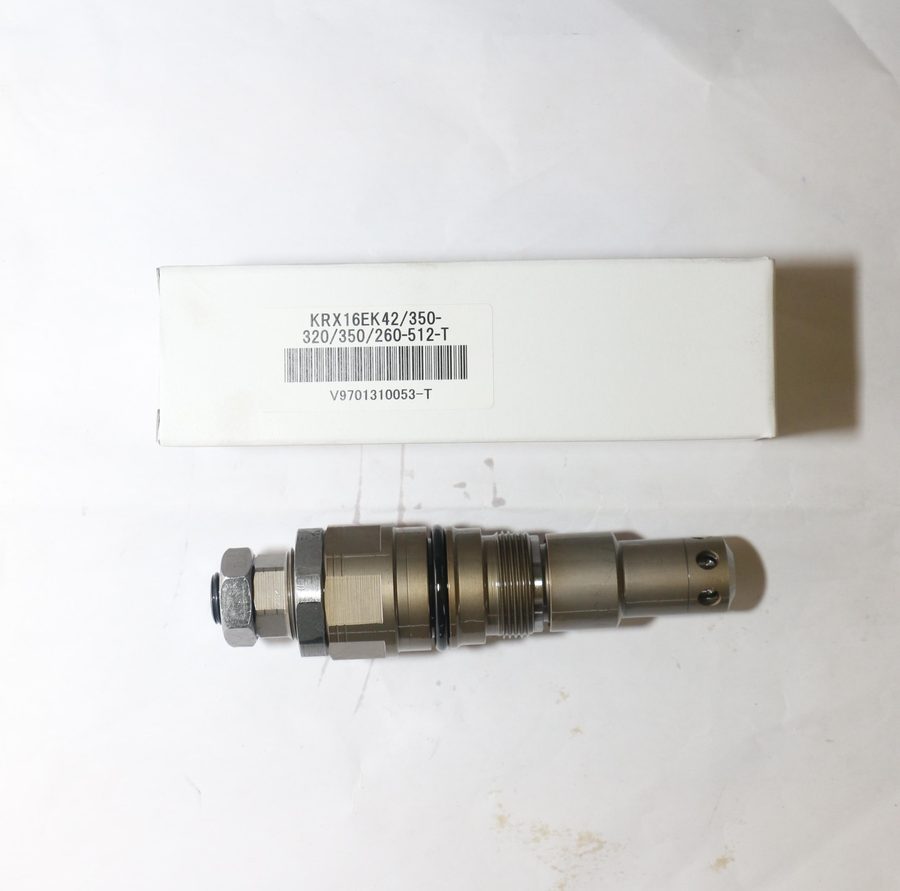
Lifting sits on four components: the main relief valve, the pump, the regulator and the boom holding valve. A worn pump loses flow and the function slows before relief; a leaking relief caps pressure early; a sticky regulator holds the pump at low displacement. For the 20-tonne class we stock pump assemblies 2924610-0030 / YN10V00005S156 and regulators 29070821-4927 / YN10V01006F2, with relief valves quoted by serial.
What to send for a quote
Send the model code, the serial, the function that will not hold, the pressure you measured and where you measured it. A photograph of the plate saves a round of questions. We hold three thousand part types on the shelf and over one hundred thousand part numbers available to order through original supply channels, each marked genuine, OEM or aftermarket.
Start from the SK200 model page, the hydraulic components range, or the K3V112 and K5V140 comparison, and send pressures through the contact page. Rated capacity tables for each model are published by the manufacturer at kobelco.co.jp.
Guangzhou Shenyue Machinery Technology Co., Ltd. is an independent supplier of Kobelco parts, not affiliated with Kobelco Construction Machinery Co., Ltd. Genuine parts come through original channels alongside quality OEM and aftermarket alternatives at distributor-level prices.
Frequently Asked Questions
Does lift mode increase what my Kobelco can lift?
It increases hydraulic lifting capacity by raising the relief ceiling in the boom circuit, so the machine stalls later. It does not change stability or structural limits, and those usually govern. The load chart for your serial, not the mode switch, is the authority.
Where do I measure radius for the load chart?
On the ground, from the centre of the swing circle to the centre line of the load, with the machine level and stationary. Bucket weight and any sling or hook offset count toward the load. Guangzhou Shenyue Machinery Technology Co., Ltd. sees lifts fail because radius was guessed from the cab.
Is it safe to lift with the bucket teeth instead of a hook?
It is done, but it is not the same lift. The bucket's weight stays in the load path and the load centre moves further out, so the rated figure for a hook does not apply. Use the chart for bucket lifting if one is published, and keep the load close.
Why will my machine no longer lift its rated load?
Usually a worn pump, a leaking main relief valve or a sticking regulator. Pressure at the relief valve is the first test, followed by pump flow. Relief valves for the 20-tonne class are commonly quoted as V9510318049-T, LP22V00001F1 or YN22V00004F1.