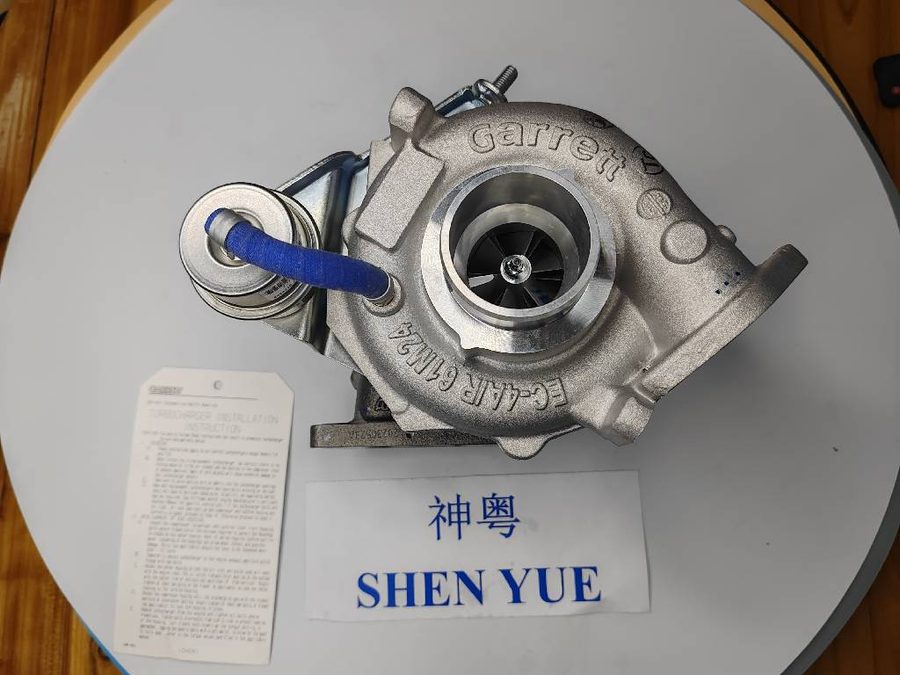
Altitude is the part of a site survey that gets skipped. A machine specified for a quarry at sea level and then sent to work at 3,000 m will lose power, run hotter exhaust temperatures and work its cooling system harder, and none of that is a fault — it is physics. Knowing which systems feel the altitude tells you what to carry and what not to chase. Guangzhou Shenyue Machinery Technology Co., Ltd. supplies machines into mountain and plateau work across several export markets, and these are the items that decide how well they run.
What altitude does to a diesel
Air density falls by roughly 12 per cent for every 1,000 m of altitude. The engine still needs the same mass of air to burn its fuel cleanly, so at altitude the turbocharger has to spin faster to push the same mass into the cylinders. Three consequences follow. Rated power falls and the controller derates the engine to protect it. Exhaust gas temperature rises, and that is what shortens the life of exhaust valves and aftertreatment components. And the cooling system loses capacity, because a radiator or charge-air cooler is rejecting heat into air that is thinner and carries less heat away per cubic metre.
The systems that feel it
Intake and filtration come first. Thinner air means the engine needs every gram of it, so a filter that would last 500 hours at sea level can cost real power long before it looks blocked. The turbocharger is next: higher speed and higher temperature at the same time accelerate wear on its bearings and seal. Cooling is third, with radiator cores, coolers and their hoses working at their limit on long climbs. Fuel and injection come fourth, because the fuelling schedule is calibrated around a target air mass that is no longer available. Aftertreatment comes last, and it is the one that catches operators out: a diesel particulate filter regenerates under harder conditions at altitude, and the interval between regenerations shortens.
What to carry on a mountain or plateau site
| Item | Numbers quoted in our records |
|---|---|
| Air filter assembly and element set | LE11P00011F1KG3; YN11P00034R100 |
| Fuel filter | VH23304EV360 |
| EGR cooler and valve gasket | VH25608E0280 / VHS173091120; VH25634E0020 |
| Turbocharger assembly | 787873-5001S / VH241004631A / CSP1VH17201E0A00 / VH17201E0523 |
| Water pump | VH16100E0872 / VH16100E0491 / VH16100E0860 / VH161004120A |
| Thermostat | VA3434611500 |
| Oil cooler | LQ05P00071F1; VA3433903100 |
Two of those lines deserve a note. Carry a thermostat, because a machine running cold in a cold season soots its aftertreatment faster, while one that runs hot on a long climb needs a thermostat that opens at specification rather than early. Carry an oil cooler too, because oil temperature follows coolant temperature, and thin air makes both rise together. Add coolant hoses to the same shelf: a split hose at 3,000 m is a two-day wait for a part that costs very little.
Maintenance intervals that should move
Three intervals should shorten at altitude: air filter service, because there is less margin before restriction costs power; cooling system cleaning, because dust and thin air together are hard on cores; and a visual check of the exhaust and aftertreatment, because higher gas temperatures show up there first. Engine oil and fuel filter intervals can normally stay as specified while fuel quality is good, but an aftertreatment-equipped machine working at altitude on variable fuel quality is exactly the machine that earns its keep from oil sampling at every service.
On the parts side, the engine parts range and the cooling and air conditioning range both apply to these machines, and the way dust and heat attack the same components is covered in our hot, dusty and humid sites guide. Manufacturer product information is published by Kobelco Construction Machinery. Send your site conditions through contact and Guangzhou Shenyue Machinery Technology Co., Ltd. will quote the consumable set that matches the altitude rather than the flatland schedule.
Frequently Asked Questions
Why does my Kobelco lose power at altitude?
Because air density falls as altitude rises — roughly 12 per cent per 1,000 m — and a diesel engine needs a fixed mass of air to burn its fuel cleanly. The turbocharger works harder to compensate and the controller derates the engine to protect it. It is protection rather than a fault, and it is worse on machines with a restricted air filter or a leaking intake.
Should oil and filter intervals change at altitude?
Air filter service intervals should shorten, because there is less margin before restriction costs power, and cooling system cleaning needs more attention. Engine oil and fuel filter intervals can normally stay as specified while fuel quality is good, although aftertreatment-equipped machines on variable fuel quality benefit from oil sampling at every service.
Which parts should I keep on a mountain site?
In our experience the productive set is air filters, fuel filters, a thermostat, coolant hoses, a water pump and an oil cooler, with a turbocharger held against the day a machine is stopped. Our records quote the air filter assembly as LE11P00011F1KG3, the fuel filter as VH23304EV360, the thermostat as VA3434611500 and the oil cooler as LQ05P00071F1 / VA3433903100.
Do you supply parts for high-altitude fleets outside China?
Yes. Guangzhou Shenyue Machinery Technology Co., Ltd. exports Kobelco parts to mining and construction fleets in several markets, with 3,000+ part types on the shelf and 100,000+ part numbers available to order through original supply channels. Tell us the site altitude, the ambient temperature and the duty so the consumable set matches the conditions.