Ripping is the one job a Kobelco does that loads the machine in a direction it was not designed around. Digging loads the bucket, the linkage and the boom in a controlled arc through material the operator can see. Ripping drives a shank into rock and then pulls, which sends shock loads straight up through the shank, the mounting, the stick and the track frame, and does it thousands of times a shift. Owners who budget for ripper teeth and forget everything downstream usually discover the real cost at the undercarriage counter. This guide covers the ripper end, the undercarriage that pays for it, and the numbers Guangzhou Shenyue Machinery Technology Co., Ltd. quotes when a ripping machine comes in for a rebuild.
What ripping does differently
Three loads define ripping. The first is penetration: the shank tip takes a point load that no bucket tooth sees, and it transmits that load into the shank pocket and the mounting pins. The second is drawbar pull: the machine pulls at the limit of traction, so the track chains, sprockets and final drives work at maximum torque for long periods rather than in short bursts. The third is shock: when the shank releases through a seam, the load drops to nothing and then returns, and that cycle repeats. A machine that rips eight hours a day accumulates more fatigue in its track frame and its stick than a machine that digs the same hours in soil. Kobelco's own application notes for the SK range are published at kobelco.co.jp.
The ripper end: teeth, shanks and pins
Ripper GET is a smaller market than bucket GET, which is exactly why buyers get caught out. Shank styles vary by manufacturer and by machine class, tooth retention is either pin-type or wedge-type, and the two are not interchangeable on the same shank. In our experience the failure sequence is predictable: the tooth wears to a blunt pad, penetration drops, the operator pushes harder, and the extra force goes into the shank pocket and the pins. Replacing teeth on condition rather than on a calendar is the single cheapest way to protect the shank. Where we do not have a confirmed number for a specific ripper tooth, we quote it as commonly quoted and ask for photographs of the shank and the retainer before we commit.
Where the bill actually lands
| Wear item | Why ripping accelerates it | Number we quote |
|---|---|---|
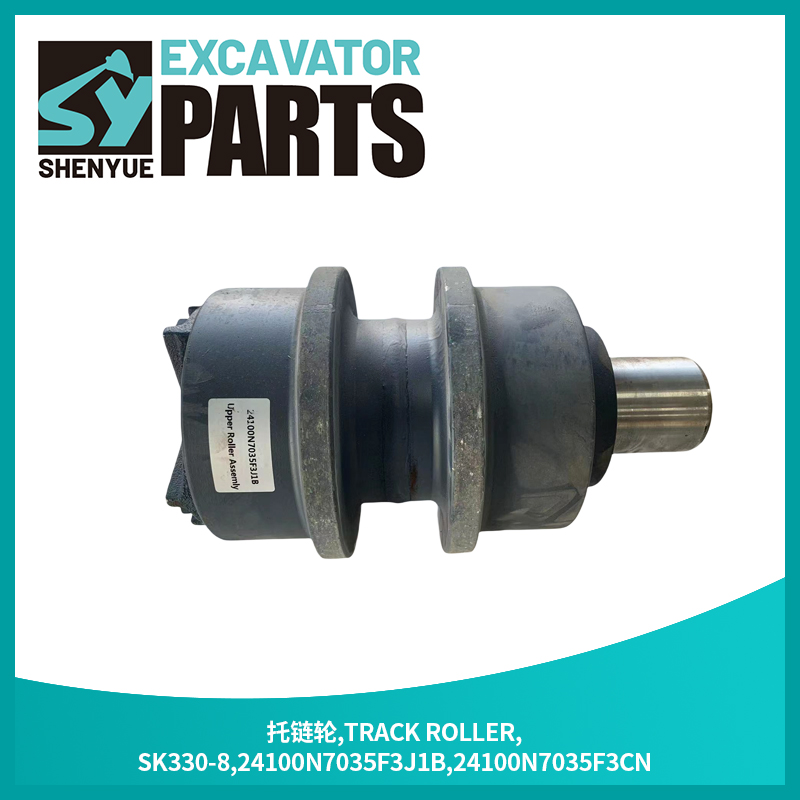
| Track rollers | Constant drawbar pull keeps the rollers loaded instead of rolling free | 24100N7035F3J1B / 24100N7035F3CN (SK330-8 class) |
| Idlers and shafts | Shock loads transfer through the front idler on every release | Idler shaft VA32F2303402 |
| Arm and bucket bushings | Ripping works the stick through a short, heavily loaded arc | Arm bushing LC12B02199P1 — confirm fitment by machine |
| Sprockets and chains | Maximum torque at low speed wears the chain joint and the sprocket tooth together | Quoted from link pitch and shoe width |
| Shank and pocket | Point load and shock, concentrated in a small area | Commonly quoted — photographs required |
The roller numbers above are worth pausing on, and they apply across the SK330 class. A single roller casting can carry two printed markings, because the same roller is supplied under more than one number depending on the batch and the market. Reading the casting rather than the model name is what keeps a six-roller order from becoming a three-roller order plus three returns.
Track shoes for rock
Ripping machines usually want a narrower shoe than the same machine working in mud, because traction comes from penetration into the surface rather than from flotation, and a wide shoe on rock simply gives the chain more leverage to twist. The trade-off is ground pressure and stability on the slope. Shoe selection is a measurement conversation, not a catalogue lookup: we need the link pitch, the shoe width and the bolt pattern, and we will quote the shoe and the matching bolt and nut set together from our undercarriage range, because a chain rebuilt with reused hardware is a chain that comes loose in the first week.
Before the next ripping season
The economical approach on a ripping machine is to treat the undercarriage as a package rather than a series of emergencies. Measure roller wear, chain pitch and sprocket profile at the same time; if two of the three are past limit, replacing one alone simply transfers the wear to the new part. We quote these as sets for exactly that reason, and the wider question of quarry and aggregate work follows the same logic. Guangzhou Shenyue Machinery Technology Co., Ltd. holds 3,000+ part types on the shelf and has 100,000+ part numbers available to order through original supply channels, and every line in a quotation says whether it is genuine, OEM or aftermarket, so a fleet manager can see what the difference in price is actually buying.
Frequently Asked Questions
Which undercarriage parts wear fastest on a ripping machine?
Track rollers, the front idler and its shaft, and the chain and sprocket pair. Ripping keeps the undercarriage loaded at high torque instead of rolling free, and the shock when the shank releases transfers through the front idler. On the SK330-8 class we quote rollers as 24100N7035F3J1B / 24100N7035F3CN and idler shafts as VA32F2303402, always checked against the casting rather than the model name.
Can I fit ripper teeth from another brand's shank?
Only if the shank pocket, the retainer type and the tooth profile all match. Pin-type and wedge-type retention are not interchangeable, and a tooth that fits loosely will destroy the pocket long before it wears out. Send photographs of the shank and the retainer to Guangzhou Shenyue Machinery Technology Co., Ltd. and we quote the tooth as commonly quoted until the fitment is confirmed.
Should I replace the chain and sprockets at the same time?
Yes, when either is at its wear limit. A new chain on a worn sprocket, or a new sprocket on a stretched chain, simply transfers the wear to the new component within a few hundred hours. Measure chain pitch and sprocket profile together, and if two of the three undercarriage measurements are out of limit, quote the package.