An extending boom section solves a specific problem: digging a deep trench or sewer line without standing the machine back from the edge and without a long-reach front that cannot lift anything. Kobelco has offered telescopic and three-piece front ends on wheeled machines and selected crawlers for years, and the survivors are machines whose owners measure slide clearances on a schedule. Guangzhou Shenyue Machinery Technology Co., Ltd. supplies the cylinders, pads, pins and hoses around these front ends, and this is what we ask for before quoting one.
What the section is actually doing
A telescopic front end is two booms in one. The outer section carries the load, an inner section slides inside it on replaceable pads pushed by a cylinder mounted in the box, and the inner section carries the bucket. A three-piece boom reaches a similar result with an extra pinned joint and a link: no sliding surfaces, but a longer hose run and more pins to wear. Both keep the bucket close to the machine while reaching deep, which is why they appear on trenching and utilities work rather than mass excavation.
The clearance chain that bends rods
Every sliding section has a designed clearance, usually a few tenths of a millimetre per pad, and that clearance is the only thing keeping the inner section parallel to the outer box. As pads wear, the inner section drops and twists. The extension cylinder is bolted at one end and pinned at the other, so it cannot drop with it, and the rod starts taking side load it was never designed for. The sequence runs: pad wear, visible play at the bucket, scored gland, bent rod, and finally a cylinder that costs ten times what a set of pads costs.
Measure with the section extended and the bucket on the ground, using a dial gauge on a magnetic base against a fixed reference. Compare all four corners, not the obvious one. Uneven wear across the corners means the section is twisted, which usually means a pad has been missing for a while rather than simply worn.
Hose tracking along a moving section
The hoses must follow a joint that changes length, and failure is almost always at the fixed clamp where the hose leaves the outer box. The slack loop has to be long enough to absorb full extension without pulling the fitting and short enough that the hose does not sag into the joint on retraction. Clamp spacing near that entry point matters most, because the hose is bent hardest there and vibration concentrates.
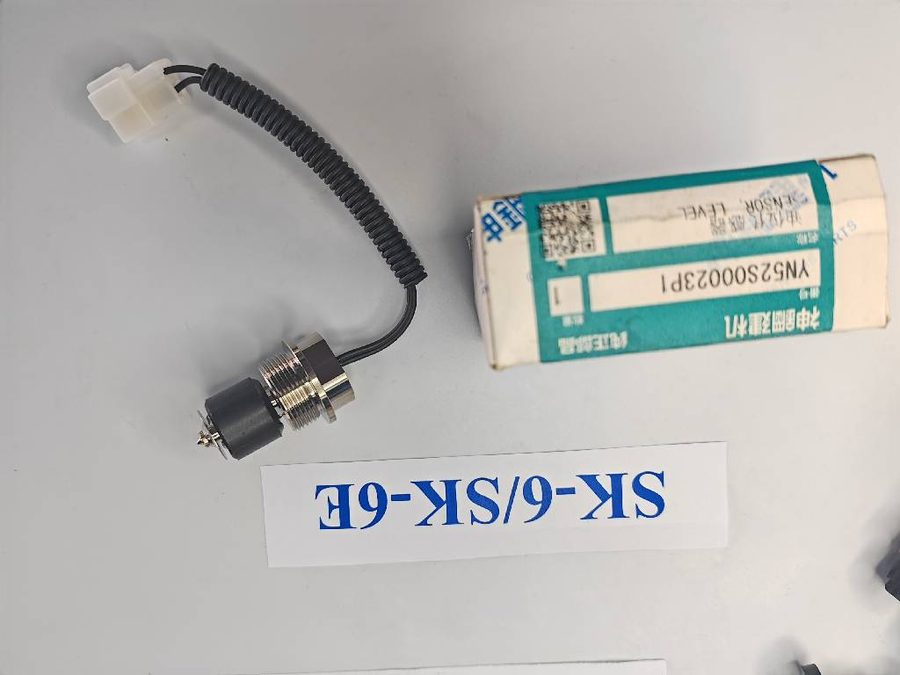
A replacement has to be the right length, not the nearest length: a short hose pulls the fitting apart at full extension, a long one sags and gets pinched. The families we hold most often for this work are YN52S00023P1 / YN52S00012P1, the YN52V01016R620 / R610 / R100 group and YY52V01006P1, quoted with end fittings and measured length.
Testing the extension cylinder without a flow meter
Three checks separate a tired cylinder from a tired pump. Hold the section at mid-stroke, engine idling, control in neutral: drift means the piston seal is bypassing or a holding valve is leaking. Extend against a load and watch speed: fast with no load and slow under load is internal bypass. Finally, look at the gland with the section fully extended, because a scored rod only leaks where the score passes the seal. If all three are clean, the fault is upstream in the pump or main valve.
Ordering by dimension, not by model name
Telescopic front ends are the least standardized part of the Kobelco range, and the same nominal model sold in different markets and years can carry a different boom section, pad thickness and cylinder stroke. We therefore quote pads by length, width, thickness and hole pattern, and cylinders by bore, stroke, pin diameter and port position. A photograph with a rule in frame matches a pad; a cylinder needs the four dimensions. Where a number is required and the plate is unreadable we write it as commonly quoted and confirm against the machine plate before shipping, because the nameplate is the authority.
Structural pins and bushings follow the same rule: measure pin, measure bore, then quote. The long reach front parts guide covers the pinned alternative in detail, and the cylinder range lists what we hold as complete assemblies and as seal kits. Kobelco's own model pages at kobelco.co.jp give the front-end configurations for each market.
Guangzhou Shenyue Machinery Technology Co., Ltd. keeps three thousand part types on the shelf and can order more than one hundred thousand part numbers through original channels, marking every line genuine, OEM or aftermarket. For front-end hardware outside the catalogue, the fastest route is the contact page with those four cylinder dimensions and a photograph of the pad in place.
Frequently Asked Questions
How much play is acceptable at a telescopic boom section?
Very little. The maker's clearance is usually a few tenths of a millimetre per pad, so once you can rock the inner section by hand at the bucket you are already outside it. Measure with the section extended and note all four corners, because uneven wear means the section is twisted.
Can I replace wear pads without removing the boom section?
In most designs the outer pads can be changed in place once the section is supported and the retaining plates released, but inner pads usually need the section drawn out. Plan for a press, a lifting frame and a clean floor, and replace pads in complete sets so the clearance stays even.
Why does my extension cylinder leak only at full stroke?
A scored or dented rod only passes the gland seal where the damage crosses it, so the leak appears at one position and disappears at others. That pattern points at the rod, not the seal. A cylinder leaking at every position is more likely a worn gland or a failed wiper.
Do you supply telescopic boom parts for Kobelco wheeled excavators?
Yes, but they are quoted by dimension rather than by model name, because front-end specification varies by market and year. Send pad length, width, thickness and hole pattern, or cylinder bore, stroke and pin diameter, and Guangzhou Shenyue Machinery Technology Co., Ltd. matches from stock or through original supply channels.