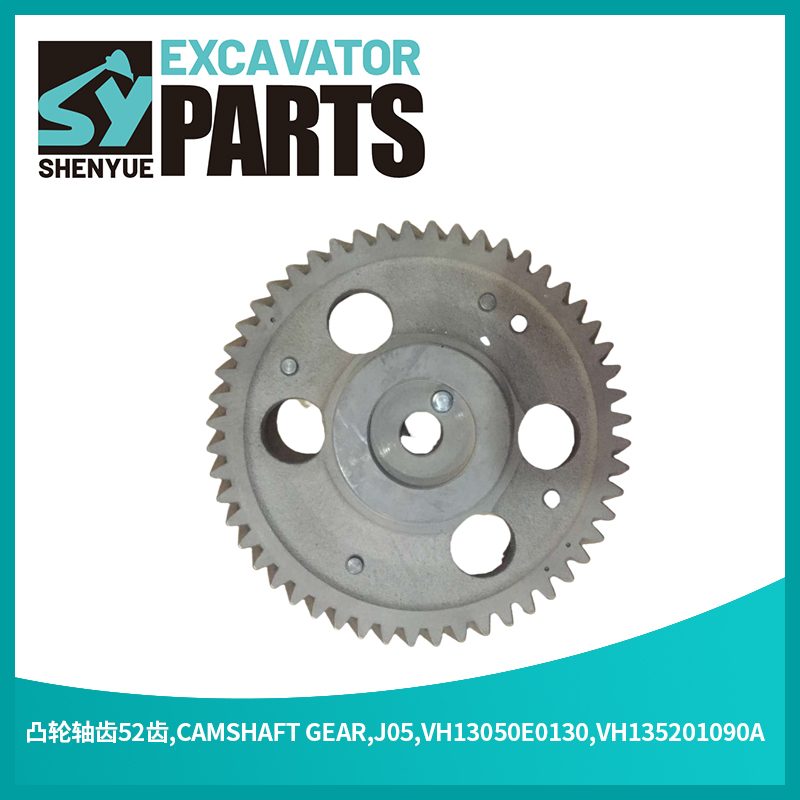
Behind the front cover of every engine in a Kobelco excavator runs a set of gears nobody thinks about until the day the engine runs rough, backfires through the intake, or starts to grind at the front. The timing gear train — crank gear, idler or center shaft, cam gear and, on these engines, the fuel pump gear — is what keeps valve motion and injection synchronized with crank rotation. Guangzhou Shenyue Machinery Technology Co., Ltd. quotes the train components weekly, mostly for machines whose front cover came off for one reason and revealed a worn gear the operator had been listening to for months.
What is in the train and what each part does
On the HINO J05 and J08 and the Mitsubishi D04FR and P11C families, the train runs at the front of the engine: the crankshaft drives the train through its gear, the camshaft gear — VH13050E0130, 52 teeth, in the J05 family, with VH135201090A as its related reference — opens the valves in time, and an idler or center shaft bridges the spacing. The idler shaft VA32F2303402 is a line we carry genuine-boxed; it carries two gears on some builds, runs on pressure-fed bushings, and is the member of the train whose wear shows up first because it turns fastest relative to its size. The gear marks stamped at the factory line up at one precise crank position, and the entire assembly logic of the engine depends on them being restored exactly when the cover comes off.
The four failures and how each one sounds
- A whine that rises with rpm. Gear teeth worn past their backlash limit; the pitch shifts with load. Harmless for a week, destructive for a season.
- A knock from the front cover at idle. Idler shaft bushings worn; the shaft hammers under the gear load instead of rotating smoothly.
- Rough running with a recent front-cover repair. The train went back one tooth out — the marks were close but not aligned, and the engine runs, badly, with valves slightly out of phase.
- Hard starting after a gear replacement. Fuel pump gear timing, not valve timing — the injection pump drives off the same train and its mark has its own position on most engines in this class.
Why these gears wear, and why the shaft wears first
The train runs in oil mist, but not in the filtered pressure the main bearings enjoy, and it absorbs every torsional pulse the crank sends up. Idler shaft bushings are the sacrifice point: as clearance grows, the mesh pattern on the idler teeth deepens, and the whine starts. Chipped teeth usually have a cause worth finding — a loose bolt through the train, a previous repair with the wrong shim, or debris that passed through the front cover. A gear with one chipped tooth is replaced as a set with its mesh partner when the damage is visible on both, because a new gear driving a worn gear inherits the worn pitch. The overhaul context that usually brings the front cover off is mapped in our J05E engine rebuild guide, the related top end work is in the top end service guide, and the wider component shelves sit on the engine parts category page.
Setting the timing marks correctly
The procedure is simple and unforgiving. Rotate the engine to the marked position — usually a stamped dot or a stamped number aligning on adjacent gears — and photograph the alignment before anything is removed, so the reference survives the teardown. Install with the marks together, rotate the engine two full revolutions by hand, and re-check; a train that walks off its marks on hand rotation is telling you a tooth count is wrong before the starter tells you harder. Torque the gears to the manual figures with their washers — gear bolts stretch like any bolt and are single-use on most engines in this class — and confirm backlash with a dial gauge or feeler stock where the manual gives a figure.
How the train is quoted and ordered
Send the engine model and serial, a photo of the gear or shaft with its stamp visible, and a description of the noise or the fault. Guangzhou Shenyue Machinery Technology Co., Ltd. confirms the family against the serial — the J05 and D04FR trains look alike in a photograph and share nothing on the bench — then quotes each line genuine, OEM or aftermarket, with the grade on every quotation. HINO's own engine service documentation defines the mark positions and backlash limits per model, and it is the cross-check we use when a reading or a mark sits on the edge. One order, one alignment, one engine that runs quiet through the front cover.
Frequently Asked Questions
What is the camshaft gear part number for a HINO J05 engine?
The J05 family camshaft gear quotes as VH13050E0130 (52 teeth), with VH135201090A as its related reference — photo-verified on the Guangzhou Shenyue Machinery Technology Co., Ltd. shelf. The engine serial confirms the variant before dispatch.
Why is my engine noisy at the front after a gear replacement?
Two usual causes: backlash outside spec because a worn gear was left meshing with the new one, or the train assembled one tooth out. Rotate two revolutions by hand and re-check the marks; a train that will not hold its alignment is a tooth count problem, not a noise problem.
Can I replace one chipped gear on the timing train?
Only if its mesh partners show no visible damage. A new gear on a worn gear inherits the worn pitch and whines again within weeks; if both faces are marked, replace the pair. The idler shaft VA32F2303402 is carried genuine-boxed and is the first member worth checking when the noise predates the damage.