Track shoes are the cheapest line on an undercarriage quotation and the most expensive one to get wrong. A set chosen for the wrong ground raises fuel burn, loads the travel motors, scrubs the bushings out of the links and turns a two-year chain into an eighteen-month chain. Guangzhou Shenyue Machinery Technology Co., Ltd. quotes shoes every week, and the questions that decide the order are always the same three: how wide, how tall a grouser, and how thick a plate.
Three dimensions, three different jobs
Width controls ground bearing pressure. Grouser height and pattern control grip and how well the shoe cleans itself. Plate thickness controls how long the shoe survives abrasive rock before the grouser is worn to a stub. Buyers routinely fix one and ignore the other two, which is why machines arrive in soft fill with narrow rock shoes, or on demolition sites with thin plates that fold at the bolt holes. The undercarriage range we keep is built around that distinction.
| Ground | Shoe strategy | What it protects |
|---|---|---|
| Rock, quarry, abrasive aggregate | Narrower shoe, standard triple grouser, heavier plate | Grouser life, link and pin load, side scrub |
| Soft fill, mud, dredging spoil | Wider shoe or dedicated swamp shoe with a smooth profile | Flotation, travel motor torque, sinking and bogging |
| Sticky clay | Fewer, cleaner grousers; avoid deep narrow patterns that pack solid | Traction, fuel, cleaning time at shift change |
| Asphalt, concrete yard, indoor slab | Rubber pads or flat shoe, no grouser damage to the surface | The floor, and the customer relationship |
| Demolition debris, rebar | Reinforced heavy-duty shoe, guarded rollers | Plate cracking, roller and idler damage |
Wider is not automatically better
Ground bearing pressure is machine mass divided by the contact area under the shoes. Widening the shoe lowers that number and keeps a 20-tonne machine on top of soft ground instead of sinking to the frame. The cost is leverage: every extra centimetre of shoe is extra length hanging off the link, and steering on hard ground has to scrub that length sideways. Links, pins and bushings wear faster, and travel becomes heavier because the machine is dragging more steel through the dirt. On compact fill and in wet sand, the wider shoe wins clearly. On shot rock and packed gravel, it usually loses.
Grouser height and pattern
Triple grouser is the general-purpose answer and the one most machines leave the factory with. It grips in both directions, steers predictably and works across mixed ground. A taller grouser bites deeper in loose material but wears to the plate faster in abrasion, and once the height is gone the shoe still looks serviceable while traction has quietly disappeared. Self-cleaning patterns with a relieved centre section are worth the premium in wet clay, where a fully packed shoe behaves like a slick. For work that never leaves a slab, rubber pads are the only sensible choice, and they should be treated as a consumable with a known replacement interval rather than a permanent fitting.
Matching shoes to a worn undercarriage
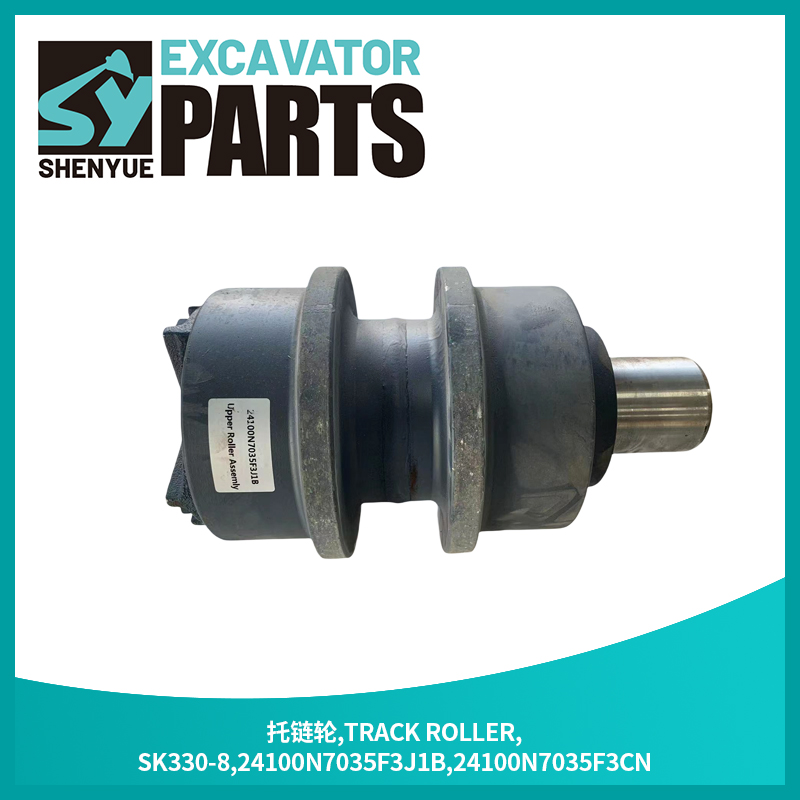
A new set of shoes bolted to a chain that is already 70 percent worn is money spent in the wrong place. The chain dictates the pitch, the pitch dictates how the shoe sits on the link, and a sloppy chain hammers the bolt holes oval within a few hundred hours. Before ordering shoes, read the whole undercarriage: sprocket tooth profile, roller flange thickness, idler wear, and chain pitch measured over several links. The same discipline applies to the numbers. Configuration markers exist all through the undercarriage — the SK330-8 roller we stock as 24100N7035F3J1B is listed with 24100N7035F3CN alongside it — and a shoe number without its marker is a guess with freight attached.
Bolts are part of the selection
Track shoe bolts are high-strength plow bolts and they are not interchangeable with whatever fits the hole. Fit them dry unless the manual says otherwise, torque in a cross pattern, and re-check after the first shift and again at 50 hours. A missing bolt is not cosmetic: the link hole starts working, the next bolt overloads, and a cracked link is a chain replacement rather than a bolt.
Measure before you ask for a price. Shoe width in millimetres, bolt hole spacing, bolt diameter, grouser height and the number of bolt holes per shoe will identify a shoe faster than a model name will. Send those five figures with a photograph, and Guangzhou Shenyue Machinery Technology Co., Ltd. can confirm against 3,000+ part types on the shelf and 100,000+ part numbers available to order, with genuine, OEM and aftermarket options priced separately.
The order of decisions
Choose the ground condition first, the shoe width second, the grouser pattern third and the plate thickness last — then check the rest of the undercarriage before the money is spent. Buyers sourcing undercarriage for a mixed fleet often compare the same shoe across brands before committing; our export arm at corbayparts.com handles that kind of multi-brand enquiry, while the Kobelco-specific fitment questions come back here. Kobelco's own published specifications at kobelco.co.jp remain the authority for what a given serial was built with.
Frequently Asked Questions
Does a wider track shoe always improve flotation?
It lowers ground bearing pressure, which helps in mud and soft fill, but it also lengthens the lever acting on the link and increases steering scrub on hard ground. On rock and packed gravel a narrower, thicker shoe usually lasts longer. Match the shoe to the ground the machine spends most of its hours on.
How do I know when a grouser is worn out?
When grouser height approaches the plate surface, traction is already gone even though the shoe still looks intact. Measure height at the leading edge, not the middle, and compare against a new shoe. Worn height plus oval bolt holes means replacement, not re-tightening.
Can I fit new shoes to a worn track chain?
You can, but the new shoes will not last. A stretched chain lets the shoe rock on the link, hammering the bolt holes oval. Measure chain pitch over several links and inspect the sprocket before buying shoes, or replace both together.
What do the extra letters in an undercarriage part number mean?
They are configuration markers — the SK330-8 roller is recorded as 24100N7035F3J1B with 24100N7035F3CN listed alongside it. Quote the full number from the part you are replacing. Guangzhou Shenyue Machinery Technology Co., Ltd. verifies the marker against stock before quoting.