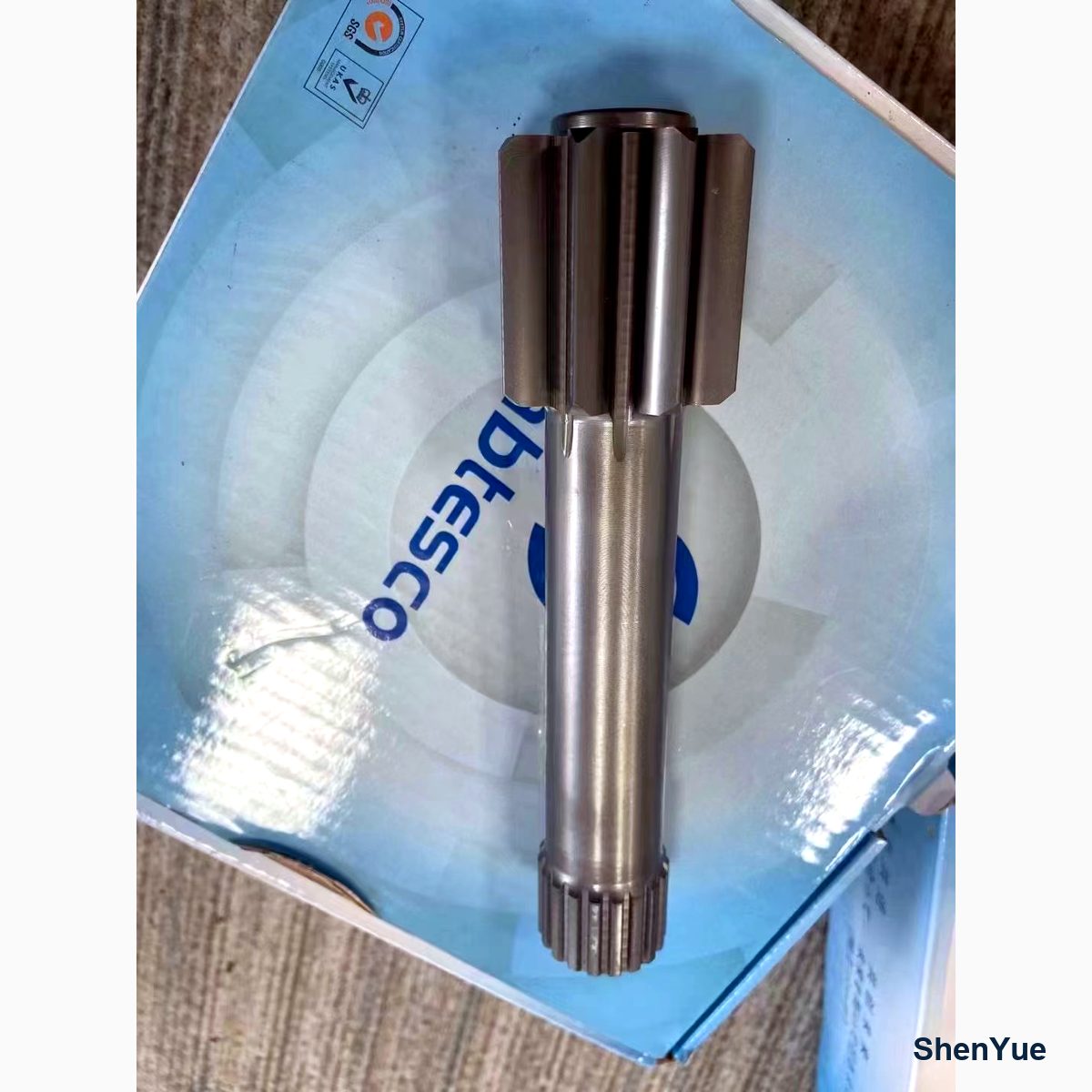
A Kobelco that refuses to leave low range is rarely suffering from a failed travel motor. The two-speed shift is a small circuit with four suspects — the switch, the solenoid, the pilot line and the shift spool inside the motor — and the expensive part is almost always the last thing that needs replacing. Working the checks in the order below keeps a two-thousand-dollar motor off the truck when a coil or a blocked orifice was the whole fault. This is the sequence Guangzhou Shenyue Machinery Technology Co., Ltd. walks customers through before it quotes a unit.
What the button actually does
The travel motor has no gearbox to shift. A regulator inside the motor moves the swash plate between two angles. At the large angle the motor displaces more oil per revolution, so it turns slowly with high torque; at the small angle it turns faster with less torque. Pilot pressure from a solenoid valve on the control valve block pushes a spool that changes that angle. If the machine is fast but gutless on a grade, or slow in both directions when the monitor says high, the answer lives in that chain — not in the final drive.
Read the symptom before touching a spool
| What the operator reports | Most likely half of the circuit |
|---|---|
| Slow in both directions whatever the mode, strong pushing | No shift pressure reaching the motor: solenoid, wiring or blocked pilot line |
| Fast but stalls or crawls on a slope, weak on both tracks | Stuck in high range: shift spool held over, or solenoid energised permanently |
| Shifts on one track only | One motor's shift port, hose or solenoid branch |
| Shifts by itself, or drops out under load | Marginal pilot pressure, leaking shift hose, failing coil when hot |
Prove it with track marks, not with a stopwatch in the cab
Mark both tracks on clean ground, travel 30 seconds in low, mark again, then repeat in high. A healthy machine shows a clear step between the two marks; a five per cent creep is not two-speed, it is a machine that never shifted. Doing this on both tracks at once also settles whether the fault is one motor or the whole circuit, which halves the diagnosis before a gauge comes out.
The electrical half: switch, harness, solenoid
Check the mode indicator on the monitor first — if the display does not change, the machine never commanded the shift and the motor is innocent. Then measure the solenoid coil, listen for the click with the key on, and inspect the connector at the valve block for corrosion and pulled pins. A coil that reads open when hot and normal when cold is a classic intermittent, and it explains a machine that only loses high range after an hour of work. If a second machine of the same class is on site, swapping the coil is a two-minute confirmation.
The hydraulic half: pilot pressure at the motor
Tee a gauge into the shift port at the motor and repeat the test in both modes. No pressure means the fault is upstream — solenoid, hose, or a blocked orifice in the valve block. Pressure present but no change in track speed means the shift spool in the motor regulator is held, scored or spring-broken, and that is a motor repair rather than a circuit repair. Compare the reading with the figure published at kobelco.co.jp for your serial; Kobelco changed pilot pressures across generations.
The generation trap: GM38VB and GM38VC
The SK200-8 and SK210-8 use the Nabtesco GM38VB unit, quoted as YN15V00037F1, YN15V00037F2 or YN15V00037F3. The SK200-10, SK210-10 and SK220XD-10 use the GM38VC, quoted as YN15V00083F1. The two generations are not interchangeable, and a machine fitted with the wrong one can show shift behaviour that looks like an electrical fault forever. Before blaming the circuit, confirm which unit is physically on the machine — the plate, not the invoice. Guangzhou Shenyue Machinery Technology Co., Ltd. quotes from the plate for this reason.
Before you order. Send the symptom, the model, the serial and a photograph of the travel motor plate. Guangzhou Shenyue Machinery Technology Co., Ltd. keeps 3,000+ part types on the shelf and 100,000+ part numbers available to order, so the solenoid and the assembly can usually be quoted the same day — and the quote will say whether each line is genuine, OEM or aftermarket. Machines in mixed fleets are also covered through our all-brand range at corbayparts.com, but the generation check still comes first.
What the repair actually costs
Nine times out of ten the invoice is a coil, a hose or a spool. The tenth time it is a motor, and then the right move is to quote the assembly by its full tail plus the seal and piston parts behind it, and compare a repair kit against a complete unit. Circuit parts sit in our hydraulic components range; if the motor has to come off, send the plate through the contact page with the serial.
Frequently Asked Questions
Why is my Kobelco stuck in low travel speed?
In most cases no pilot pressure is reaching the shift port on the travel motor, because the solenoid, the wiring or the pilot line has failed. Confirm the monitor changes mode, then measure pressure at the motor. If pressure arrives and the track speed does not change, the shift spool inside the motor is the fault.
Can I fit a GM38VC travel motor to an SK200-8?
No. The SK200-8 and SK210-8 use the GM38VB, quoted as YN15V00037F1, F2 or F3, while the SK200-10 and SK210-10 use the GM38VC, quoted as YN15V00083F1. The two are not interchangeable, and fitting across generations produces shift and travel faults that are hard to trace later.
How do I test the travel speed solenoid?
Check that the monitor mode indicator changes, then measure the coil for resistance against the manual figure and listen for a click with the key on. A coil that reads correctly cold and open when hot explains a machine that loses high range only after an hour of work. Swapping a known-good coil settles it in minutes.
Does a slow Kobelco always need a new travel motor?
No. A motor replacement is the last step, not the first. Most two-speed faults are electrical or a blocked pilot line, and Guangzhou Shenyue Machinery Technology Co., Ltd. quotes the solenoid, hose and spool separately so a customer can fix the circuit before committing to an assembly.