Every front end is designed to reach the end of its travel gently. Somewhere near full boom raise, full stick curl and full bucket curl, the linkage is meant to land on a stop block, a pad of steel that takes the load and spares the cylinder. When those blocks are worn, loose or missing, the cylinder itself becomes the stop, and the noise that follows is the sound of rod, gland and pin taking a hammer blow on every cycle. Guangzhou Shenyue Machinery Technology Co., Ltd. supplies the linkage hardware around the blocks, and the noise is one of the cheapest faults to catch early.
Where the stops are and what they do
Stop blocks sit where the structure can take the load: at the boom foot for boom raise, on the stick for stick curl, and on the bucket linkage for curl. They are sacrificial by intent. Their job is to stop the moving mass on a broad, strong surface, so the shock goes into the casting and the frame rather than into the thin end of a cylinder rod at full extension, which is the weakest point in the whole load path.
How the damage actually happens
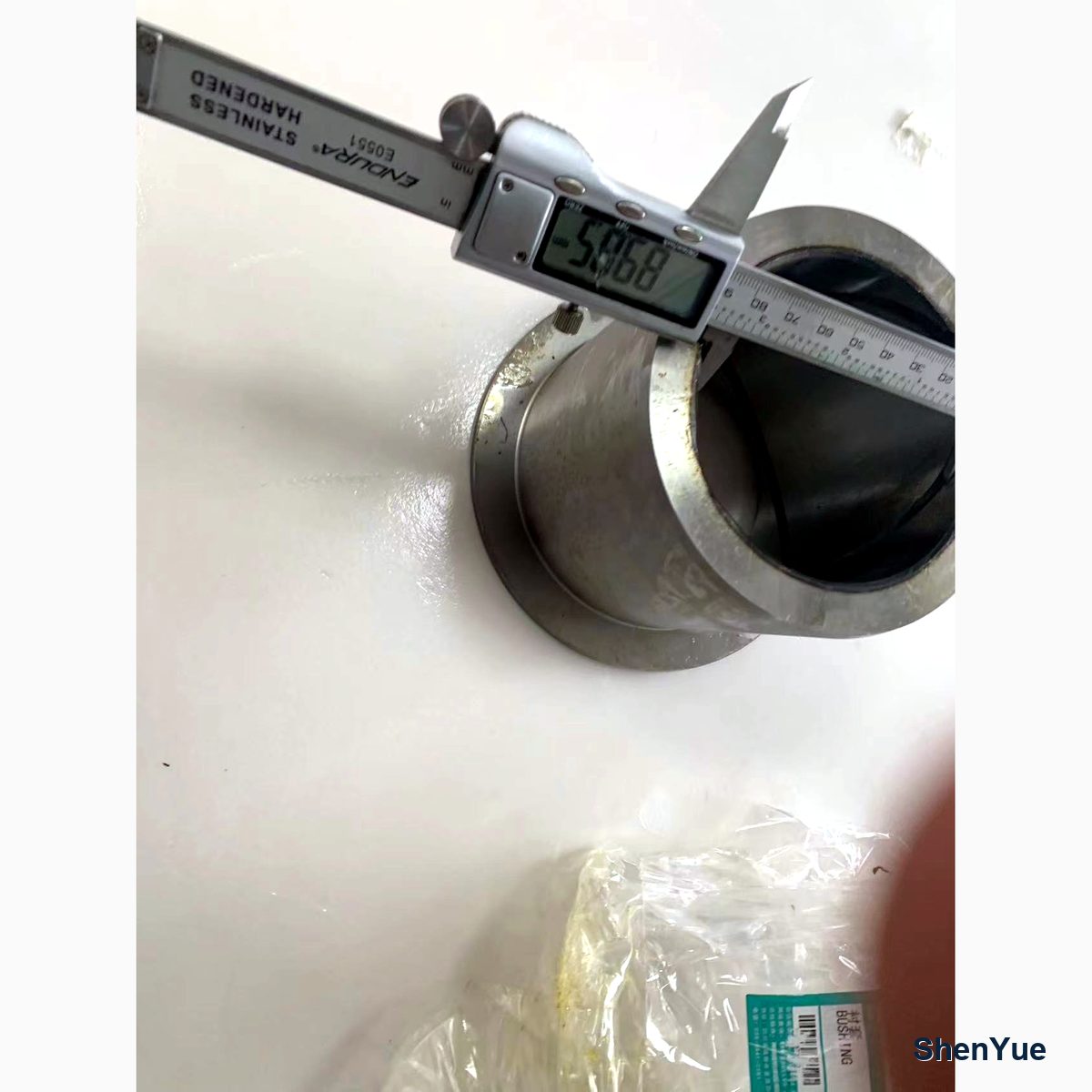
The failure is progressive. A block wears or its mounting bolts stretch, the gap grows a few millimetres, and the cylinder starts decelerating the linkage directly. Each cycle the metal-to-metal bang arrives a little harder; the operator stops noticing it the way you stop noticing a squeaky door. Meanwhile the shock load travels into the boom and arm pins, into the bushings such as LC12B02199P1, and back into the welds around the boss. What began as a worn pad ends as a cracked weld or a scored rod.
| Where the bang is loudest | Inspect first | Then inspect |
|---|---|---|
| Full boom raise | Boom foot stop pads and their bolts | Boom cylinder rod near the gland, boom foot boss welds |
| Full stick curl | Stick stop block and shims | Bucket and stick cylinder rods, stick base pins |
| Full bucket curl | Bucket linkage stops | Bucket cylinder rod, linkage bushings and pins |
| Bang plus slop in the linkage | Stop gap measurement | Pins and bushings across the front end |
Inspecting the blocks
The inspection is a tape measure and a torque wrench. Measure the remaining pad height or the gap against the figure in the manual for the serial, and check the mounting bolts to their specified torque, because a block that moves is wearing twice as fast and hammering its own threads. Look at the contact face: a block that has been mushroomed has already taken impacts it should not have, and the cylinder rod behind it deserves a close look for scoring and a rod seal test before the machine returns to work.
Repair practice that lasts
Replacement blocks must match the machine model, because pad height sets the cylinder's parked position and geometry; a block built thicker or thinner changes the linkage's range of travel and can hold a cylinder partially over its cushion. Fit with new bolts at the specified torque, restore any shims the original had, and never rebuild a missing block by welding unknown steel onto the frame without a pattern, because the repair weld sits exactly where the impact energy arrives on every cycle.
Front-end crack consequences are covered in the boom and arm crack repair guide, and pin and bushing wear in the cylinder pin and bushing guide. Model-level linkage layouts for the 20-tonne class start on the SK200 model page. Structural and linkage drawings are published by the manufacturer at kobelco.co.jp.
Guangzhou Shenyue Machinery Technology Co., Ltd. holds three thousand part types on the shelf and over one hundred thousand part numbers available to order through original supply channels, each marked genuine, OEM or aftermarket. Send the machine model and serial through the contact page with a photograph of the worn block, and we will quote the pad, the bolts and the pins around it in one list.
Guangzhou Shenyue Machinery Technology Co., Ltd. is an independent supplier of Kobelco parts, not affiliated with Kobelco Construction Machinery Co., Ltd. Genuine parts are supplied through original channels alongside quality OEM and aftermarket alternatives at distributor-level prices.
Frequently Asked Questions
What does a boom stop block do on a Kobelco?
It takes the load at full boom raise so the boom cylinder does not. When the block wears or goes missing, the cylinder rod becomes the stop, and the repeated impact damages the rod, the gland and the pins behind it. Guangzhou Shenyue Machinery Technology Co., Ltd. quotes stop pads together with their mounting bolts.
Why is there a bang at the end of boom travel?
Most often a worn or missing stop block, so the linkage lands metal on metal through the cylinder. Measure the pad height and the gap against the manual for the serial, and check the mounting bolt torque before suspecting the cylinder itself.
Can I weld my own stop block?
Only with a pattern and the correct parent material, because the weld sits where the impact energy arrives every cycle. A block of the wrong thickness also changes the cylinder's parked geometry. The safer route is a matching replacement with new bolts.
What else should I check when a stop block is worn?
The cylinder rod for scoring near the gland, the rod seal for a new leak, and the front-end pins and bushings such as LC12B02199P1, which absorb the shock that the missing block no longer takes.