Every service job that starts with "tilt the cab" - the pump, the cooler pack, the harness channels, the tank - depends on a mechanism most owners never think about until it grinds, sags or refuses to move. On Kobelco machines the tilt-up cab is a small hydraulic or gas-assisted system with its own cylinder, its own holds and its own hardware, and it earns its keep in service hours. Guangzhou Shenyue Machinery Technology Co., Ltd. supplies Kobelco cab and body parts to workshops worldwide, and this post walks through how the system works and which parts keep it safe.
How the tilt system raises and holds the cab
A tilting cab pivots on hinges at its front edge and lifts at the rear. The lift comes from a tilt cylinder - hydraulic on most machines, gas-strut assisted on some compact models - and the weight it handles is more than it looks: the cab itself, the air conditioning unit, the glass and the operator seat add up quickly. Once raised, a mechanical prop or lock takes the load; the cylinder is a lifting device, not a holding device. That division of labor is the safety core of the whole system, and it is where most careless mistakes happen.
The safety prop is not optional
Working under a raised cab without the prop engaged is the classic shortcut, and it fails in a way nobody plans for: a slow internal leak in the tilt cylinder lets the cab sink while the fitter is under it, quietly and without noise. The prop - a solid bar, strut or lock bracket - exists precisely because hydraulics drift. Before any service job, the check order is simple: raise the cab fully, engage the prop and confirm it is seated in its lock, and only then put hands or head under the structure. If the prop hardware is bent, worn at its seat or missing its retaining pin, it is replaced before the next service, not after.
What actually wears in the tilt system
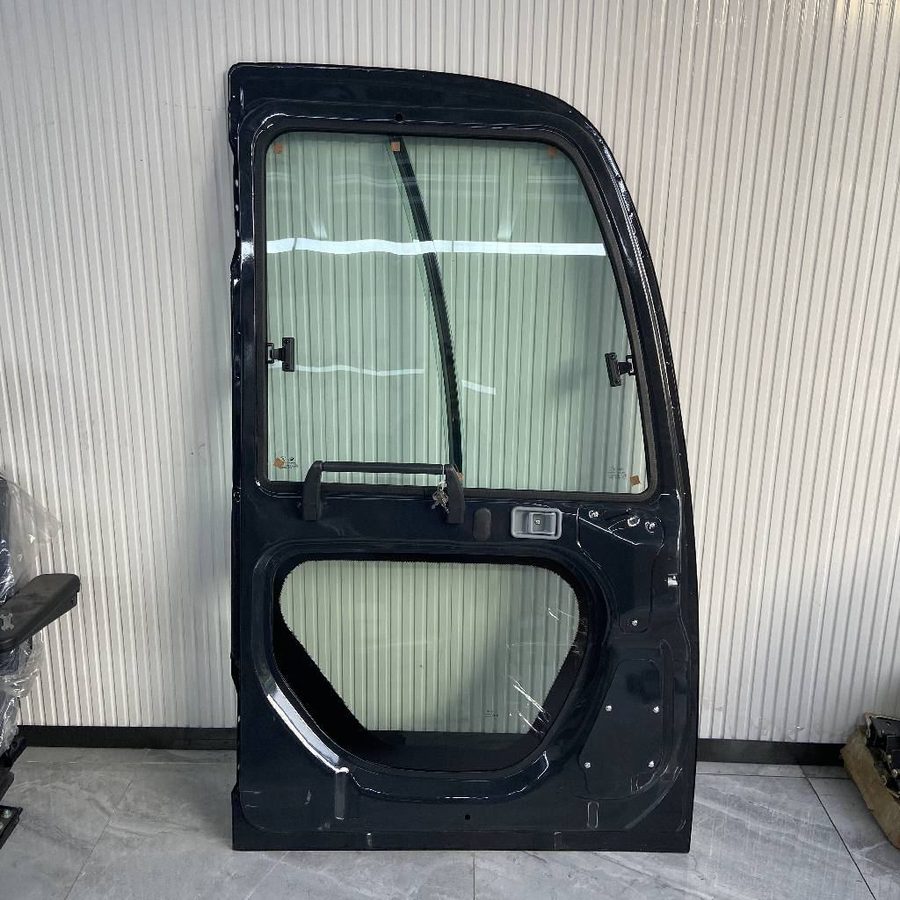
Three things age first. The cylinder seals weep with age and cycles - a tilt cylinder that needs pumping to reach full height, or that settles visibly during an afternoon, has worn seals and can be resealed or replaced as a complete assembly. The hinge bushes and pins wear with washing and dust, and the play they create shows up as a cab that rattles over uneven ground and a latch that needs a shove. And the latch itself - the rear lock that holds the cab down while traveling - wears its striker and roller, which is why a cab that "pops" open on rough sites is a latch problem long before it is a hinge problem. All of these are quoted against the machine serial: assemblies such as the cab door YN51C00009F1KL in our records show how specific Kobelco cab hardware is, and matching the serial is what avoids a door that fits badly because it came from a neighboring generation.
Service habits that keep the system working
Grease the hinge pins on the machine's own schedule - dry hinges are the top cause of bent props, because the operator lifts against a stiff pivot and the prop seat takes the shock. A lithium or EP2 grease at the hinge boss, worked in until fresh grease shows at the seal, is a five-minute job that saves the prop, the latch and the cylinder seals at once. Keep the cylinder rod clean; a rod that parks dust into its seal every time the cab closes wears out years early. And inspect the prop hardware at every cab-tilt service the way the brake system is inspected at every travel service - it is the same kind of never-needed-until-critical part. Shenyue is an independent supplier and is not an authorized dealer of Kobelco Construction Machinery Co., Ltd.; we supply these lines through original supply channels alongside quality replacement parts, and the factory-side service intervals are published at the Kobelco official English site, with 3,000+ part types on the shelf and 100,000+ part numbers available to order.
Cab comfort and vibration are covered from a different angle in our guides to cab mounts and seat suspension and cab door glass and interior trim. Send the machine model and serial with photographs of the cylinder and prop hardware, and Guangzhou Shenyue Machinery Technology Co., Ltd. confirms each part in writing before quoting.
Frequently Asked Questions
My cab slowly sinks while I am working under it - what is failing?
That is a tilt cylinder with worn internal seals, and it is a stop-work signal, not a maintenance note. The cylinder is a lifting device; holding is the prop's job, so a sinking cab means the prop is not engaged or not fitted. Raise the cab, seat the prop properly, and then plan the cylinder seal repair or replacement - do not work under a cab held only by a leaking cylinder.
Is the tilt cylinder quoted complete or as seal parts?
Both routes exist, and the right one depends on the machine and the wear state. A seal kit suits a cylinder with a sound rod and bore; a complete assembly suits one with a scored rod or damaged mounts, and it ships ready to fit. Send the cylinder's own markings and a photograph with the machine serial, and the quote comes back with the correct route and the part numbers in writing.
Why does my cab latch pop open on rough ground?
A worn striker or roller in the rear latch, or a latch that has drifted out of adjustment after a hinge bush replacement. The latch wears gradually, so the change is easy to miss until the cab starts popping. Inspect the latch hardware alongside the hinge bushes, and quote the latch parts against the machine serial rather than buying a generic latch - Kobelco cab hardware is model-specific.