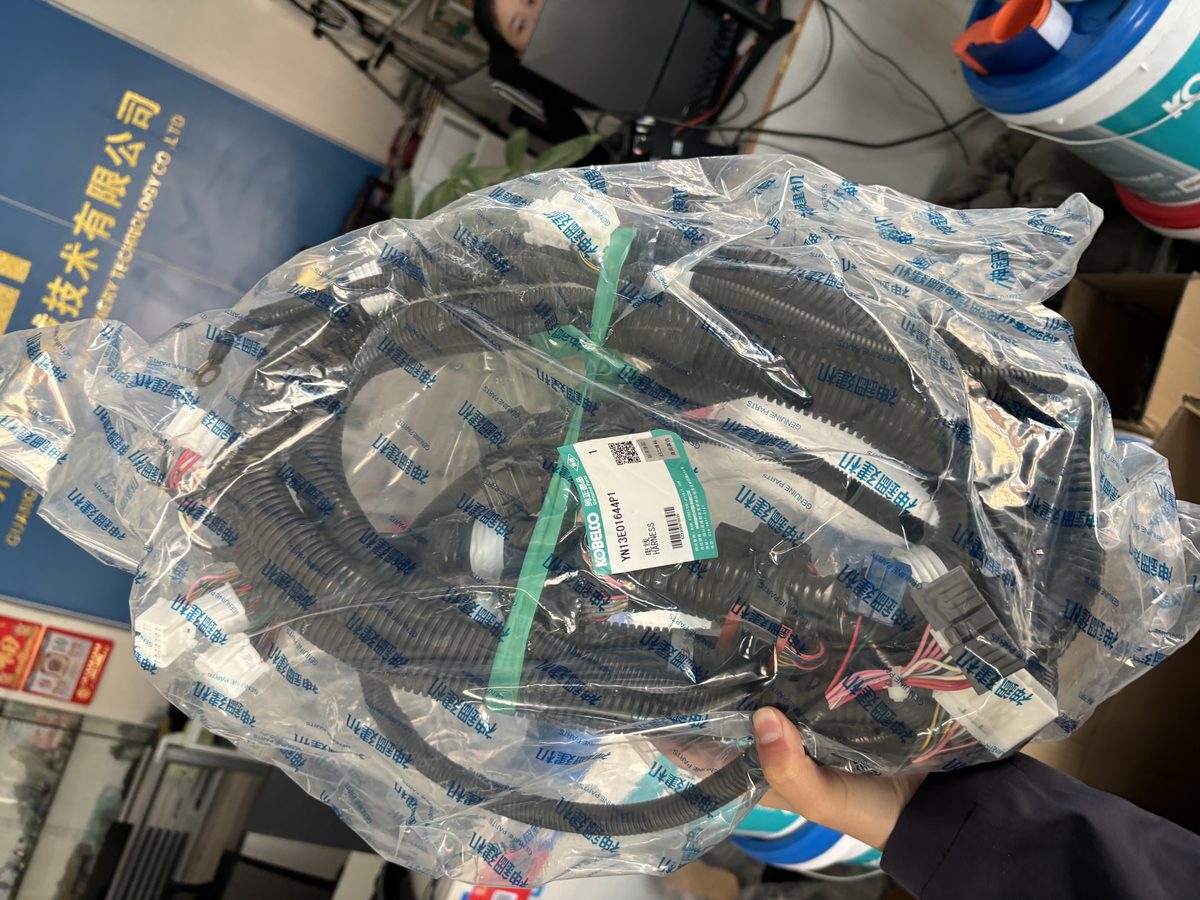
Modern Kobelco excavators run on a small network. The engine ECU, the machine controller, the monitor and various sensor modules exchange data over a CAN bus, and when that bus is healthy the operator sees nothing unusual. When it fails, the symptoms look catastrophic: a blank or frozen monitor, several unrelated fault codes at once, a machine that derates or refuses to start, and gauges that default to zero. The instinct is to replace controllers, which is expensive and often wrong. This guide from Guangzhou Shenyue Machinery Technology Co., Ltd. explains what the bus does and the order in which to test it.
What the network does
CAN is a two-wire serial link. Every module listens to the same pair of wires and speaks only when its message slot arrives, so one broken wire or one failed node can silence a whole conversation. On an excavator the bus carries engine speed and load, hydraulic pressure and temperature, controller commands, monitor requests and diagnostic codes. That is why a single fault can look like a dozen: the monitor is not lying, it is reporting that the data it needs never arrived.
Symptoms that point to the bus
Look for patterns rather than single codes. Several codes from different systems appearing in the same ignition cycle, a monitor that is blank while the machine still starts, values that read zero or a fixed default, or a machine that runs normally until it warms up and then loses communication — all point to the network rather than to the individual components named in the codes. A single code for one sensor, with everything else behaving, is usually that sensor or its local circuit, not the bus.
The physical layer in plain terms
The bus is a twisted pair with a terminating resistor at each end, typically 120 ohms each, which gives about 60 ohms measured across the two wires with the power off. With the power on, both wires sit around 2.5 V and move in opposite directions as data passes, which is why a voltmeter sees a small fluctuating differential rather than a steady signal. Those figures are standard for the physical layer, not a Kobelco-specific setting, and they are the quickest way to tell a wiring fault from a module fault.
A test order that saves time
First, read and record every code before clearing anything, because the order in which codes set contains information. Second, inspect the harness visually along the boom, frame and cab entry, where chafe and water ingress do their work. Third, measure resistance across the pair at a convenient connector. Fourth, check voltage on each wire with the ignition on, looking for a short to ground or to battery positive. Fifth, wiggle the harness at suspected points while watching live data, which finds the intermittent faults that a static test misses. Only then isolate nodes one at a time by disconnecting them and watching whether communication returns.
| Reading or symptom | Likely meaning | Next step |
|---|---|---|
| About 60 ohms across the pair | Bus wiring and both terminators intact | Suspect a node or connector |
| About 120 ohms | One terminator or one leg open | Check terminators and harness continuity |
| Near 0 ohms | CAN-H shorted to CAN-L | Find the pinch or chafe point |
| No communication when hot | Heat-related connector or module fault | Reproduce with live data and a heat check |
The usual causes
In practice, most failures are mechanical before they are electronic: a harness rubbed through where it passes a frame edge, water in a connector after pressure washing, a corroded pin in the cab entry, a loose ground that shifts the reference voltage for every node, or a replacement controller with the wrong calibration. Battery and charging problems deserve a mention too, because low voltage makes a marginal bus fail first. A machine that misbehaves only on cold mornings is often telling you about the batteries, not the network.
Parts and replacement rules
When a part is genuinely needed, order by the controller or harness reference and the machine serial, not by appearance. Our records quote controllers under YN22E00193F5, YN22E00694F8 and the LC22E00336F8 / LC22E00323F8 pair, and the engine harness as VH82121E0301 for one Hino application; each must be matched to the build. Guangzhou Shenyue Machinery Technology Co., Ltd. supplies these through original channels alongside quality replacement alternatives and declares each item genuine, OEM or aftermarket. Our guide to ECU and CPU controller families explains the numbering, the harness and fuse guide covers connector repair, and the complete harness set is listed in our catalogue. Hino's engine documentation at hino-global.com is useful background on the engine-side electronics.
Frequently Asked Questions
What are the signs of a CAN bus fault on a Kobelco?
Several unrelated codes in one ignition cycle, a blank or frozen monitor while the machine still runs, gauge values stuck at zero, or communication that drops out when the machine warms up. A single code for one sensor usually points to that sensor, not the network. Guangzhou Shenyue Machinery Technology Co., Ltd. supplies the controllers and harnesses involved.
How do I test a Kobelco CAN bus with a multimeter?
Switch off the ignition and isolate the batteries, then measure resistance across CAN-H and CAN-L. About 60 ohms means the bus and both terminators are intact, about 120 ohms means one side is open, and near 0 ohms means the pair is shorted. Then check voltage on each wire with the ignition on.
Can a bad battery cause communication errors?
Yes. Low or unstable voltage makes a marginal network fail first, and the fault often appears on cold mornings or during cranking. Check battery condition, terminals and charging before replacing controllers. A loose ground can shift the reference voltage for every module on the bus.
Which Kobelco controllers does Guangzhou Shenyue record?
Our records quote controllers under YN22E00193F5, YN22E00694F8 and LC22E00336F8/LC22E00323F8, plus the engine harness VH82121E0301 for one Hino application. Each reference is matched to the machine serial and build before supply, and the condition class is declared on the quotation from Guangzhou Shenyue Machinery Technology Co., Ltd.