The counterweight is the least exciting part on a Kobelco and the one that decides three commercial questions at once: what the machine can lift at a given radius, what it weighs on a low-bed, and how long the mounting hardware lasts. Standard and heavy counterweights are different parts, segmented versions are bolted together, and on a machine that has been working with a long front or a heavy attachment the mounting hardware is often the first thing to show distress.
Why the counterweight is a parts question
Every lift chart is drawn for a specific counterweight. Fit a heavier one and the chart improves at short radius while the swing motor, swing bearing and track loads all rise. Fit a lighter one, or remove segments for transport and forget to refit them, and the machine is suddenly marginal with the attachment it has been running. Guangzhou Shenyue Machinery Technology Co., Ltd. quotes counterweight hardware by part number for exactly this reason: the configuration has to be known before any stability claim is made.
Standard, heavy and segmented
Most 20-tonne class machines leave the factory with a single-piece cast counterweight. Larger classes commonly use a fabricated or segmented counterweight, bolted together so that sections can be removed to bring transport weight down. Segmented units are held by a mix of studs and bolts, and the joint faces are machined; once a segment has run loose, the faces fret and the assembly will not sit flat again without machining.
| Class | Typical arrangement | What changes for the owner |
|---|---|---|
| 13 to 16 tonnes | Single-piece cast, bolted directly to the frame | Rarely removed; transport weight usually acceptable as built |
| 20 to 26 tonnes | Single-piece, or two-piece on some builds | Removal for low-bed transport is common; stud condition matters |
| 30 to 40 tonnes | Segmented or heavy option | Segment count drives transport planning and re-torque routine |
| 45 tonnes and above | Multi-segment, sometimes with a separate heavy option | Crane capacity, lifting points and permit weight all interact |
These are arrangements, not weights: the nameplate and the specification sheet for that serial are the authority.
Removal for transport
Use the dedicated lifting points on the counterweight, never a sling around the casting, and check the crane capacity against the actual weight first. Crack the retaining hardware in sequence, not one corner at a time, so the last fastener is not carrying the whole load.
Keep the shims and spacers with the machine and photograph the joint face before separating it. Mixed shim stacks refitted to the wrong side are a common cause of a counterweight that sits proud and works loose in service.
The hardware that fails
Counterweight studs and bolts fail by stretch rather than by snapping. Once a stud has taken a set it will not hold torque, and the assembly starts to fret against the frame. The symptom is a dull knock when the machine swings, followed by paint cracking around the mounting ear. That is the point to stop working and re-torque, not to add another washer.
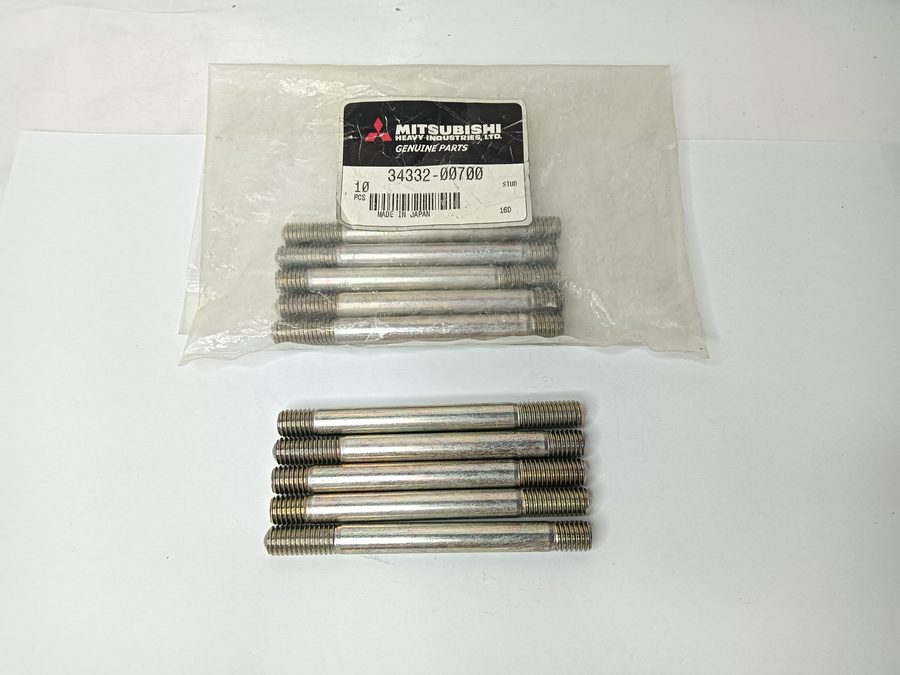
We hold studs and heavy washers in the VA3433200700 and VA3430900800 families, quoted by machine model because the same casting uses different hardware between builds. Replace stretched hardware as a set rather than individually, clean the threads, and torque dry unless the manual specifies a lubricant.
Stability is not solved by a bigger counterweight
A heavier counterweight raises the lift chart at short radius, and that is all. It does not raise the structural limit of the boom, it does not increase swing holding capacity, and it does not make a long front safe on a slope. On a long-reach or three-piece front the counterweight, cylinder sizing, relief settings and transport plan all change together, and the configuration has to be confirmed against the serial rather than assumed.
Where a machine works on a slope, the limiting factor is usually track gauge and ground bearing pressure, not the counterweight.
What to send for a quote
Send the model and serial, the counterweight part number if it is still legible, the number of segments, and the hardware you need with quantities. Photographs of the mounting ears and the joint face help us tell a hardware problem from a casting problem. We supply from three thousand part types on the shelf and over one hundred thousand part numbers available to order through original supply channels, each marked genuine, OEM or aftermarket. Buyers sourcing a mixed-brand fleet often start at our export brand partner site corbayparts.com, while whole-machine configurations are listed at excavatorpartsglobal.com.
The fastener and torque guide covers bolt families and tightening practice, the long-reach front guide covers the attachment side, and the lifting and tie-down guide covers transport. Start a quote through the contact page.
Guangzhou Shenyue Machinery Technology Co., Ltd. is an independent supplier of Kobelco parts, not affiliated with Kobelco Construction Machinery Co., Ltd. Genuine parts are supplied through original channels alongside quality OEM and aftermarket alternatives at distributor-level prices. Counterweight and transport data for each model is published at kobelco.co.jp.
Frequently Asked Questions
Can I fit a heavier counterweight to increase lifting capacity?
It raises the lift chart at short radius only. It does not raise the structural limit of the boom or the swing holding capacity, and it increases load on the swing bearing, swing motor and undercarriage. Confirm against the serial and the specification sheet first.
How often should counterweight bolts be re-torqued?
After the first week of work following any removal, then at the interval in the service schedule. Studs and bolts fail by stretching, so a dull knock when swinging plus cracked paint around the mounting ear means stop and re-torque.
Can I remove part of a segmented counterweight for transport?
Yes, on machines built with a segmented counterweight, and that is what the segments are for. Keep the shims with their original side, use the dedicated lifting points, and refit and re-torque before the machine works. Forgetting a segment leaves the machine marginal with its own attachment.
Why does my counterweight keep working loose?
Usually stretched hardware or a fretted joint face. Once a stud has taken a set it will not hold torque, and a segment that has run loose will not sit flat without machining. Replace the hardware as a set and check the joint face.