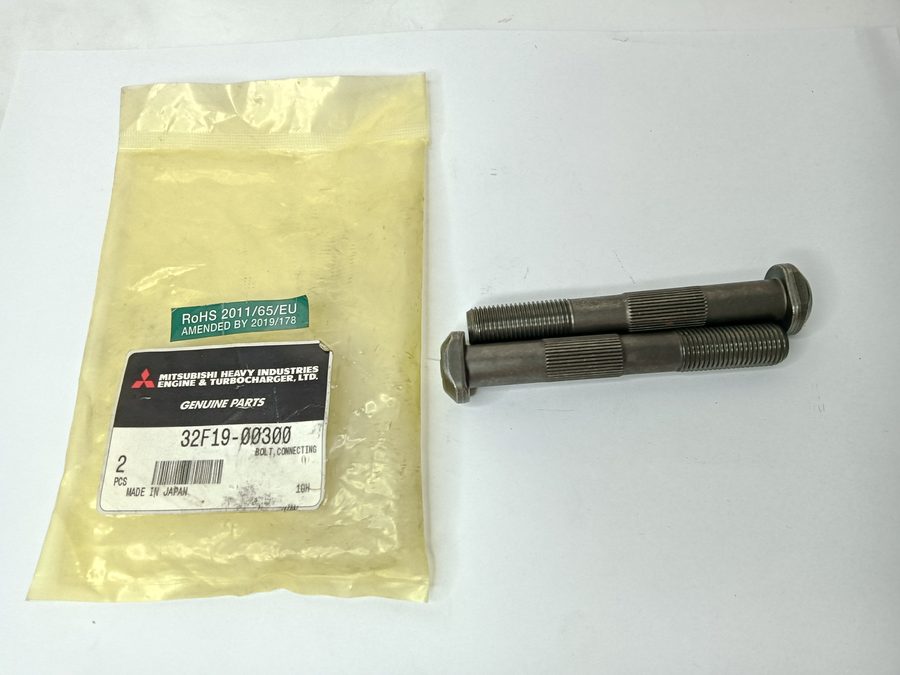
A fastener is the cheapest line on an excavator quotation and one of the most frequently returned, because it is ordered by description rather than by number. "A cylinder head bolt for a J05E" is not a part, it is a guess. Engine and hydraulic fastener families each have their own numbering and their own washers, and the tightening specification lives somewhere else again. Guangzhou Shenyue Machinery Technology Co., Ltd. ships these lines every day, so here is how they are built and what our records quote.
Why fasteners go wrong
Three things make fasteners harder than they look. First, the same bolt length appears in several assemblies with different strength grades and coatings, and only the number separates them. Second, high-strength fasteners are usually single-use: a cylinder head bolt or a connecting rod bolt tightened to its angle specification has already stretched and should not go back in. Third, the washer is part of the assembly, not an accessory — a high-collar washer and a plain washer are different purchases.
Reading the number
Fastener numbers follow the same logic as the rest of the machine. The prefix tells you which part of the machine the item belongs to: YN, LC and LQ prefixes sit on hydraulic, undercarriage and body fasteners, while VA and VH prefixes sit on engine-group fasteners, which is why engine bolts so often look like Hino numbers. The number also carries the thread and the strength grade, which is why two bolts that look identical on a bench are not interchangeable in the parts book. That matters when the engine family differs from the hydraulic family, and it matters even more across generations: an engine bolt from a Hino-powered machine and one from a Cummins-powered machine will never share a number, however similar they look.
What our records quote
| Fastener | Number quoted in our records |
|---|---|
| Cylinder head bolt | VHS111852450, VHS111852460 |
| Connecting rod bolt | VA32F1900300, VAME012232 |
| Flywheel bolt | VHS134551550 |
| Bearing seat bolt | VHS115211261 |
| Turbocharger bolt | VA3433200301 |
| Stud | VA3433200700 |
| Exhaust valve bolt | VHS1793E0070 / VHSZ12610016 / VH936910150A |
| Injection bolt | VHSZ91024496 / VH900124600A |
| Washer | VHS110111380 / VH11011E0060; VA3430900800; 3724670-0058 / LB15V00011S124 |
Where a line shows two or three numbers, that is one assembly with multiple markings rather than a choice. Quote any one of them and the others can be confirmed against the parts book for your serial range.
Where the torque values live
Not on the bolt. Torque and tightening angle come from the workshop manual for the machine's serial range, and the sequence matters as much as the figure — a cylinder head tightened in the wrong order will not seal, whatever value is used. Two practical consequences follow. Inspect before deciding to reuse a fastener, or simply replace it, because a stretched bolt has already lost its clamp load. And when a joint is opened, order the washers and the gaskets in the same enquiry rather than hoping the originals can be reused.
The same logic applies across the whole assembly. Guangzhou Shenyue Machinery Technology Co., Ltd. quotes the bolts and the washers alongside a head set rather than as an afterthought, because a rebuild should not stall on a five-dollar line.
Ordering fasteners without a parts book
Send the machine designation and serial, the assembly the fastener belongs to, and a photograph of the bolt with its washer. A measured dimension — overall length, shank diameter and thread pitch — is enough to resolve most lines when the head marking is worn. For engine fasteners, add the engine plate, because the same model can carry different engine families by market. Our part number prefix guide explains the prefixes in more detail, the engine parts range lists the assemblies these fasteners belong to, and the workshop tools and rebuild kit guide sets out what a rebuild actually consumes. If you already have the number, the part number search is the fastest route. Torque specifications for the J05E and J08E families are published by Hino, and assembly practice for the components around them follows the manufacturers' own guidance, such as Kobelco Construction Machinery.
Frequently Asked Questions
Can I reuse a Kobelco cylinder head bolt?
Generally no. Cylinder head and connecting rod bolts are tightened to a torque plus an angle and stretch permanently in service, so a reused bolt may not hold its clamp load. Our records quote the head bolts as VHS111852450 and VHS111852460 and the rod bolts as VA32F1900300 and VAME012232. Measure a used bolt against a new one if you want proof before deciding.
Are the washers really necessary?
Yes. The washer is part of the joint — a high-collar washer spreads load differently from a plain one, and the number identifies which is correct. Our records quote washers as VHS110111380 / VH11011E0060, VA3430900800 and 3724670-0058 / LB15V00011S124. Ordering the bolt without its washer usually means a second shipment and a machine standing still.
Where do I find the tightening torque?
In the workshop manual for your machine's serial range, not on the bolt. Torque and angle values change between engine families and between running changes inside a series, and the tightening sequence matters as much as the figure. Quote the machine serial when you ask, and we will tell you which assembly the fastener belongs to.
How fast can Shenyue supply these lines?
Fast-moving engine and hydraulic fasteners are held on our shelves in Guangzhou, with 3,000+ part types on the shelf and 100,000+ part numbers available to order through original supply channels. Guangzhou Shenyue Machinery Technology Co., Ltd. confirms the number against the parts book and declares every line genuine, OEM or aftermarket before shipping.