A crusher bucket turns a 20-tonne excavator into a mobile processing plant, and a screening bucket turns it into a sorting tool. Both are attractive because they remove a separate machine from the site, but both put demands on the carrier that a digging bucket never does. In our experience the attachment is usually well built; failures start on the Kobelco side — the wrong circuit, a relief valve set for a bucket, hoses too small for continuous flow, or a tank that cannot breathe. This guide from Guangzhou Shenyue Machinery Technology Co., Ltd. covers what to check before and after the attachment arrives.
What the two attachments actually do
A crusher bucket grabs material between jaws and crushes it by hydraulic force, cycle after cycle. A screening bucket rotates or shakes a drum or disc set to separate fines from oversize. The crusher is an intermittent, high-pressure load with a reverse cycle; the screener is a continuous rotation at moderate pressure. That difference decides the circuit: a crusher normally needs a two-way (bi-directional) auxiliary circuit so the jaws can be reversed to clear a blockage, while many screeners run on a one-way circuit with a return line. Neither will perform properly on a circuit that was plumbed for a breaker.
Flow, pressure and the circuit type
The attachment supplier's flow and pressure figures govern, not the excavator's maximum. A crusher sized for a 30-tonne carrier runs slowly and heats the oil on a 20-tonne machine, and a small crusher on a large carrier can be over-powered unless flow is limited. Check three things before the first coupling: the required flow range, the maximum working pressure, and whether the attachment has its own relief block. If it does not, the carrier's auxiliary relief becomes the only protection, and it must be set to the attachment's limit — not left at the breaker setting.
| Requirement | Why it matters | What to check |
|---|---|---|
| Two-way flow | Crusher jaws must reverse to clear a jam | Pedal or joystick circuit and hose count |
| Relief setting | Protects jaws, motor and hoses | Attachment relief block or carrier auxiliary relief |
| Return capacity | Continuous flow overheats if restricted | Return hose size, fittings and cooler condition |
| Case drain | Motor seals fail without a free drain | Drain port and route back to tank |
Relief, back pressure and case drain
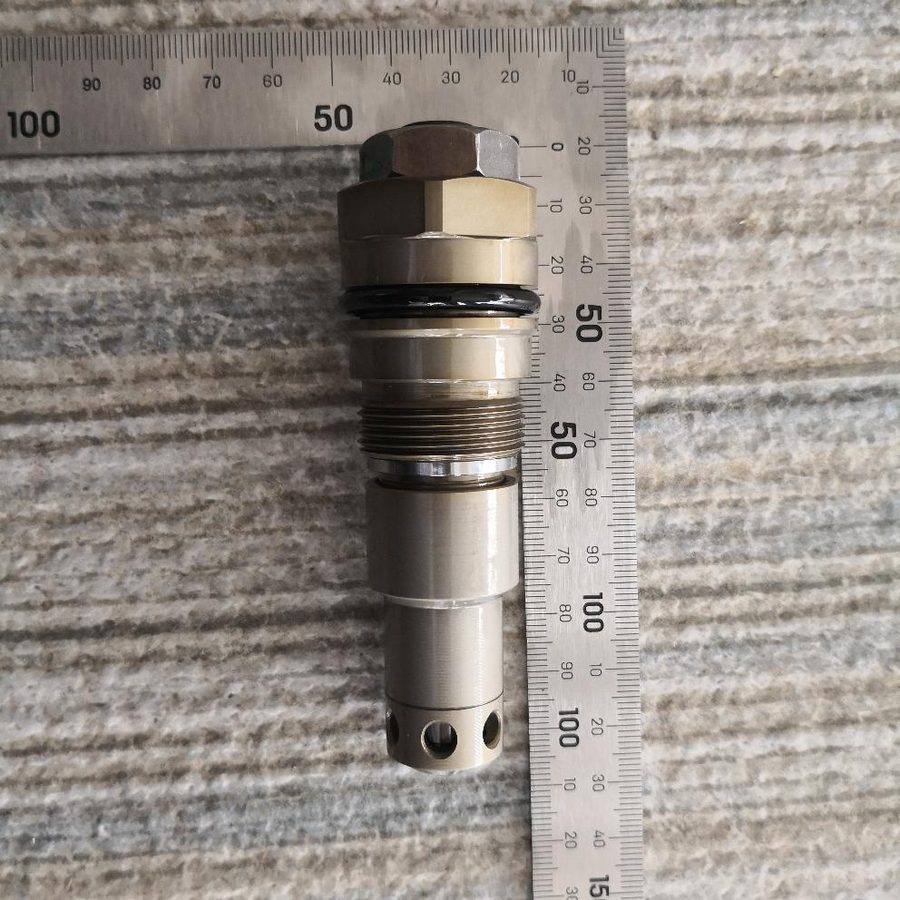
Three hydraulic details cause most early failures. Relief: a valve set too high protects nothing and a valve set too low dumps oil and cooks it. Back pressure: a small return line or a crushed hose end raises pressure behind the motor, which pushes oil past seals and heats the circuit. Case drain: a motor with a restricted drain will blow its shaft seal, and the oil then disappears into the housing rather than the tank. Our records quote the main relief group as V9510318049-T, LP22V00001F1 and YN22V00004F1, and we confirm the correct setting for the machine and attachment rather than shipping a generic valve.
Hoses, filtration and dust
Crusher and screening work is dusty and abrasive. Keep the hydraulic tank breather clean, service the pilot filter on condition, and inspect hose covers weekly: a crusher cycles thousands of times a day, and a hose that rubs on the bucket shell will fail sooner than the calendar suggests. Route hoses with a loop at the coupler so the attachment can move without pulling on the fitting, and use the correct pressure rating, not the next size down. On screening buckets, dust also packs around the rotation bearing, so greasing points deserve the same attention as the hydraulic side.
Wear parts and carrier match
Jaws, teeth, screens and discs are consumables, and their cost per tonne matters more than their purchase price. Guangzhou Shenyue Machinery Technology Co., Ltd. supplies the carrier-side wear parts alongside the hydraulic items. Ask the attachment maker for the wear-part numbers before you buy, and check that they will still be available in two years. On the carrier side, match the attachment to the machine's stability: a fully loaded crusher bucket at full reach puts a large overturning moment on a short-undercarriage machine. If the site runs the attachment all day, plan for extra hydraulic oil cooling and a shorter oil service interval.
What to order and what to confirm
Buyers usually need the carrier-side parts, not the attachment: relief valves, hose assemblies, couplers, pilot filters and seal kits. Guangzhou Shenyue Machinery Technology Co., Ltd. supplies these through original channels alongside quality replacement alternatives and declares each item genuine, OEM or aftermarket. The holding valve for attachment lines is a common companion part, our attachment flow matching guide explains the circuit logic, and the hose part-number guide helps with routing and sizing. Buyers sourcing attachments and wear parts for other brands often compare notes on excavatorpartsglobal.com; Kawasaki's corporate site at khi.co.jp is useful background on the pump technology inside the carrier.
Frequently Asked Questions
Can any Kobelco excavator run a crusher bucket?
No. The machine needs a suitable two-way auxiliary circuit, enough flow at the coupler, and a relief setting that matches the attachment. A crusher sized for a larger carrier will run slowly and overheat the oil. Guangzhou Shenyue Machinery Technology Co., Ltd. checks the carrier circuit before quoting parts.
Why does a screening bucket need a case drain?
The drive motor needs a free path for internal leakage back to the tank. If the drain is blocked or undersized, pressure builds inside the motor housing and pushes oil past the shaft seal. The same rule applies to crusher bucket motors and to any attachment motor run continuously.
Which relief valve protects a Kobelco attachment circuit?
Either a relief block on the attachment or the carrier's auxiliary relief. Our records quote a main relief group under V9510318049-T, LP22V00001F1 and YN22V00004F1, but the setting must match the attachment, so we confirm it per machine rather than shipping a default. Guangzhou Shenyue Machinery Technology Co., Ltd. declares the condition of every valve supplied.
Do crusher buckets damage the excavator's hydraulic pump?
Not if flow, relief and cooling are correct. Damage usually starts with restricted return lines, a relief set too high, or dirty oil. Keeping the breather, pilot filter and oil clean protects the pump, and a shorter service interval is sensible on machines that run an attachment all day.