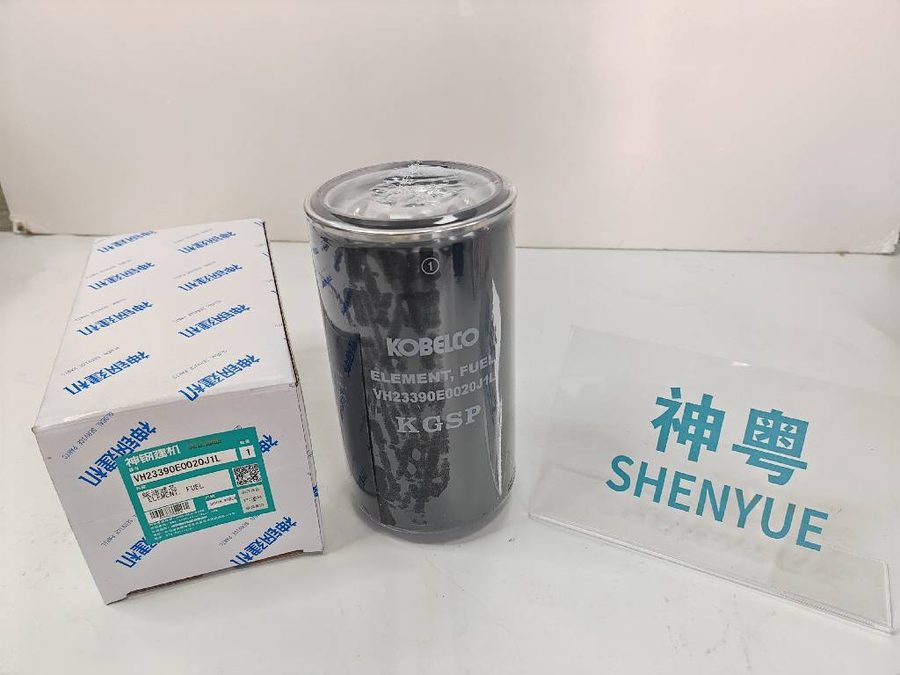
On a mechanical injection engine, dirty fuel cost power. On a common-rail Kobelco — J05E and J08E families included — dirty fuel costs injectors, a high-pressure pump and sometimes a cylinder. The clearances inside the system are measured in microns, and the only thing standing between them and the tank is a filter and a water separator. Guangzhou Shenyue Machinery Technology Co., Ltd. sells both, and the conversation that precedes the order is usually about what fuel the machine is actually running.
What the system expects
A common-rail system pressurises fuel to very high values and meters it with an electronic valve on each injector. Water, grit and polymerised fuel all attack that metering. Water rusts and pits; grit laps the plungers; oxidised fuel leaves varnish on the control valve and the nozzle seat. None of these fail immediately, which is why fuel problems are usually diagnosed as electrical faults first and found in the tank second. Filter numbers in our filters and lubricants range for the Kobelco applications we stock include VH23390E0020J1L, VH23390E0020J1M, VH23390E0060, VH23304EV360 and YN21P01068R100J1N, with YN21P01157F1 as a water separator assembly.
What different fuels do
| Fuel | Behaviour that matters on site | Practical consequence |
|---|---|---|
| Mineral diesel (B0 to B7) | Baseline water separation and seal compatibility | Normal filter intervals |
| B20 and higher FAME blends | Absorbs and holds water, oxidises faster, attacks some older elastomers, loosens tank deposits | Shorter filter life, seal weeping, a plugging event after the first tanks |
| HVO (paraffinic renewable diesel) | Very low aromatics, high cetane, good cold flow, low water absorption, lower lubricity unless additised | Clean burn, but check seal and lubricity compatibility on older machines |
| Stored or blended fuel of unknown age | Oxidation, microbial growth, water from condensation | Filters plugging in days, injector damage |
The single most useful thing a buyer can do is know which of those four is in the tank. "Diesel" is no longer a specification.
Water is the failure mode, not dirt
Most fuel-system damage we see traces back to water. It arrives as condensation in a half-empty tank, as free water in a delivery, or absorbed into a biodiesel blend. The water separator is there to catch it, and the separator only works if it is drained. Drain it at the start of a shift while the machine is cold and the water has settled, not after a day of work when it has been emulsified back into the fuel. If the bowl fills quickly, the problem is the supply, not the separator.
Symptoms that point at fuel rather than electronics
Hard starting when cold but normal when warm; power that fades under load and returns after a filter change; a filter that plugs within days of fitting; black smoke with no boost fault; a rail pressure code that appears only on long pulls. Any of those, combined with a recent fuel delivery or a switch to a biodiesel blend, is a fuel investigation before it is a sensor investigation.
The switching rule
When a machine moves to B20 or to HVO, expect the first tanks to clean the system. Deposits that built up on mineral diesel soften and travel, and the filter catches them. Carry spare elements, check the separator daily for the first two weeks, and treat the first filter change as early rather than scheduled. After that the system settles. Machines that never adapt are usually machines whose tanks were dirty to begin with.
Tank hygiene beats filter quality. Keep tanks full to reduce condensation, draw fuel from a settled height rather than the bottom, filter what goes in, and log every delivery. Guangzhou Shenyue Machinery Technology Co., Ltd. ships fuel filters and water separators in kits so a fleet can standardise on one number per machine rather than an emergency order from whatever is on the shelf — see contact for a kit list.
Records that save an argument
Keep fuel delivery notes, filter change dates and any water findings in the machine file. When an injector fails at 4,000 hours, that record decides whether the conversation is about a warranty claim or about the fuel supply. For a mixed-brand fleet, the same discipline applies across makes; our colleagues at excavatorpartsglobal.com handle those enquiries on the full-brand side. Hino's published guidance at hino-global.com is a useful reference for engine-side fuel requirements, and the machine manual remains the final word.
Fuel is the one consumable that touches every precision part in the engine. Treat it like a specification and the filter budget stays boring, which is exactly what it should be.
Frequently Asked Questions
Can a Kobelco excavator run on B20 biodiesel?
Many can, but expect shorter filter life and closer attention to water. FAME blends absorb water, oxidise faster and loosen tank deposits, so the first tanks often plug a filter. Check the machine manual for the approved blend limit and carry spare elements during the transition.
Is HVO suitable for a Kobelco common-rail engine?
HVO is generally well regarded for clean burn and cold flow, but it has lower aromatics and lower lubricity unless additised, and older seals may not be compatible. Confirm approval for your engine family and monitor the water separator and filters after switching.
How often should the water separator be drained?
Daily, at the start of a shift while the machine is cold and water has settled. If the bowl refills quickly, the problem is the fuel supply rather than the separator. YN21P01157F1 is the separator assembly we stock for these applications.
Why did my fuel filter plug within a week of changing fuel?
A switch to a biodiesel blend or HVO loosens deposits that built up on mineral diesel, and the filter catches them. That is normal cleaning behaviour. Change the element early, check the separator daily for two weeks, and investigate the tank if plugging continues. Guangzhou Shenyue Machinery Technology Co., Ltd. keeps the common numbers on the shelf.