Everyone watches the track chain because it is big, visible and obviously worn. The drive sprocket sits at the back, half hidden behind the track frame, and gets inspected when someone remembers. Yet the sprocket is what converts hydraulic power into travel, and it is the part that decides how long a new chain lasts. A chain fitted to hooked teeth wears at several times its normal rate, and the owner blames the chain. Guangzhou Shenyue Machinery Technology Co., Ltd. quotes undercarriage parts every working day, and the most common avoidable loss we see is a chain replaced one season too late and a sprocket replaced two seasons too late, in that order.
How a sprocket actually wears
The sprocket tooth does not push the bushing; it rolls into it. Each engagement, the tooth face contacts the bushing outer diameter and drives it around the arc. When the tooth face is new, contact is a rolling line and the load is spread. As the face wears, the profile changes from a curve into a ramp, the tooth hooks forward, and the bushing slides instead of rolling. Sliding means abrasion, and abrasion accelerates both parts.
Chain wear makes this worse independently. As pin centres move apart, the effective pitch of the chain grows, and a chain with a longer pitch no longer seats in a sprocket cut for the original pitch. It climbs the tooth, loads the tip, and wears the tooth into a hook. The two failures feed each other, which is why they should be judged together.
Measure the tooth, not the paint
Clean the teeth, then look at three things. Tooth thickness at the pitch line, measured with a gauge or calipers against the specification, tells you how much material is gone. Profile tells you whether the face is still a curve or has become a ramp. Cracks at the tooth root or around the hub bolts tell you the part is finished regardless of thickness. Photograph both sides of the sprocket, because the drive side wears faster and the idler side can look acceptable while the drive side is hooked.
| What you see | Stage | Action |
|---|---|---|
| Polished faces, profile still curved, thickness in spec | Normal running | Monitor at each undercarriage check |
| Visible flat on the face, slight hook starting | Early wear | Plan replacement with the next chain |
| Pronounced hook, tooth tip thinned | Advanced | Replace sprocket and chain together |
| Cracks at root or loose hub bolts | End of life | Stop operating, replace before failure |
Segments, or the whole hub
Larger machines often use a bolt-on sprocket segment ring around a reusable hub, and on those the segments can be changed without pulling the final drive. Smaller machines frequently use a one-piece sprocket that mounts to the final drive flange, so the whole part is replaced. When segments are used, the hub must be inspected for wear at the segment seats and the bolts replaced rather than reused, because a segment that moves on its hub will crack.
Tooth count is not a service detail. A sprocket with the wrong tooth count for the chain pitch changes the final drive ratio and loads every link incorrectly. Quote the number from the machine, not from a photograph of a similar sprocket.
Numbers and what to quote
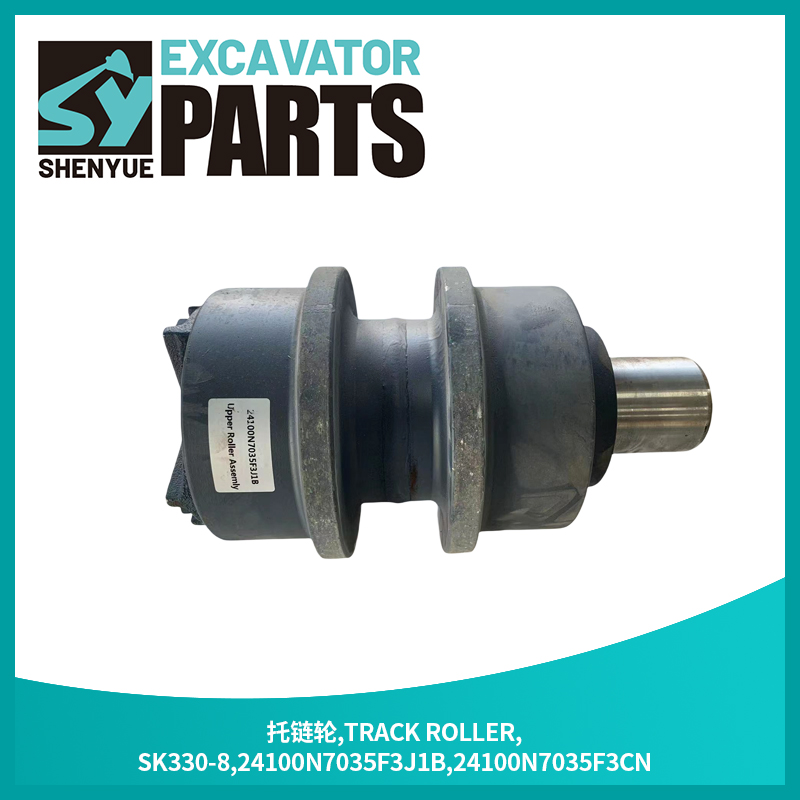
Undercarriage numbers are long and easy to mistype, which is why we ask for the plate rather than the model name. Our records use 24100N7035F3J1B and 24100N7035F3CN for the SK330-8 track roller with an idler shaft under VA32F2303402, and sprocket numbers are commonly quoted per serial because the same model can carry different track frames. Where the plate is unreadable, the part is identified by measurement: tooth count, pitch, mounting bolt pattern and hub diameter.
Quote the running gear as a set. Guangzhou Shenyue Machinery Technology Co., Ltd. holds 3,000+ part types on the shelf and 100,000+ part numbers available to order through original Kobelco, Hino and KPM channels. Send tooth count, pitch, bolt pattern and photographs of both sprocket faces, and the quote covers sprocket, rollers, idlers and chain so the wear is judged as one decision.
What a sprocket costs when it is ignored
Running a hooked sprocket does not just shorten chain life. It loads the final drive bearing through a sliding contact instead of a rolling one, it accelerates bushing wear on one side of the chain, and it introduces a pulsing load that shows up as a noise the operator cannot place. Buyers sourcing undercarriage across several brands through our export brand corbayparts.com run into the same rule: the parts are cheap as a planned set and expensive as an emergency.
Where to start
Measure before you order anything. The track chain and link assembly guide covers pitch measurement, the undercarriage part number guide explains how the numbers are built, and the undercarriage and cylinder parts page lists what is stocked. Kobelco publishes undercarriage specifications by model at kobelco.co.jp. Send the plate photograph and the measurements through the contact page and the set is quoted together.
Frequently Asked Questions
How do I know when a Kobelco drive sprocket needs replacing?
Measure tooth thickness at the pitch line against specification, look at whether the face is still curved or has become a ramp, and check for cracks at the root or loose hub bolts. A pronounced hook or a thinned tip means replacement, and it should be done with the chain rather than before or after it.
Can I replace only the sprocket segments instead of the whole hub?
On machines built with a bolt-on segment ring, yes: the segments are replaced on the reusable hub and the final drive stays in place. Inspect the segment seats on the hub for wear and fit new bolts rather than reusing old ones. One-piece sprockets are replaced as a complete part.
What happens if I fit a new track chain to a worn sprocket?
The new chain wears far faster than its rating, because a hooked tooth scrapes the bushing instead of rolling into it. The same is true in reverse: a new sprocket on a stretched chain climbs the tooth and loads the tip. Judge chain, sprocket, rollers and idlers against each other.
What information do I need to quote a Kobelco sprocket?
Model and serial, tooth count, chain pitch, mounting bolt pattern and hub diameter, plus photographs of both sprocket faces. Guangzhou Shenyue Machinery Technology Co., Ltd. quotes sprocket numbers per serial because one model can carry different track frames, and records rollers such as 24100N7035F3J1B exactly as stamped.