Railway work is different from every other job an excavator does. On a formation renewal, a drainage upgrade or a cable route beside the track, the machine spends its day on ballast: crushed, angular stone that never settles into a cushion the way soil does. The work also happens in short possession windows, in a narrow corridor, with no room to swing wide or to bring in a second machine. Owners ask this guide's author, Guangzhou Shenyue Machinery Technology Co., Ltd., which Kobelco parts fail first in this work, and the honest answer is that the machine rarely fails as a whole. A handful of wear points take almost all the punishment.
Why ballast is harder on a machine than soil
Ballast is abrasive by design. Each stone has sharp edges, and under a track those edges behave like a grinding wheel: they scour bushings, polish roller surfaces and work into every gap. Add the impact of loading spent ballast and the dust that rises whenever the stone is disturbed, and three wear mechanisms run at once — abrasion, impact and contamination. Soil can be compacted into a working platform; ballast stays loose, so the track never stops shuffling and the pins never stop moving. That constant micro-motion is what turns a long-life undercarriage into a short-life one on rail work, long before the hour meter suggests a rebuild.
Undercarriage is the first bill
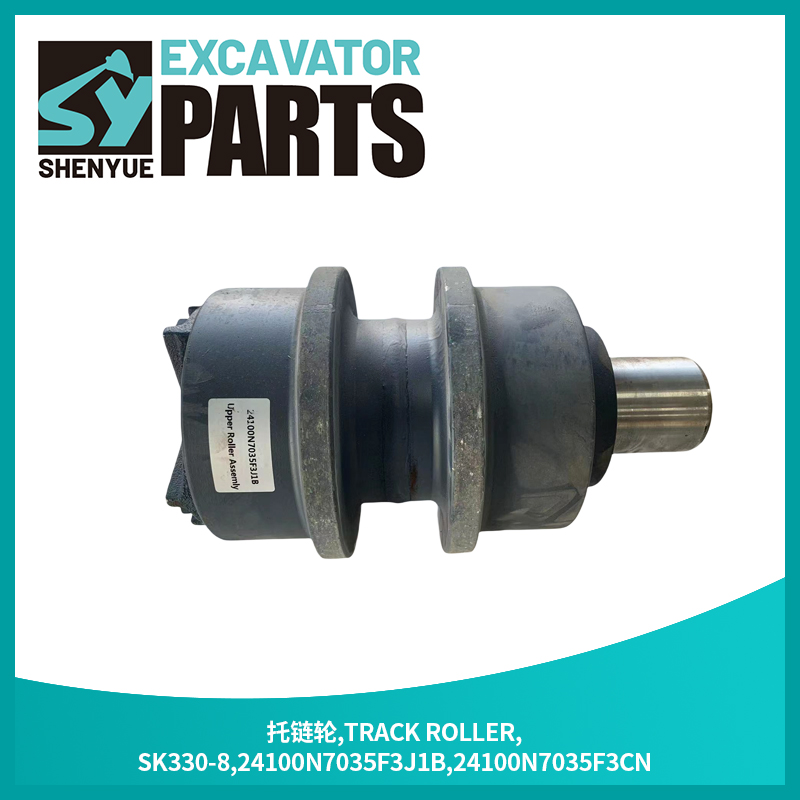
Track rollers, idlers, links and shoes carry the cost. Rollers wear flat on the running surface and develop a step at the flange; idlers lose flange height; link bushings and pins wear oval; shoes crack at the bolt holes after repeated impact. Measure rather than judge by eye: roller diameter, flange height, link pitch and shoe thickness say how much life is left. References differ by model and serial, so order from the parts book for the machine rather than from a generic size. As an example of how the numbers look, our records quote the SK330-8 track roller as 24100N7035F3J1B and 24100N7035F3CN, and the idler shaft as VA32F2303402; every one is confirmed against the serial before invoicing.
Bucket, teeth and pins
Loading spent ballast is a scraping job, not a digging job. Teeth and adapters wear on the underside, pin and bushing joints at the bucket and arm take a shock load every cycle, and a bucket that is allowed to rattle develops oval pin bores long before the plates wear through. Keep the bucket tight: a worn pin and bushing set such as LC12B02199P1 is cheap against a line-bored boss. Avoid dragging rails or sleepers with the bucket; side loads are what crack ears and bend pins. If the site needs to break out old ballast or rock, use a breaker and keep the bucket for clean loading.
Hydraulics, dust and daily checks
Two hydraulic habits matter on rail work. First, dust: ballast dust is fine and sharp, and it finds its way into breathers, pilot filters and open hose ends. Change the pilot filter on condition, keep the hydraulic tank breather clean, and cap every hose during repair, because a restricted breather pulls dirt past seals. Second, heat and routing: machines work at low travel speed with the boom cycling constantly, so oil runs hot and hoses chafe against the boom and frame. Inspect outer covers at every service and replace any hose with a rubbed-through cover before it fails in the corridor, where a spill costs a possession window as well as oil.
Stability in a narrow corridor
Rail corridors leave little room for error. Keep the track gauge as wide as the site allows, carry the bucket low when travelling, and never swing a loaded bucket across the track. A dozer blade helps dress the formation and steady the machine on cross-fall, but not replace a proper working platform. On embankments, work parallel to the slope rather than across it, and re-check the ground after rain: ballast over soft formation can punch through under one track and put the machine on its side. Most rail-site incidents are ground failures, not hydraulic failures.
The parts list and how to order it
For a rail-support machine the working list is short: track rollers, idlers, link assemblies or shoes, bucket pins and bushings, teeth, pilot filters, breather elements and a spare set of hoses. Guangzhou Shenyue Machinery Technology Co., Ltd. supplies these through original channels alongside quality replacement alternatives, with each item declared genuine, OEM or aftermarket on the quotation. Our guide to the track frame and rollers explains what to measure, the bucket linkage guide covers pins and GET, and references can be checked on the part-number search page. Kobelco's corporate site at kobelco.co.jp is a useful background reference for the machine ranges used in this work.
Frequently Asked Questions
Why does an excavator wear faster on railway ballast than on soil?
Ballast is angular crushed stone that never compacts into a cushion, so the track keeps shuffling and the pins keep moving. Abrasion, impact and dust attack the undercarriage at the same time, and rollers, idlers, links and shoes wear out well before their normal hour life. Guangzhou Shenyue Machinery Technology Co., Ltd. supplies these parts by machine serial.
Which Kobelco undercarriage parts should a rail-site machine stock?
Track rollers, idlers, link assemblies or shoes and sprocket segments are the core list, plus bucket pins and bushings. For an SK330-8 our records quote the track roller as 24100N7035F3J1B and 24100N7035F3CN and the idler shaft as VA32F2303402. References are confirmed against the serial before invoicing.
Is a dozer blade useful on railway formation work?
Yes, for dressing the formation and steadying the machine on cross-fall, but it does not replace a proper working platform. On embankments the machine should work parallel to the slope, and the ground should be checked again after rain because ballast over soft formation can fail under one track.
Can Guangzhou Shenyue supply rail-site Kobelco parts quickly?
Guangzhou Shenyue Machinery Technology Co., Ltd. holds 3,000+ part types on the shelf and has 100,000+ part numbers available to order, so common undercarriage and bucket items can ship without a long lead time. Urgent items are quoted with the fastest realistic routing rather than a promise.