Three complaints arrive at our desk under the same heading — "fuel problem". The machine cranks too long before it fires, especially after a filter change or after standing overnight. The gauge drops to empty while there is clearly fuel in the tank. Or the engine hunts and sags under load and the owner assumes the injection pump is finished. They are three different faults in three different places on the same side of the machine, and on a Kobelco they can be separated by opening the right compartment and reading the right number. This guide covers the parts that sit between the filler cap and the injection pump, and the numbers Guangzhou Shenyue Machinery Technology Co., Ltd. quotes for them.
Where air actually gets in
Almost every "fuel" hard start on a diesel excavator is air entering the suction side, not fuel failing to arrive. The suction side runs from the tank pickup through the primer, the pre-filter or water separator, the main filter head and on to the feed pump. Every joint and every O-ring on that run is a potential ingress point, and the failure is progressive: a seal that weeps a trace of air when cold becomes a real leak when the machine sits overnight and the column drains back. That is why the symptom is worst on the first start of the day and fades once the engine has run for a few minutes. It is also why replacing the injection pump on this evidence alone is an expensive way to stay broken.
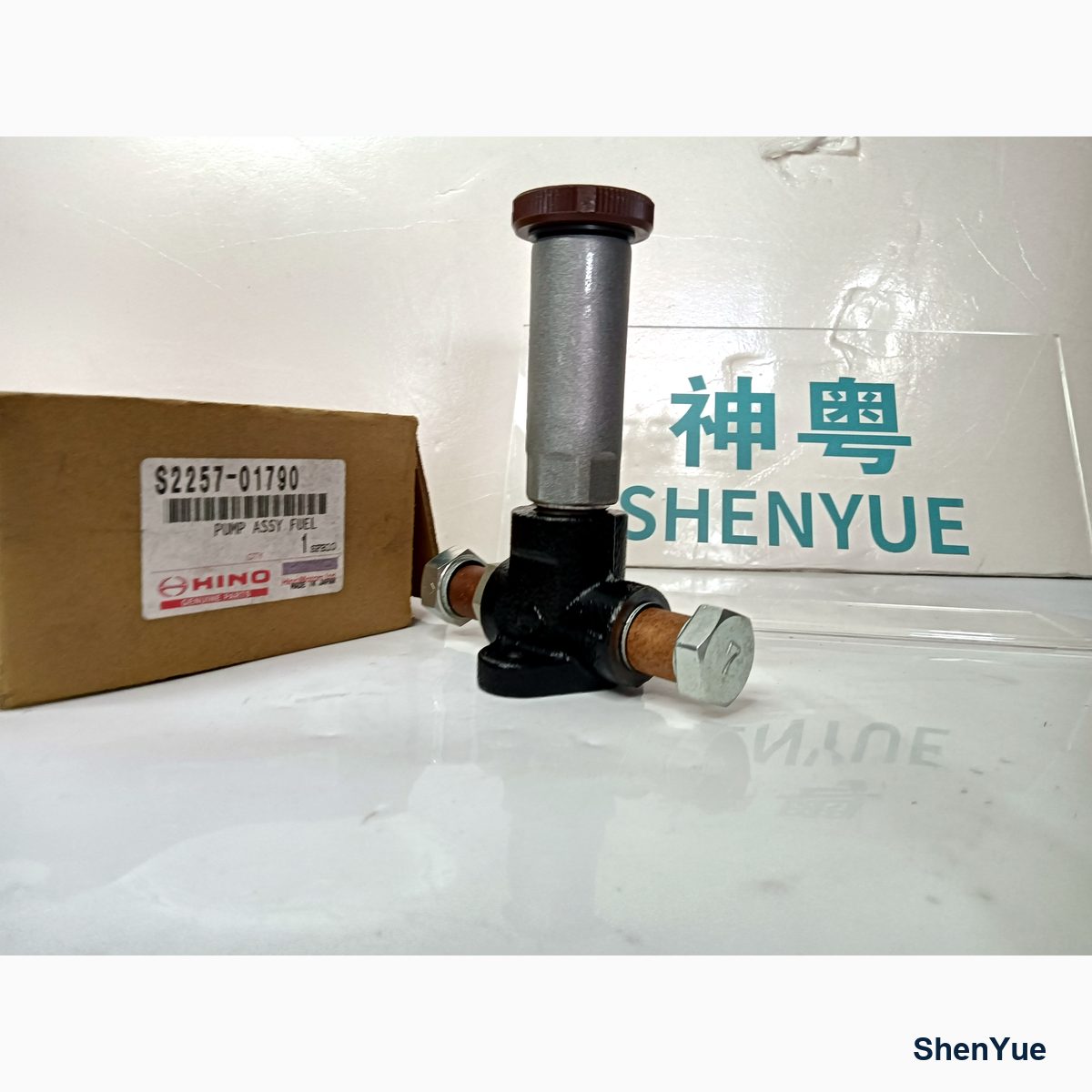
The hand primer: VHS225701790A
The hand primer is the most useful diagnostic tool on the machine and the most neglected part on the shelf. It fills the filter head and suction line after a filter change and proves, by feel, whether the circuit holds pressure. A healthy primer goes firm within a few strokes and stays firm. One that pumps forever without hardening is telling you either that air is being drawn in upstream or that its own internal valves have failed. We stock the primer as VHS225701790A, and it is worth carrying as a spare on any machine that works away from a workshop, because a failed primer turns a five-minute filter change into a no-start.
Filter head and element numbers
Filter elements for the Kobelco range turn up in our filter stock list against more than one marking, because the same element is recorded under different numbers depending on the sourcing batch and the market the machine was built for. YN21P01174F1 and VHS23300E0250 are the two we quote most often for the fuel filter position. The practical rule is to read the number off the element you are removing and send it with the engine plate: the element number tells us the physical fit, and the engine code tells us the filtration spec the machine was built to. On common-rail machines the second part of that sentence matters, because the wrong micron rating costs far more than the price difference between two elements.
| Complaint | First place to look | Number we quote |
|---|---|---|
| Long crank first start of the day | Primer hardness and suction joints | Hand fuel pump VHS225701790A |
| Power sags, filter light on early | Element spec and water in bowl | Fuel filter YN21P01174F1 / VHS23300E0250 |
| Gauge reads empty with fuel in tank | Sender float and wiring at the tank | Sender commonly quoted — confirm by tank shape |
| Idle hunts, no smoke, no power loss | Governor step motor, not the fuel side | Step motor YN20S00002F1 |
The sender, and why the gauge lies
A sender that reads empty at a quarter tank, or swings while the machine works on a slope, is usually a worn resistance track or a float that has absorbed fuel and lost buoyancy. We do not publish a single sender number for the whole Kobelco range, because the tank and the mounting flange differ between classes; we quote it as commonly quoted against photographs of the tank top and the connector, then confirm before shipping. Buyers who skip that step tend to receive a sender that fits the hole but reads backwards, which is a worse outcome than a gauge that reads low.
What we keep, and how it is labeled
Filters, primers, water separators and tank hardware for the Kobelco range are routine shelf lines at Guangzhou Shenyue Machinery Technology Co., Ltd. Every quotation states whether the item is genuine, OEM or aftermarket, and we will not substitute one for another without saying so, because on the fuel side the difference shows up as filtration efficiency and seal life rather than as a visible defect. The engine-side numbers, including the Hino injector and common-rail components, follow the engine plate rather than the excavator model — Hino documents its engine families at hino-global.com — and we confirm them the same way. For the filter-to-injector sequence in more detail, see our guide to Kobelco fuel system filters and SCV parts.
Frequently Asked Questions
How do I know whether my hard start is air in the fuel or a failing injection pump?
Run the hand primer first. If the primer VHS225701790A goes firm within a few strokes and the machine then starts and runs cleanly, the pump is delivering and you are chasing an air leak on the suction side. If the primer stays soft, or the engine still cranks long after a firm primer, the restriction or the pump is the next thing to test. Guangzhou Shenyue Machinery Technology Co., Ltd. asks for both results before quoting fuel-system parts.
Do you supply the fuel sender for every Kobelco class?
We quote senders as commonly quoted, because the tank flange and connector differ between classes and we will not publish one number as if it covered the range. Send a photo of the tank top, the connector and the old sender, and Guangzhou Shenyue Machinery Technology Co., Ltd. confirms the correct unit before it ships.
Which fuel filter numbers do you quote most often?
YN21P01174F1 and VHS23300E0250 are the two we quote most often for the Kobelco fuel filter position, always alongside the engine code from the engine nameplate. Element numbers describe the physical fit; the engine code describes the filtration spec, and on common-rail engines the second one decides whether the element protects the injectors.