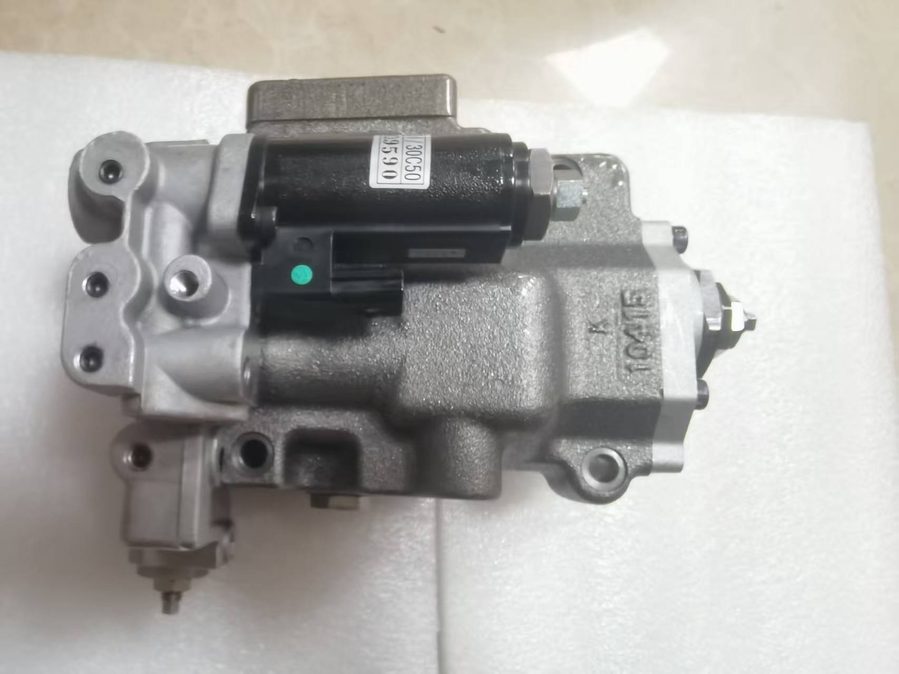
There is a specific kind of dead end in hydraulic diagnosis that every workshop meets sooner or later. The machine is slow — all functions, or all functions on one pump — the owner has already replaced filters and oil, and the pressure test comes back at full relief pressure on every circuit. On that evidence the pump looks healthy, the relief valve looks healthy, and the machine goes back to work still slow. The mistake is the instrument, not the mechanic: a pressure gauge measures the highest pressure a circuit can hold, and a machine can hold full relief pressure with almost no oil moving through it. This article sets out what a gauge can prove, what it cannot, and the order in which Guangzhou Shenyue Machinery Technology Co., Ltd. recommends testing a slow Kobelco.
What a pressure gauge actually proves
A relief pressure reading proves one thing: that the relief valve opens at its set pressure and the circuit upstream of it can be pressurized. It is a valid, cheap test and should always be done first. But pressure is what the circuit builds when flow is blocked at the relief. The moment oil is allowed to move, pressure tells you nothing about volume. A pump worn past its service limit can still deadhead at full pressure and deliver a fraction of its rated flow, which is precisely the failure that produces a machine that is uniformly slow, hot, and impossible to fault on a gauge.
The three places flow disappears
| Loss | What it looks like on the machine | How to separate it from the others |
|---|---|---|
| Pump delivery falls (wear) | All functions on that pump slow, oil temperature climbs, no external leak | Flow test at the pump outlet, or case drain measurement against spec |
| Oil bypasses internally | One function slow, or slow only under load, pressure still good | Cap the suspect circuit and test flow; compare with a known-good function |
| Control signal is wrong | Slow and smooth, no heat, often both pumps equally affected | Pilot and negative-control pressures before touching the pump |
The third row is the one that gets skipped, and on Kobelco machines it is also the cheapest to rule out. The pump only delivers what the regulator and the control signal ask it to deliver; if the machine is slow because the pump is being commanded to stay near standby, the pump is innocent and a replacement will change nothing. That is why negative-control and pilot pressures belong at the front of the test order, not at the end.
Where the numbers sit
The main pump on the SK200-8 class is quoted as assembly 2924610-0030 / YN10V00005S156, with the valve plate at 2924110-0056 / LC10V00010S153 and the regulator at 29070821-4927 / YN10V01006F2. Regulators also appear in our list as YN10V01006F1 and YN10V01009F4 / GYT6K, and this is where buyers lose money: the regulator is a matched assembly, not a universal fitment, and swapping between generations to save a few dollars produces a machine that is either sluggish or uncontrollable. When a regulator is the confirmed fault, send the number stamped on the unit you are removing together with the pump plate, and we will match the assembly rather than guess from the model name — the pump and regulator number guide explains how the generations differ.
When to stop testing
There is a point where more testing stops paying. If case drain flow is well above the wear limit, if the oil is carrying bronze or steel fines, or if the pump has already been through one rebuild on the same housings, the honest answer is a pump or a core exchange rather than another regulator. Continuing to run a worn pump to protect a repair budget usually costs a set of internal parts as well, because the debris it generates travels through the whole circuit and settles in the places that are hardest to clean. If a pump has failed catastrophically, the flush is not optional and it must happen before the replacement goes on.
Buying the right level of repair
Hydraulic components at Guangzhou Shenyue Machinery Technology Co., Ltd. are quoted at the level the buyer actually needs: a seal and internal-parts kit from our hydraulic components range for a pump that is serviceable, a regulator assembly for a control fault, or a complete pump for a worn unit, each labeled as genuine, OEM or aftermarket. We hold 3,000+ part types on the shelf and have 100,000+ part numbers available to order, and we will say plainly when the cheaper option is the wrong one. A slow machine is a diagnosis problem before it is a parts problem, and the diagnosis is worth more than the discount. Kobelco's own published specifications for the SK range sit at kobelco.co.jp and are the reference we work back to when a machine's history is unclear.
Frequently Asked Questions
My Kobelco shows full relief pressure but every function is slow. Is the pump worn out?
Not necessarily, and not on that evidence alone. Full relief pressure only proves the relief valve opens and the circuit holds pressure; a worn pump can deadhead at spec while delivering far less flow than it should. Test standby and pilot pressures first, then case drain or flow at the pump outlet. Guangzhou Shenyue Machinery Technology Co., Ltd. quotes pump internals, regulators and complete assemblies, so the diagnosis decides which of the three you actually need.
Can I fit a different regulator to save money?
No. Regulators are matched assemblies, and the numbers in our list — 29070821-4927 / YN10V01006F2, YN10V01006F1 and YN10V01009F4 / GYT6K — exist precisely because they are not interchangeable across generations. A mismatched regulator typically produces either a sluggish machine or one that will not hold a setting. Send the number from the unit you are removing with the pump plate and we match it exactly.
How do I know whether to rebuild the pump or replace it?
Three indicators decide it: case drain flow against the wear limit, metal content in the oil, and whether the housings have already been rebuilt once. Past those limits a rebuild does not restore the machine and a complete pump is the cheaper answer. After a catastrophic failure, flush the circuit first — new oil and new filters — before the replacement pump is fitted.