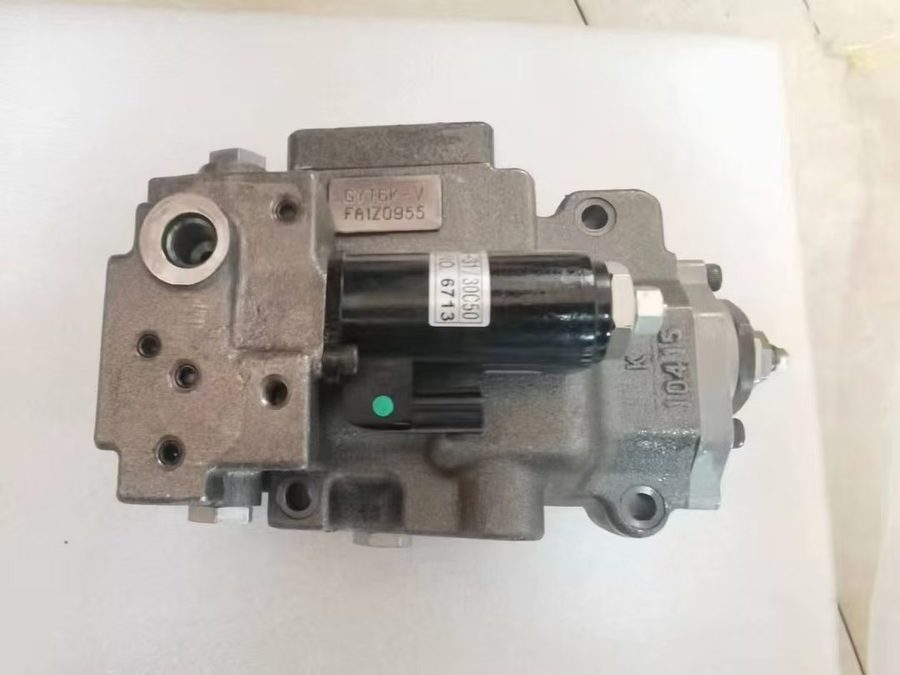
There is a category of Kobelco fault that wastes more money than any other: the machine that is slow but not broken. It digs and it lifts, just not with the urgency it had last season, so owners respond by replacing the pump. Sometimes that fixes it. Often it does not, because the pump was only obeying a signal that had gone wrong upstream. That signal is negative control, and reading it takes one gauge and twenty minutes — a check the technical desk at Guangzhou Shenyue Machinery Technology Co., Ltd. asks for before it quotes a pump.
What negative control does
On a Kobelco excavator the main pump does not run at full displacement all day. It waits. The control valve sends a small bleed of oil back to the pump regulator, and that bleed carries a pressure signal called negative control, or NC. When every spool is centered, the oil has to pass through a restrictor, so NC pressure stays high and the regulator holds the pump at minimum displacement. Stroke a spool and the bleed path opens, NC pressure drops, and the regulator strokes the pump up to meet demand: the pump learns what the operator wants from a pressure difference.
On the SK200-8 the pump is the K3V112DT, and the regulator is the part that converts that signal into stroke. We hold regulator assemblies under 29070821-4927 / YN10V01006F2 and YN10V01009F4 / GYT6K, plus the earlier YN10V01006F1 — three numbers that appear in the same conversations and are not interchangeable across every serial.
The two readings that matter
Put a gauge on the NC port at the pump, warm the machine to operating temperature, and record two numbers: NC pressure with all levers neutral, and NC pressure with one function held at full stroke. The workshop manual for your serial gives the acceptance window; the figures we quote in conversation are commonly quoted ranges, not a substitute for that page.
| Reading | What it should do | What it means when it does not |
|---|---|---|
| NC pressure, all levers neutral | Rises to the standby value for that machine | Low and steady: bleed path leaking, NC hose split, or a spool not fully centered |
| NC pressure, one function at full stroke | Drops clearly from the standby value | Barely moves: blocked NC orifice, or the signal is not reaching the regulator |
| Pump delivery at standby | Small — the pump is waiting | High at standby: regulator stuck at full stroke, machine will feel harsh and run hot |
| Pump delivery at full stroke | Rises to the pump's rated flow | Short of spec with good NC signal: the pump itself is worn |
Four causes, in the order worth checking
- A split or softened NC hose. A hose that weeps under the cab floor drops the signal and the pump never wakes up properly.
- A blocked NC orifice. Debris from a previous failure, or seal material from a hose that came apart. The pump reads high NC pressure all the time and stays at minimum stroke, so the machine feels weak across every function at once.
- A sticking regulator spool. Contamination or a scored bore. The pump responds late, overshoots, and the machine feels jerky rather than simply slow.
- A worn pump. Only reached after the signal is proven good. Case drain flow and delivery at full stroke settle it.
Why the -10 machines change the diagnosis
Later platforms add electronic regulation on top of the hydraulic signal, with proportional solenoid control and sensor feedback. The mechanical check still applies, but a slow machine with correct NC pressures now points at the electrical side: a solenoid that is not being driven, a pressure sensor reading wrong, or a controller in a derate strategy. That is why we ask for fault codes alongside the gauge numbers on anything newer than a -8. The regulator fault guide walks through the hydraulic side in more detail, and the pilot pressure test sequence covers the circuit that shares the same oil.
Before you replace the pump
Two rules save real money. First, prove the signal before condemning the pump: a gauge costs less than a pump and takes an hour. Second, if the pump did fail, flush the circuit properly — the post-failure flush procedure exists because debris from a failed pump regularly destroys the replacement regulator within weeks. Our hydraulic components range lists regulators, pumps and relief valves by number, and the part number search will tell you whether a specific regulator is on the shelf.
Machine specifications and pressure settings for your serial remain with Kobelco. Guangzhou Shenyue Machinery Technology Co., Ltd. has supplied Kobelco parts since 2007 and is an independent supplier, not a Kobelco dealer; genuine parts come through original supply channels, and replacement alternatives are labelled as such on every quotation.
Frequently Asked Questions
What is negative control pressure on a Kobelco?
It is the small pressure signal the control valve sends back to the pump regulator. High NC pressure with the levers neutral keeps the pump at minimum displacement; when a spool strokes, NC pressure drops and the pump strokes up. A wrong NC signal makes the machine feel slow even when the pump is healthy.
What should standby pressure be on an SK200-8?
The acceptance figure is the one printed in the workshop manual for your machine serial, and it should be measured with the oil at operating temperature. The ranges quoted in conversation are commonly quoted values only; Guangzhou Shenyue Machinery Technology Co., Ltd. always asks for the manual figure alongside the gauge reading before advising on a regulator.
How do I know if the problem is the regulator or the pump?
Prove the signal first. If NC pressure rises at standby and drops cleanly at full stroke, the signal is good and a pump that is short on delivery is worn. If NC pressure stays high or barely moves, the fault is upstream — hose, orifice or spool — and a new regulator will not fix it.
Which regulator part numbers fit an SK200-8?
Regulator assemblies quoted for the K3V112DT pump include 29070821-4927 / YN10V01006F2, YN10V01006F1 and YN10V01009F4 / GYT6K. They are not interchangeable across every serial, so the pump nameplate and machine serial decide which one is correct.