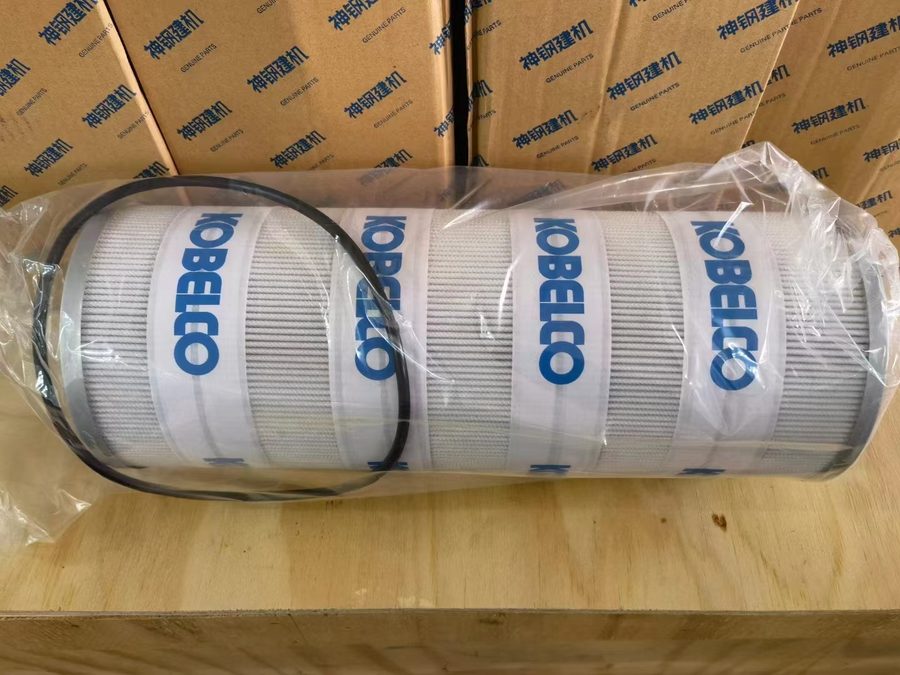
Hydraulic oil is the least glamorous line on any Kobelco quotation and the one with the widest consequences. The viscosity grade decides how the main pumps start on a cold morning, how much oil slips past the pistons on a hot afternoon, and how fast the tank breathes contamination in between. The parts desk at Guangzhou Shenyue Machinery Technology Co., Ltd. quotes oil and filters together for exactly that reason: a correctly chosen grade protected by a clogged return filter or a dead breather behaves like the wrong grade anyway.
Viscosity in plain terms
Hydraulic oils are graded by ISO viscosity class — the common choices for excavators being ISO VG 46 and ISO VG 68. The logic is a trade-off: thinner oil (VG 46) flows and protects at low temperature and keeps cold-start cavitation away, but offers less film strength at sustained high temperature; thicker oil (VG 68) holds its film in hot climates and high ambient duty but drags at cold start. The deciding inputs are your climate band and your duty, and your machine's manual is the authority on the grade range the manufacturer permits — check it before buying, because build markets differ.
| Operating profile | Lean toward | Why |
|---|---|---|
| Temperate climate, general digging | VG 46 | Balance of cold flow and film strength |
| Consistently hot climate or high ambient duty | VG 68 | Keeps film at sustained high oil temperature |
| Cold mornings, winter starts | Lower grade within the manual's range | Avoids cavitation and slow pump response at start |
| Mixed seasons, one oil all year | The grade the manual centers on | Fewer changeovers, fewer mistakes |
The three mistakes that cost pumps
- Mixing grades and brands in the tank. Topping up a VG 46 system with VG 68 shifts the actual viscosity into no guaranteed band, and additive packages may not be compatible. Drain and refill as one decision.
- Ignoring the breather. Every temperature cycle pulls air through the tank breather; a clogged or missing breather YN57V00014S003-class filter turns the tank into a contamination pump. Inspect it every service.
- Changing oil without changing filters. New oil mobilizes the sludge the old oil was holding. Return and suction filters — such as the LS52V01006R210 / R200 elements we stock — belong in the same order as the oil itself.
Buying oil for a fleet
Oil ships in drum or pail packaging, and the practical question is total volume per service cycle: tank capacity, filter volumes, and the number of machines on the same grade. Standardize one grade across the fleet wherever the manual allows — it halves the storage mistakes. Store drums off the ground, sealed, out of direct sun, and decant through a filtered transfer pump, never an open bucket. A drum of correct oil decanted dirty is a contamination event, not a service. For buyers outside China, our international outlet corbayparts.com ships the same filter-and-oil bundles under consolidated freight, and Guangzhou Shenyue Machinery Technology Co., Ltd. packs drums and filters for export transit as a single lot.
What we quote with the oil
A complete oil change line from us runs: the oil itself in drum or pail, return and suction filter elements, the tank breather, and a drain-and-fill procedure note per machine class. Everything is marked genuine, OEM or aftermarket on the quotation, and volumes are calculated from the machine serial rather than guessed from the model. Kobelco's maintenance documentation lists the grade range and capacities per model — Guangzhou Shenyue Machinery Technology Co., Ltd. quotes the consumables against those figures.
The supporting reading on this site maps the protection side of the same decision. The filter and lubricant range itself sits on the filters and lubricants category page. Contamination — the reason the breather and the return filter matter as much as the grade — is covered in our oil cleanliness guide, and the temperature side in the SK200-8 overheating diagnosis. The tank breathing hardware, including the filter that keeps airborne contamination out between services, is itemized in the breather and return filter guide.
Frequently Asked Questions
Which hydraulic oil viscosity should I use in a Kobelco SK excavator?
Work from the manual's permitted range first, then choose by climate: VG 46 suits temperate duty, VG 68 suits consistently hot climates. Guangzhou Shenyue Machinery Technology Co., Ltd. quotes the grade per machine serial so build-market differences do not catch you out.
Can I mix ISO VG 46 and VG 68 in the same tank?
No. Topping up across grades leaves the oil in no guaranteed viscosity band and may mix incompatible additive packages. Drain and refill as one decision, and change the return and suction filters in the same service — Guangzhou Shenyue Machinery Technology Co., Ltd. quotes the complete line together.
How often should hydraulic oil be changed on an SK excavator?
Follow the manual's hour interval and shorten it for hot, dusty or moist sites. Oil analysis is the better trigger: particle counts and water content tell you before the oil tells you. We quote sampling-friendly drain intervals per duty, not one figure for every machine.
Do you supply hydraulic oil in drum or pail packaging?
Both, shipped together with the matching filters and tank breather as one export-packed lot. Guangzhou Shenyue Machinery Technology Co., Ltd. calculates volume per service cycle from the machine serial, so a fleet order arrives with the right drums and the right elements in the same container.