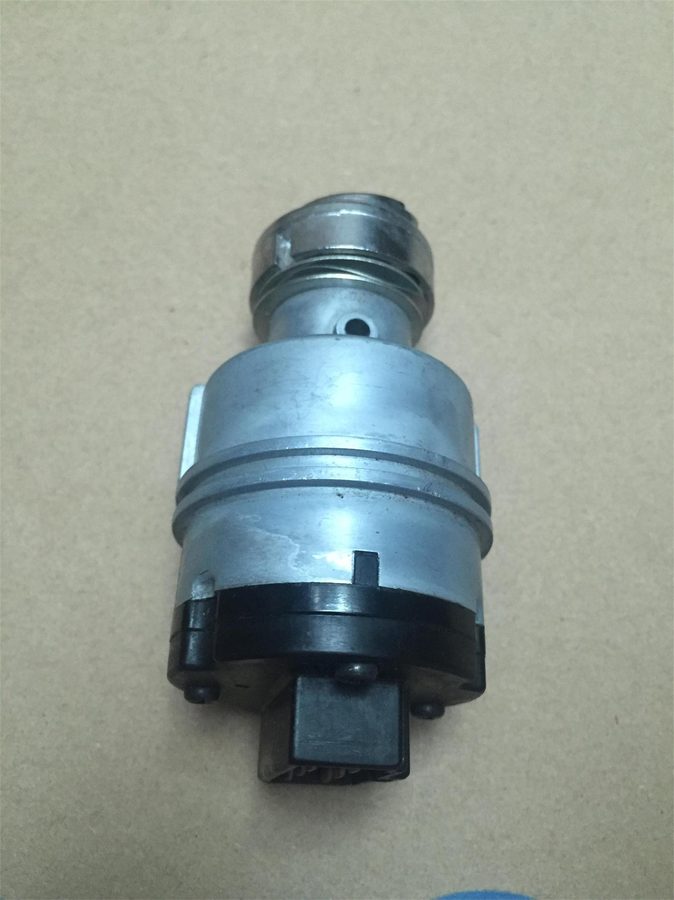
A machine that will not crank is one of the few faults an operator can describe with complete accuracy, and one of the few that owners routinely misdiagnose. The starter is the visible suspect, so the starter is what gets replaced. More often the fault is upstream: a key switch with worn contacts, a relay that has stopped pulling in, a limit or safety switch that is doing exactly what it was designed to do, or an earth strap that has quietly corroded through. Guangzhou Shenyue Machinery Technology Co., Ltd. supplies that upstream family.
What sits between the key and the starter
The starting circuit is short and entirely checkable. The key switch passes battery positive to the start terminal; a relay or switch relay takes that low-current signal and closes the high-current path; safety interlocks such as a neutral or seat switch can interrupt the signal before it arrives; and the earth return completes the circuit through the frame. Any one of those can stop the machine, which is why replacing the starter first is a lottery with poor odds.
Our records quote the key switch as YN50S00026F1 / YN50S00002F1, the switch relay as YN50S00062P1 / LP50S00003P1, limit switches as YN50S00041F1 and YN50S01001P2, a working switch as YN50S00040D1, and further switches as PW03M01751P1 and VI1824100330 / VI1824100082. They live within reach of each other on most Kobelco machines, and they fail for the same reason: contacts, springs and housings that age in a dusty, vibrating environment.
The test order that finds the fault in twenty minutes
| Step | What to measure | What it proves |
|---|---|---|
| 1. Battery and earth | Battery voltage at rest and while cranking; voltage drop across the earth strap | Rules out the most common cause, and the cheapest to fix |
| 2. Key switch output | Voltage at the start terminal with the key held | A switch that passes no voltage at the terminal is the fault, not the starter |
| 3. Relay operation | Whether the relay pulls in and whether it passes current through its contacts | A relay that clicks but does not conduct has burnt contacts |
| 4. Safety interlocks | Continuity through the limit and neutral switches in the cranking position | An interlock that is open is not a fault, it is a working safety device |
| 5. Starter terminal | Voltage present at the starter solenoid terminal during cranking | Voltage present and no crank finally puts the fault at the starter |
Voltage drop, not voltage, is the measurement that matters on step one. A meter can read a healthy twelve or twenty-four volts at rest across a strap that will not carry cranking current, and that single test explains a large share of machines that were sent for a starter and did not need one.
Switches worth carrying, and switches worth understanding
Two switches on this circuit are mistaken for faults. A limit switch that is open is usually doing its job, and a machine that will not crank with the lever out of the neutral position is working correctly. The parts worth carrying are the ones that genuinely wear: the key switch, the switch relay, the limit switches and the connectors between them. All are inexpensive, and all stop a machine completely.
Water ingress is the most common cause of premature failure in this family, particularly on machines washed regularly or working in wet conditions. A switch housing that is cracked or a connector that is not sealed will fail again, so the fault is worth tracing to its cause rather than treated at the component.
Grades, authorization and how to order
Switches, relays and connectors are quoted as genuine, OEM-quality or aftermarket, with the grade declared on every line. Guangzhou Shenyue Machinery Technology Co., Ltd. holds formal authorization for Garrett, Mitsubishi Heavy Industries, TONGMYUNG, NIKURA and Marusan, and the Mitsubishi authorization covers MHI engine parts only. Kobelco is not among them: Shenyue is an independent supplier and is not an authorized dealer of Kobelco Construction Machinery Co., Ltd., and Kobelco electrical parts are supplied as genuine components through original supply channels or as quality alternatives.
Send the machine model and serial number, the old part number or photographs of the switch in place, the quantity and the destination port. Quotations normally return within 24 hours. Browse the electrical parts range, read the circuit context in the harness, connector and fuse guide, and check the manufacturer's own literature at kobelco.co.jp.
Frequently Asked Questions
My Kobelco will not crank. Is it the starter?
Sometimes, but the starter is the last thing in the circuit and the most expensive to change. Check the battery and the earth strap first, then the key switch output, then the relay, then the safety interlocks, and only then the starter terminal. On the majority of no-crank machines the fault is upstream of the starter, where it costs far less to fix.
Why does the machine sometimes crank and sometimes not?
Intermittent cranking points at contacts rather than components: a key switch with worn internal contacts, a relay with pitted faces, or a connector that moves with vibration. Because the fault depends on position and temperature, the test has to be done while it is happening — measure at each junction while an assistant holds the key, rather than testing a cold machine that is currently starting.
Are aftermarket switches acceptable here?
For most of this family, yes, provided the electrical rating matches and the housing seals properly. Water and dust ingress is the usual cause of failure, so a well-sealed aftermarket switch outlasts a genuine one that has been fitted with a cracked connector boot. We declare the grade on every line so the choice is made deliberately rather than by default.