Three documents travel with every Kobelco machine, and mixing up what each one answers is the root of a surprising share of wasted orders and wasted workshop hours. The parts book, the workshop manual and the operator manual look interchangeable from a distance - all thick, all official - but each one answers a different question. Guangzhou Shenyue Machinery Technology Co., Ltd. works from these documents every day on the parts side, and this post separates the three jobs and shows where each one helps an order - and where each one stops.
The parts book answers: what is the number
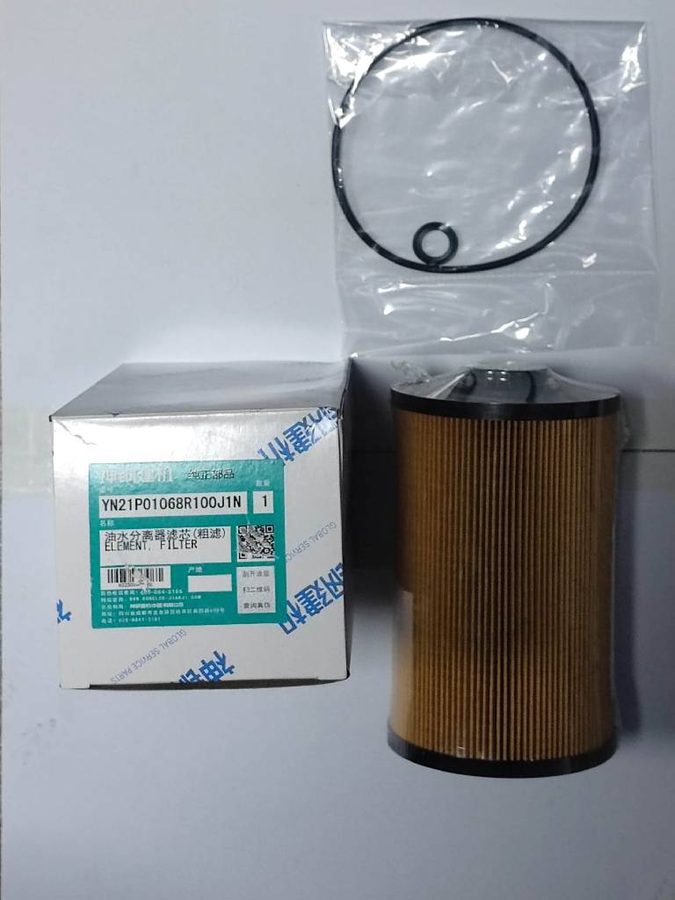
The parts book - the catalog - exists to turn a position on the machine into a part number and a quantity. It is organized by assembly group, figure and parts list, and it carries the per-unit counts; our index and figure reading guide walks that structure and the quantity column guide covers the counts. What the parts book does not carry is torque values, procedures or pressures - a buyer who wants to know how tight, how much or in what order is asking the wrong book. The boxed fuel water separator element YN21P01068R100J1N in our records is the end product of a parts book used correctly: one label, one full number, no ambiguity.
The workshop manual answers: how and to what spec
The workshop manual is the procedures document: disassembly order, torque specifications, pressure settings, clearances, special tools. It is written for trained technicians, and the numbers in it are the machine manufacturer's authority - when a rebuild needs a tightening specification, the manual, not memory or a forum, is the source. Kobelco publishes machine documentation through Kobelco Japan, and the manual's serial applicability matters as much as the parts book's, because procedures changed across generations too. What the workshop manual deliberately does not do is sell: it identifies the assembly, and the numbers still come from the parts book.
The one-line rule: the parts book says what; the workshop manual says how; the operator manual says when. An order that starts from the wrong document produces the right-looking part that does not fit, the right part fitted wrong, or the right fitting done too late.
The operator manual answers: when and how often
The operator manual is the interval document - daily checks, service intervals, fluid specifications, the safety routines. It is the source for what the machine needs on a schedule: the fuel water separator element YN21P01068R100J1N / YN21P01068R100J1L in our records, the air cleaner element YN11P00034R100, the return filter element YN52V01025R110 / YN52V01025R100 - interval items like these are scheduled in the operator manual, identified in the parts book, and replaced per the workshop manual where procedures apply. Three documents, one consumable, and the buyer who knows which document to open at each step orders cleanly. Our SK-8 service points guide turns that interval side into a practical list.
Where all three documents stop
The documents share two blind spots. First, they describe the machine as built - running changes and supersessions move the numbers after the book is printed, which is why our supersession guide exists. Second, they do not state grades or prices: genuine, OEM and aftermarket are supply decisions, not document content. That gap is where a supplier earns its place. Guangzhou Shenyue Machinery Technology Co., Ltd. quotes from live records checked against the serial, holds 3,000+ part types on the shelf and 100,000+ part numbers available to order, has done this since 2007, and sells to buyers in 30+ countries. For mixed fleets of other makes, the same document discipline applies and the wider cross-brand line sits on corbayparts.com; the Kobelco-depth records stay here.
Using the documents on an order
The sequence that works: start at the machine with the nameplate cross-reference, find the assembly in the parts book, write down the number and the quantity, and send both to the quote - the manual stays on the shelf until the part arrives and the procedure begins. If a number cannot be read or confirmed, our part number search page accepts the model and what is known, and the casting number closes the rest. Guangzhou Shenyue Machinery Technology Co., Ltd. is an independent supplier, not affiliated with and not authorized by Kobelco Construction Machinery Co., Ltd., and every quote line states genuine, OEM or aftermarket.
Frequently Asked Questions
What is the difference between a Kobelco parts book and a workshop manual?
The parts book turns a machine position into a part number and quantity; the workshop manual carries the procedures, torque values and pressure settings. One says what, the other says how. Neither replaces the other, and Guangzhou Shenyue Machinery Technology Co., Ltd. quotes parts from the parts book side while the manual stays the authority for fitting.
Where do service intervals come from - the parts book or another document?
From the operator manual. It carries the daily checks and the service schedule, which identify interval items such as the fuel water separator element YN21P01068R100J1N, the air element YN11P00034R100 and the return filter element YN52V01025R110 in our records. The parts book then supplies the numbers, and the workshop manual covers any procedures.
Why did I order the number in my parts book and receive a part that does not fit?
Because the book describes the machine as built, and running changes move numbers after printing - serial break points and supersessions decide the current number. Send the machine serial with the book number and Guangzhou Shenyue Machinery Technology Co., Ltd. checks both against live records before quoting, so the printed number and the fitted part agree.
Do I need all three documents to order parts correctly?
You need the parts book, realistically, and the nameplate serial. The operator manual helps you plan intervals, and the workshop manual matters when the part arrives. Guangzhou Shenyue Machinery Technology Co., Ltd. has worked from these documents since 2007, holds 3,000+ part types on the shelf and 100,000+ part numbers available to order, and states genuine, OEM or aftermarket on every quote line.