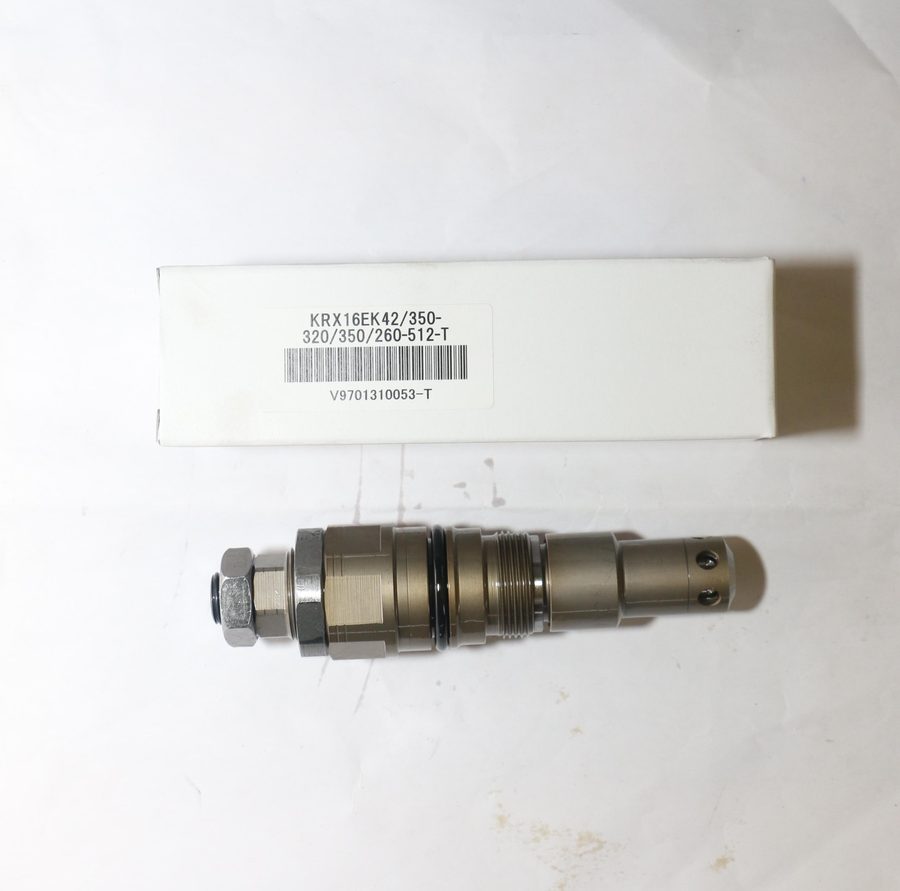
Pressure protection is the least glamorous part of a Kobelco hydraulic system and the one that decides whether a boom stays up when a hose fails. It arrives in layers, each with its own part number, its own symptom and its own failure mode, and buyers who treat it as a single "relief valve" usually end up replacing the wrong layer first. Guangzhou Shenyue Machinery Technology Co., Ltd. supplies these parts daily, so here is what each layer does and how to tell them apart.
The four layers of pressure protection
The main relief valve caps system pressure. Port relief valves cap the pressure in a single circuit — boom, arm or bucket — and let that circuit protect itself without dropping the whole system. Check valves stop flow from reversing, which is what holds a raised boom and what stops the machine sinking on a slope. The safety lock circuit sits over the top of all of it and electrically isolates the pilot signal so the machine cannot be operated from the seat with the lever locked.
Each layer fails differently, and that is the useful part. A tired main relief valve shows as low power across every function and heat in the oil. A port relief fault shows on one function only. A leaking check valve shows as a boom that creeps down under load. A safety lock fault shows as a machine that does not respond at all, yet starts and runs perfectly.
What the numbers look like
Relief valve numbers in our records often carry two or three markings for the same assembly, which is normal and does not mean there is a choice to make.
| Layer | Function it protects | Numbers quoted in our records |
|---|---|---|
| Main relief valve | Whole system pressure | V9510318049-T / LP22V00001F1 / YN22V00004F1; YN22V00001F4 / LC22V00011F1 / V9701310053-T |
| Solenoid relief valve | Spare / switched relief position | YN22V00035F1 |
| Check valve | Stops reverse flow and holds a raised load | YN21V00025P1 |
| Travel motor relief | Pressure spikes at the travel motor | C2259321450501 / LC22V00006F1 |
| Pressure sensors | Feeds the monitor and fault logic | LC52S00019P1 / YW52S00002P1 / LC52S00011P1 (low), LC52S00012P1 and LS52S00015P1 (high), LS52S00046P1 (oil temperature) |
Note the last row. Sensors are not protection, they are evidence, and they are frequently replaced when the actual fault is a relief valve setting out of specification. Replacing a sensor because the monitor shows a pressure alarm is treating the messenger.
Symptoms mapped to the layer
Low power on every function, with oil temperature climbing faster than the ambient conditions explain, points at the main relief valve or at pump output — and the two are separated by measuring pressure at the pump outlet against the specification. Low power on one function only, in one direction only, points at a port relief or the circuit's own overload protection. A boom or arm that holds when warm and creeps down when hot points at a check valve or a cylinder seal, and the pair is separated by isolating the cylinder: if it still creeps with the cylinder closed off, the fault is in the valve.
On the travel side, a machine that jerks when starting or stopping, or that overspeeds downhill, usually has a travel motor relief or brake circuit issue rather than a pump issue. Our records quote the travel motor relief as C2259321450501 / LC22V00006F1, and alongside it the internal rotating group parts that are often found worn when that relief is opened: the travel motor block C2162221251701 / LC15V00023S040, the ball guide C2162420488601 / LC15V00023S042 and the swash plate C2162122059801.
What a safety lock fault actually looks like
The safety lock is where electrical and hydraulic faults meet. The engine starts, the display comes up, the gauges read normally, and nothing moves. Because the symptom is so dramatic, the lock valve and its solenoid are usually blamed first, and just as often the fault turns out to be a blown fuse, a corroded connector or a failed pressure sensor that the controller needs to enable the circuit. Check the fuse and the connector before condemning the valve, and check the wiring harness and fuse guide for the common corrosion points.
If you need the valve itself, quote the full string from the parts book — machine designation, serial, section, figure and key number — or the number cast on the valve body, and check it against the hydraulic components range. For machines in the SK200 class the SK200 model page is the fastest route to the right section, and for anything unresolved the contact page reaches the team that will read the plate photographs. Pressure-protection principles behind these circuits are described by Kobelco Construction Machinery, and Guangzhou Shenyue Machinery Technology Co., Ltd. resolves the specific valve for your serial range from the plates you send.
Frequently Asked Questions
How do I know whether my Kobelco main relief valve or my pump is weak?
By measuring pressure at the pump outlet against specification and comparing it with the relief valve setting. A pump that is down on flow shows low power with slow, soft movements, while a relief valve that opens early caps pressure cleanly and evenly across every function. The pressure reading separates the two before any part is ordered.
Can I replace a relief valve cartridge only, instead of the whole assembly?
Sometimes. Our records show several markings for what is the same assembly — for example V9510318049-T / LP22V00001F1 / YN22V00004F1 and YN22V00001F4 / LC22V00011F1 / V9701310053-T for main relief valves. Whether a cartridge or the complete valve is the right purchase depends on the internal condition, so send the number on the valve body and the pressure readings.
My Kobelco starts and runs but nothing moves. Is the safety lock valve faulty?
Not necessarily. The safety lock circuit is a common cause, but a blown fuse, a corroded connector or a failed pressure sensor produces the same symptom because the controller will not enable the circuit without valid inputs. Check the fuse and connector first, then the lock solenoid, then the valve itself — the valve is usually the last item that is actually at fault.
What should I include with a relief valve order?
The machine designation and serial, the section, figure and key number from the parts book, the number cast on the valve body, and the measured pressure at the affected port. Guangzhou Shenyue Machinery Technology Co., Ltd. checks the markings, flags any supersession and declares each line genuine, OEM or aftermarket before quoting.