Two Kobelco machines of the same model can need completely different undercarriage work at the same hour reading, because they are not running the same kind of track chain. Dry, sealed and lubricated chains wear in different places, fail for different reasons and reward different repairs. Buying a chain without knowing which one came off the machine is how operators reline an undercarriage that only needed bushings turned. Guangzhou Shenyue Machinery Technology Co., Ltd. quotes undercarriage parts every week, and this is what we sort out first.
Three kinds of track chain
A dry chain runs pin and bushing metal to metal with no seal and no lubricant. It is cheap, tolerant of mud, and wears internally and fast, which shows as elongation. A sealed chain holds grease in the joint so the internal surfaces do not wear, and its life moves outward to the bushing's outside diameter and the sprocket. A lubricated chain goes further, with oil held in the pin and fed to the joint; it lasts longest and is the most sensitive to seal damage.
The consequence is that a sealed or lubricated chain usually dies from external wear while a dry chain dies from internal wear, and those two deaths call for different parts. Order bushings for a machine that has actually worn its sprocket teeth and nothing improves.
Where each type wears, and how to measure it
Four measurements give the whole picture. Pitch over four or five links shows internal wear: a dry chain stretched past the limit will not sit correctly on a new sprocket. Bushing outside diameter shows external wear and predicts sprocket life. Link height shows rail wear, which is what eventually cracks a link. Sprocket tooth thickness shows whether chain and sprocket are still matched. Take each reading at three places around the loop, because one reading on the tightest span flatters a worn chain.
| Chain type | Wears first | What the measurement shows | Right repair |
|---|---|---|---|
| Dry | Pin and bushing joint | Pitch growth, slack that will not adjust out | Turn pins and bushings, or reline |
| Sealed | Bushing OD and sprocket teeth | Bushing diameter below limit, hooked teeth | Bushings and sprocket segments |
| Lubricated | Seals, then bushing OD | Oil weeping at the joint, then diameter loss | Seal and bushing set, check pin bores |
Turning pins and bushings: the economics
On a dry chain the pin wears on one side and the bushing on the other, both on the same arc. Turning each through 180 degrees presents unworn metal to the load, and a chain at its limit can run another share of its life for the cost of labour, a master link and seals. That is the largest saving in undercarriage work, and it is only available while the links are sound.
Sealed and lubricated chains can be turned too, but the arithmetic differs: every joint opened needs new seals, and a seal not seated correctly turns a long-life chain into a dry one within a few hundred hours. Without clean conditions, turning a sealed chain is a false economy.
When turning is the wrong answer
Three situations rule it out. A sprocket already hooked or pointed destroys the new surface within weeks, so it is replaced at the same time. A chain with cracked or heavily fretted links will not hold the new pin, because a pin pressed into a worn bore makes a loose joint that fails early. And a machine in abrasive slurry wears the bushing OD faster than the joint, so turning addresses the wrong surface.
The parts around the chain
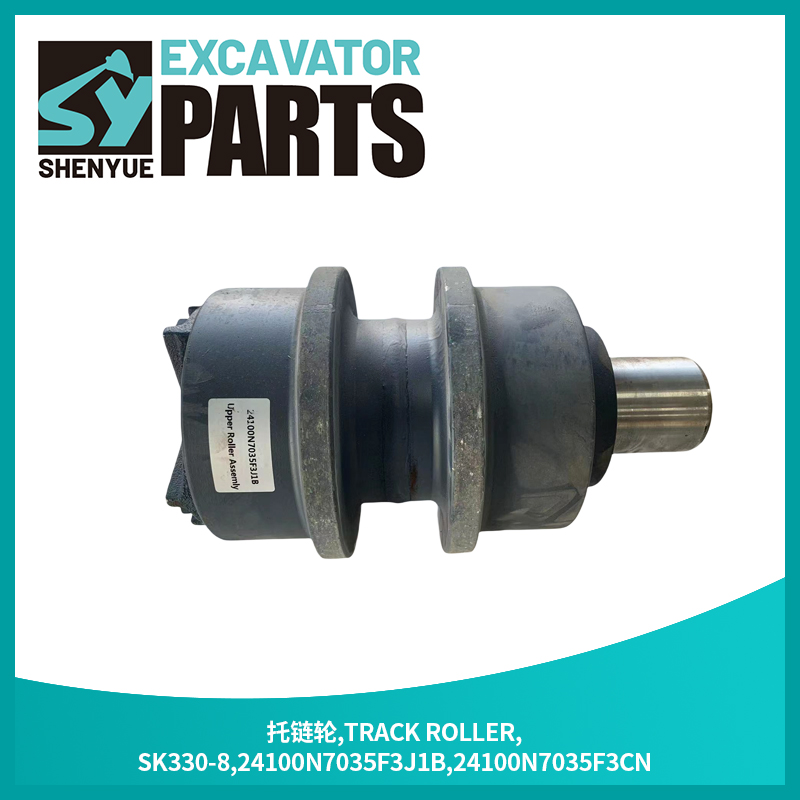
A chain job is never only a chain. Rollers, idlers and carrier rollers sit on the same worn rails and should be measured in the same session; a track roller such as 24100N7035F3J1B is read off the casting, and an idler shaft such as VA32F2303402 is quoted by its own number. Track tension hardware fails quietly too: a recoil spring that has taken a set, or a tension cylinder whose seal weeps, will let a new chain run slack and wear early.
Our track chain measurement guide covers the numbers in detail and the undercarriage part number guide explains how roller, idler and shoe numbers are structured. The undercarriage and cylinders range lists what we hold. Guangzhou Shenyue Machinery Technology Co., Ltd. keeps three thousand part types on the shelf and can order over one hundred thousand part numbers through original channels, and we will say plainly when a turn beats a reline.
Send chain type, the four measurements and the machine serial through the contact page, and the quotation returns itemised with genuine, OEM and aftermarket options side by side. Kobelco's undercarriage service limits are published in its service literature at kobelco.co.jp, and those figures are what to measure against rather than a general rule of thumb.
Frequently Asked Questions
How do I tell whether my Kobelco has a sealed or dry track chain?
Look at the joint between pin and bushing: a sealed chain has a visible seal ring and usually a grease reservoir at the link and does not weep, while a dry chain shows bare metal and rust staining. The chain markings and the machine parts book settle it, and the nameplate is the authority when plate and model year disagree.
How much life does turning pins and bushings add?
On a structurally sound dry chain, turning typically restores a large part of the original joint life at a fraction of reline cost, because unworn surfaces are presented to the load. The gain depends on how far the chain has worn and whether the sprocket is serviceable.
Can I turn the pins on a sealed track chain?
It is possible but rarely economic. Every joint opened needs new seals, and a seal installed in dirty conditions or seated badly turns a long-life chain into a dry one within a few hundred hours. Guangzhou Shenyue Machinery Technology Co., Ltd. recommends it only when the chain is otherwise sound and the work can be done cleanly.
Why does a new track chain wear out quickly after fitting?
Almost always because the sprocket was left in service with hooked or pointed teeth, or tension was set with a failing recoil spring or weeping tension cylinder. A new chain against a worn sprocket matches badly from the first hour.