Thread damage is the least glamorous repair in the workshop and the one most often made worse. A stud snaps flush, an easy-out breaks inside it, a drill wanders into a water jacket, and a two-hour job becomes a cylinder head. The difference between a repair that holds and one that comes back is almost never skill with a drill — it is choosing the right option before the first tool is picked up. Guangzhou Shenyue Machinery Technology Co., Ltd. supplies the fasteners that go back in through the engine parts range, and the numbers matter as much as the method.
Where threads fail on a Kobelco
| Location | Typical fastener | Why it fails |
|---|---|---|
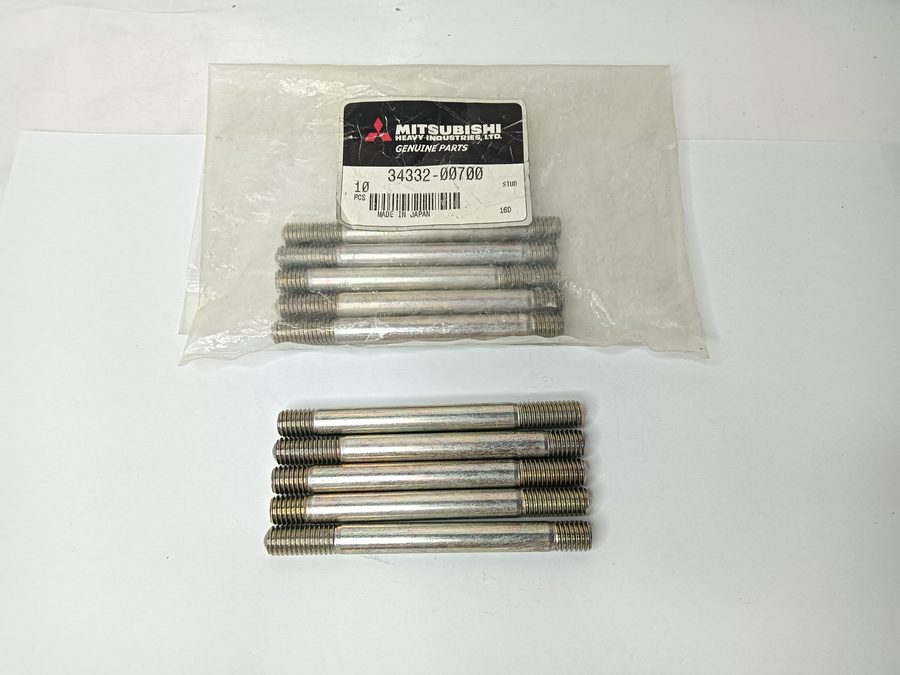
| Exhaust manifold to head | Stud VA3433200700 | Heat cycling, corrosion, galled threads |
| Turbocharger mounting | Bolt VA3433200301 | Heat, vibration, repeated removal |
| Cylinder head | Bolt VHS111852460 | Torque-to-yield stretch, reused bolts, dirty threads |
| Connecting rod | Bolt VA32F1900300 / VAME012232 | Reuse beyond specification, stretch, fretting |
| Bearing cap and seat | Bolt VHS115211261 | Over-torque, thread damage from previous repair |
The pattern is consistent: the hot side corrodes, the highly loaded side stretches, and both are usually damaged by a previous repair rather than by the machine.
Four options and when each is right
Chase the thread. If more than about two-thirds of the thread depth is intact and the thread form is continuous, run a correct-size tap or thread chaser down it, clean with solvent and compressed air, and fit a new fastener. This is the only option that keeps the original clamp load and costs almost nothing. It is also the option most often skipped in favour of an insert that was never needed.
Thread insert. A wire or solid insert restores the original thread size in a hole that has lost its form. It is the right answer for a pulled thread in cast iron where the surrounding material is sound and there is enough wall thickness. Fit it square, break the tang cleanly on a wire insert, and torque to the original specification — a correctly installed insert carries the same load as the original thread.
Weld and re-drill. Filling a ruined hole and starting again is legitimate on a thick casting and risky on a thin one, because welding changes the local metallurgy and can distort a machined face. On anything with a gasket surface nearby, expect to re-face afterwards.
Replace the component. When a thread is in a housing that also carries a bearing bore, a gasket face or a press fit, repair economics turn quickly. A manifold or a cover is cheap compared with a second failure.
Getting a broken stud out without making it worse
Penetrant first, then heat — and heat means a proper oxy-fuel tip on the casting around the stud, not a heat gun on the stud itself. Let it cool, try again, and repeat. A left-hand drill bit on a centre-punched stud recovers a surprising number of them before any extractor is needed. If an extractor is used, drill the pilot hole deep enough that the extractor engages on its full length, and stop turning the moment it starts to cam out. A snapped extractor turns a repair into a machining job.
Never drill a blind hole deeper than the original thread. Behind many blind holes sits a water jacket, an oil gallery or a pushrod cavity, and the drill exits into it without warning.
Torque discipline after the repair
Thread condition changes clamp load more than most people expect. A lubricated thread reaches a given preload at a lower torque than a dry one, and a thread that has been chased and cleaned behaves differently from one that has not. Follow the manual's stated condition, use a calibrated torque wrench, and tighten in the specified sequence — our fastener and torque guide covers the numbering side. Torque-to-yield bolts such as cylinder head bolts and many connecting rod bolts are single-use: they are tightened to an angle past yield, and a reused bolt has already lost the property that made it work. Replace them, and replace the rod bolts whenever the rod is opened.
Send the number with the photo. A broken stud photographed beside a rule, with the model and serial, is enough for Guangzhou Shenyue Machinery Technology Co., Ltd. to identify the correct replacement through part number search and confirm whether the joint uses a single-use bolt. The 3,000+ part types on the shelf and 100,000+ part numbers available to order include the fastener families above.
What to write on the job card
Record the repair method, the insert size if one was fitted, the torque used and the thread condition. The next technician — or the next owner — needs to know that one hole in that manifold is no longer original. Kobelco's published service data at kobelco.co.jp gives the specified figures; a generic torque chart from a forum does not, and the difference is a stretched bolt or a cracked casting.
Frequently Asked Questions
Can a stripped thread in a cast iron housing be repaired?
Usually yes, with a thread insert, provided the surrounding material is sound and there is enough wall thickness. Chase first to see how much thread remains; if more than two-thirds is intact, a chase and a new fastener is the better repair.
Should I reuse cylinder head bolts on a Kobelco?
No. Bolts such as VHS111852460 are torque-to-yield and are tightened past yield, so a reused bolt no longer clamps correctly. Replace them, clean the threads, and follow the manual's sequence and stages.
How do I remove a broken exhaust stud without damaging the head?
Penetrant, then heat on the casting around the stud rather than on the stud, then a left-hand drill bit on a centre punch mark. Use an extractor only after a full-depth pilot hole, and stop if it cams out. Never drill deeper than the original thread.
Why do bolts in blind holes crack the casting?
A bolt that is too long bottoms out and hydraulic-locks on trapped oil or air, and the pressure cracks the casting as the bolt is tightened. Check bolt length against hole depth, and never substitute a longer bolt because it is what the shelf had. Guangzhou Shenyue Machinery Technology Co., Ltd. confirms length and grade against the part number.