Track tension is the one undercarriage setting every crew can check without tools, and the one most crews check last. On a Kobelco SK machine, tension that drifts too loose puts the chain on the ground at the front idler; tension set too tight loads every roller, pin and bushing on the machine at once. The technical desk at Guangzhou Shenyue Machinery Technology Co., Ltd. hears the same story every season: a machine that threw a track, an adjuster that will not hold grease, and a schedule nobody planned for. This guide walks the system in the order it should be diagnosed.
What correct tension looks like
Tension is set by sag, not by feel. Lift the chain clear of the ground, measure the droop at the mid-span between the front idler and the sprocket — or between rollers, on machines whose manual says so — and compare it with the figure for your model and ground condition. Mud needs a looser setting than rock; the manual's table is the authority, and Kobelco publishes the procedure in its operation and maintenance documentation. Write the measurement down every service. A number that keeps growing between greases is a diagnosis, not a chore.
The adjuster: a grease cylinder doing a hydraulic job
The track adjuster is a small grease cylinder at the front of the track frame. Pumping grease through its valve extends the yoke and pushes the front idler forward, taking up chain slack. Because grease does not compress, the cylinder holds position under load — and the recoil spring behind it absorbs the shocks that grease alone could not survive. Two failure modes matter:
- Slack grows and greasing will not hold. The cylinder is leaking down internally or the valve is weeping. Grease it to spec, run the machine, and measure again the same day — a setting that decays within hours condemns the seals.
- The adjuster is fully extended and the chain is still loose. The chain has worn past its pitch limit. More grease cannot fix elongation; this is a chain and sprocket decision, not a tension decision.
Recoil springs: respect and diagnosis
The recoil spring sits behind the yoke, preloaded to push the idler back when the chain runs over a rock. It fails in two ways: the yoke stops returning after impact (a broken or settled spring stack), or the track sits visibly forward in the frame. Both are undercarriage teardown items.
When the chain comes off: derail diagnosis
| Symptom | Most likely cause | Check order |
|---|---|---|
| Track throws at the front idler on turns | Tension too loose, or worn idler flanges | Sag measurement, then idler flange wear |
| Track throws over the sprocket under load | Chain pitch elongation, worn sprocket teeth | Pitch measurement, tooth profile photographs |
| Slack that returns every few days | Adjuster cylinder leak-down | Grease to spec, re-measure same day |
| Track visible forward in the frame | Recoil spring settled or broken | Frame inspection at the recoil housing |
Work the table in order before ordering parts — a derailment caused by pitch elongation will come straight back if you only renew the idler.
What we quote against an adjuster job
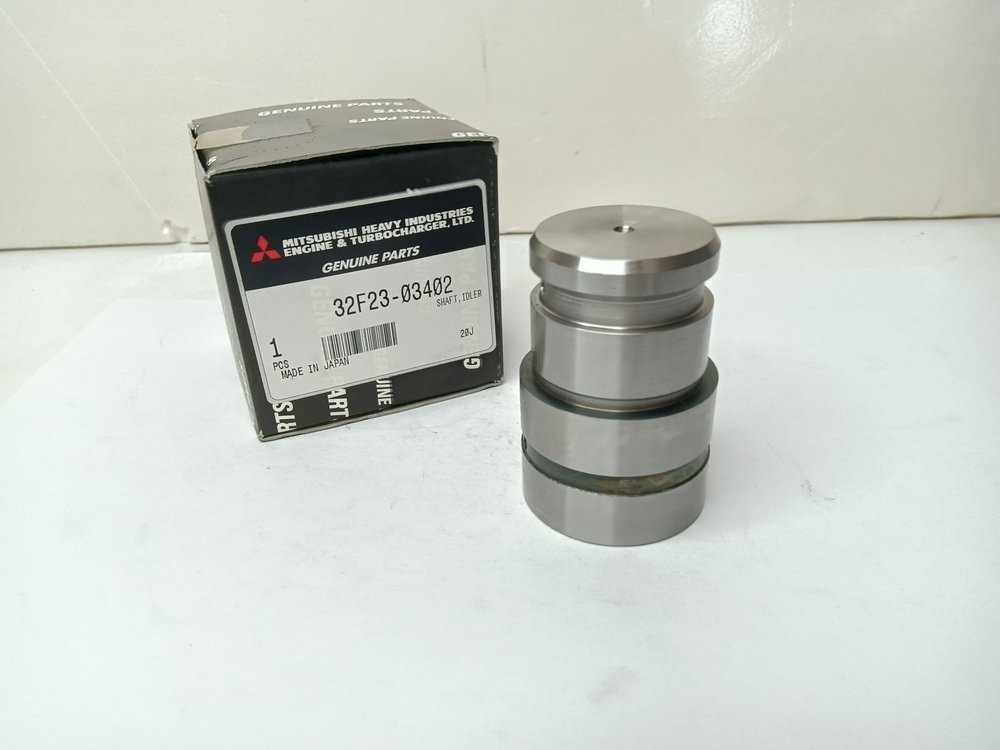
A tension-side repair usually touches the front idler, its shaft, and the adjuster or recoil group. The idler shaft quoted as VA32F2303402 is a stocked example from our shelf — genuine-boxed, the pivot the adjuster pushes against, and a part that should always be inspected for scoring whenever the idler comes out. Adjuster and recoil assemblies quote per machine class: send the serial number and a photograph of the group in the frame, and Guangzhou Shenyue Machinery Technology Co., Ltd. will confirm the assembly number rather than guessing from the model badge, because revisions differ within the same model family.
Prevention cheaper than repair
Check sag every 250 hours, after any impact event, and whenever the machine changes ground type. Grease through the adjuster valve with the chain lifted, never to rock-hard tension, and never from the top of the range. Undercarriage is the largest consumable on the machine; tension is the cheapest lever you have over its life. The full component map behind the adjuster — chain, sprockets, rollers and idlers — is set out in our track frame and rollers guide, the stockable items sit on the undercarriage and cylinders category page, and if you only have a worn part and a machine badge, start from the part number search and let the serial number finish the match.
Frequently Asked Questions
How do I check track tension on a Kobelco SK excavator?
Lift the chain clear of the ground and measure the sag at mid-span, then compare it with your model's manual figure — mud runs looser than rock. Guangzhou Shenyue Machinery Technology Co., Ltd. recommends recording the measurement every 250 hours so drift becomes visible before a derailment.
Why will my track adjuster not hold tension?
A setting that decays within hours or days means the grease cylinder is leaking down internally or the valve is weeping. Re-grease to spec and re-measure the same day; if slack returns, quote the adjuster assembly through Guangzhou Shenyue Machinery Technology Co., Ltd. with the machine serial number.
Can I disassemble the recoil spring myself?
No. The recoil spring is preloaded and releases dangerous energy if opened without press tooling and the manual procedure. Send photographs and the assembly number to Guangzhou Shenyue Machinery Technology Co., Ltd. and quote the complete group instead of opening it in the yard.
What is part VA32F2303402?
It is the front idler shaft we stock — genuine-boxed, the pivot the track adjuster pushes against. Guangzhou Shenyue Machinery Technology Co., Ltd. supplies it with the idler renewed or as a separate line, confirmed against your machine serial before dispatch.