Most operators treat the work mode selector as a fuel setting: heavy work, standard work, economy, and a button that drops the engine to idle when the machine is waiting. That description is close enough to be useful and wrong enough to cost money. On a Kobelco, a work mode is a paired command. The controller picks an engine speed target and, at the same time, a current for the pump regulator, which sets how much oil the pump displaces per revolution. Change the mode and both change. Guangzhou Shenyue Machinery Technology Co., Ltd. sees the results of that pairing in two directions: machines running economy mode in heavy digging and overheating, and machines running full power on light work and burning fuel for nothing.
Two dials, one decision
Hydraulic power is pressure multiplied by flow, and flow is engine speed multiplied by pump displacement. The controller cannot create power; it can only choose where on that map the machine operates. A high-power mode raises the engine speed target and holds pump displacement high, so the machine is fast, strong and thirsty. An economy mode lowers the speed target and trims displacement, so the same cylinder moves more slowly on less fuel. An attachment mode fixes flow and holds engine speed steady, because a breaker wants constant oil, not maximum oil.
The letters differ between series and markets, and some panels show an icon instead. Read the panel on the machine in front of you instead of assuming that H on one series means the same as H on another.
Where economy mode quietly costs money
Economy mode is efficient only while the load is light. Digging hard clay or lifting a loaded bucket at reduced flow opens the relief valve earlier and more often, and every litre that goes over the relief becomes heat instead of work. Hydraulic oil temperature climbs through the shift, the machine feels lazy at the end of the stroke, cycle time stretches, and fuel consumption barely improves because the engine is still working against a stalled pump. The cheap fix is the correct mode, not a new pump.
Where full power quietly costs money
The opposite mistake costs less per hour and more per year. Grading, trenching and truck loading rarely need maximum flow. Running full power for them raises fuel burn, oil temperature, noise and wear on every component in the circuit, and the operator gains nothing because the work is limited by the bucket, not by the pump.
| Task | Sensible mode | Reason |
|---|---|---|
| Mass excavation, rock bucket, hard digging | High power | Flow demand is continuous; economy mode would relieve oil and make heat |
| Trenching, grading, precision work | Standard or economy | Work is limited by control, not by flow |
| Breaker, compactor, auger | Attachment mode | Constant flow protects the attachment; speed changes do nothing useful |
| Waiting, talking, loading a truck by hand | Auto-idle or one-touch idle | Idle burns fuel and glazes cylinders for no output |
Auto-idle is not the same as shutting down
Auto-idle drops engine speed after a few seconds without a control input; one-touch idle does it on demand from a button or the safety lever. Both cut fuel and noise, neither stops the machine, and neither replaces a proper cool-down. A turbo shut down hot cooks its oil in the bearing housing, which is why the last two minutes of a shift should be idle, not a key-off.
When it is not the mode at all
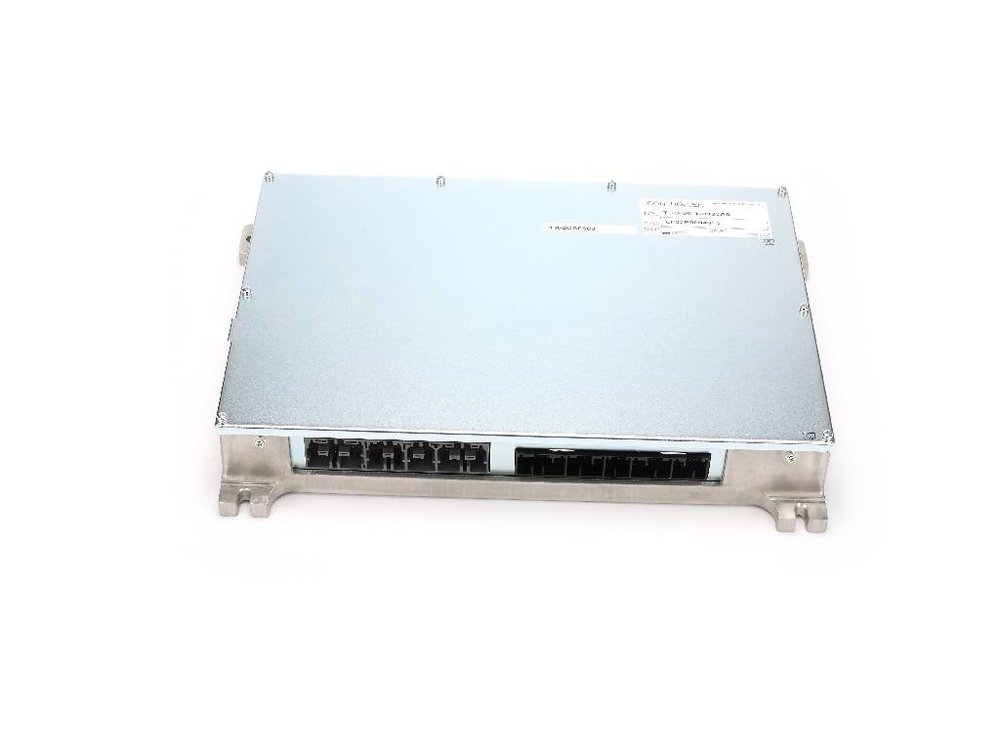
A machine that is strong in one mode and weak in another is usually telling you about the control side, not the mechanical side. If the engine reaches its target speed and the pump still will not deliver, look at the regulator and the signal that drives it: a sticking regulator, a failing solenoid or a negative-control pressure that never reaches spec all feel like a mode problem. Guangzhou Shenyue Machinery Technology Co., Ltd. records the SK200-8 pump assembly as 2924610-0030 or YN10V00005S156 and the regulator as 29070821-4927 or YN10V01006F2; the ECU that commands them appears as YN22E00193F5. Confirm any of these against the serial before ordering.
Ten minutes of measurement beats an hour of opinion. Record engine speed at full throttle in each mode, cycle time for one standard dig-and-dump, and hydraulic oil temperature at the start and end of the test. Guangzhou Shenyue Machinery Technology Co., Ltd. uses those three numbers plus the regulator part number to decide whether a weak machine needs a control part or a pump overhaul.
What to write down before you call
Note the panel layout, which mode the operator actually uses, whether auto-idle is enabled, and whether the weakness follows the mode or the function. A machine slow in every mode on every function has a different problem from one that is slow only when travelling. Then read the negative control and standby pressure guide, check the pump and regulator number guide, and browse the hydraulic components page for what is stocked. Kobelco's published model information at kobelco.co.jp is the reference for mode naming by series.
Frequently Asked Questions
Does economy mode actually save fuel on a Kobelco?
It saves fuel when the load is light and costs fuel when the load is heavy. In hard digging, reduced flow opens the relief valve early, so oil is converted to heat rather than work while the engine still burns fuel. Match the mode to the task: economy for grading and trenching, high power for mass excavation.
What is the difference between auto-idle and one-touch idle?
Auto-idle drops engine speed automatically after a few seconds with no control input. One-touch idle does the same on demand, usually from a button or the safety lever. Both reduce fuel and noise while the machine waits. Neither replaces a two-minute idle cool-down before shutdown, which protects the turbo bearing.
My Kobelco is weak in high power mode but normal in standard mode. Is the pump failing?
Not necessarily. If engine speed reaches target and flow still falls short, the fault is usually on the control side: a sticking regulator, a failed solenoid or negative-control pressure below specification. Test pressure before replacing a pump. Guangzhou Shenyue Machinery Technology Co., Ltd. quotes regulator 29070821-4927 or YN10V01006F2 for the SK200-8 after serial confirmation.
Which mode should I use with a breaker or auger?
Use the attachment mode where the machine has one, because it holds a steady flow and engine speed, which is what a breaker or auger wants. Running a breaker in high power mode adds flow the attachment cannot use and heats the oil. Confirm the attachment's flow and pressure requirement before setting the mode.