Every Kobelco operator knows the sound of a machine whose front end is being abused: a hard clunk as the boom lands or the arm reaches the end of its stroke. Sometimes that bang is the stop block doing its job. Sometimes it is the cushion valve that should have softened the last few degrees of travel, and no longer is. We have covered the mechanical side in our guide to stop blocks and end-of-stroke impact; this page covers the hydraulic side. Guangzhou Shenyue Machinery Technology Co., Ltd. supplies the valves and the surrounding parts behind both causes, and this guide explains how to tell them apart before you order anything.
What a cushion valve actually does
A cushion valve sits at the port end of a boom or arm cylinder and meters the oil leaving the cylinder during the last part of the stroke. As the piston nears the end, the normal outlet path closes and flow is forced through a controlled orifice, so the load decelerates gently instead of arriving metal on metal. On Kobelco machines the cushion function is usually built into the main control valve section or into a cartridge at the cylinder port, depending on the model and generation, which is exactly why identification matters.
How the failure looks from the cab
A failing cushion usually announces itself gradually. The boom that used to settle softly onto the ground now lands with a knock; the arm stops at full reach with a visible jolt. Cycle after cycle that impact travels into the rod, the gland, the pins and the structure behind them, which is why a worn cushion is a structural problem wearing a hydraulic disguise. The reverse symptom, boom or arm drifting down while parked, points instead at the hold valve or the cylinder seals, not the cushion, and the two should not be confused.
Telling cushion from relief from stop block
Start mechanical. Inspect the stop blocks and measure the pad against the manual for the serial, because a worn block changes the geometry the cushion was calibrated for. Then look at when the bang happens: a stop-block problem bangs at exactly full stroke with the machine parked position identical every time, while a cushion problem can knock under load mid-slowdown as well. Finally, if both check out, the system relief pressure must be verified with gauges, never adjusted by feel; our walkthrough of relief valves and safety circuits covers the valve side. The service manual for your serial is the only authority for settings.
| Symptom | Most likely cause | First check |
|---|---|---|
| Bang only at exact full stroke | Stop block worn or missing | Measure pad height and gap |
| Knock as the load decelerates | Cushion orifice or cartridge stuck | Inspect valve section, check for contamination |
| Bang plus slow cycles everywhere | Relief setting or pump issue | Gauge the main relief, compare to manual |
| Boom sinks while parked | Hold valve or cylinder seals | Isolate the cylinder before touching the valve |
Contamination is the usual killer
Cushion cartridges meter flow through a small, precise opening, so they fail the way precision parts always fail: something hard got there first. A collapsed hose, pump debris after a main relief valve V9510318049-T event, or metal from a failing travel motor relief C2259321450501 can all travel downstream into a valve section. When one cushion fails, clean the system and ask why, rather than fitting a new cartridge into dirty oil and watching it stick again within weeks.
Ordering a cushion valve the safe way
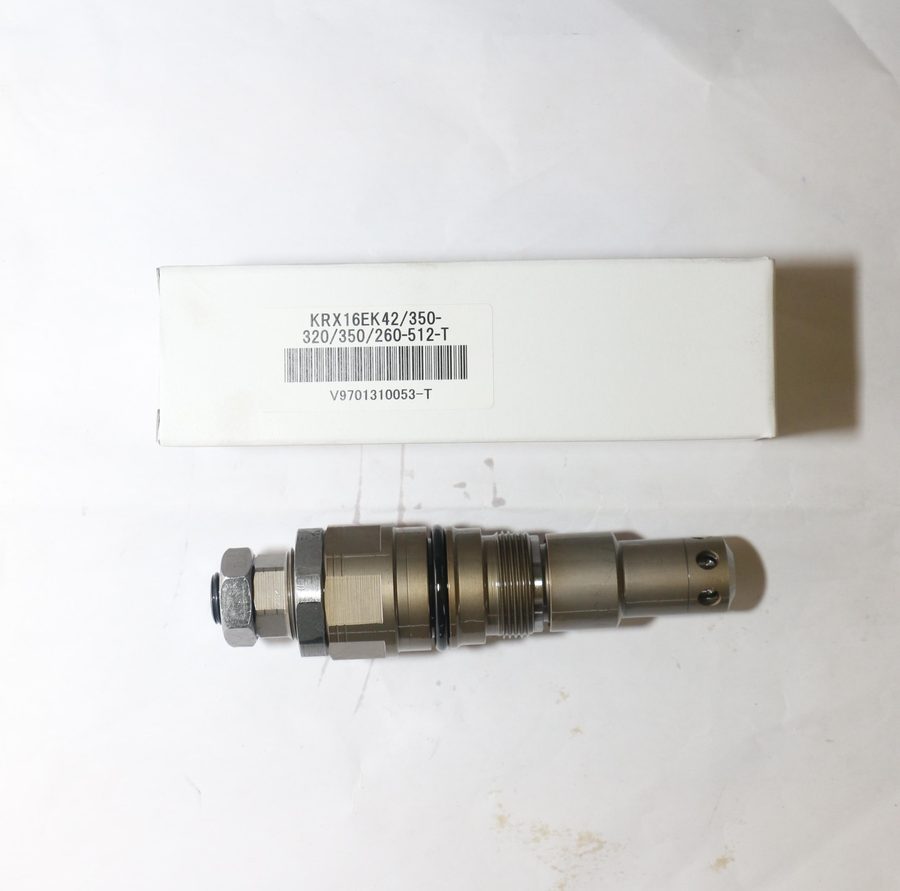
Cushion valves are commonly quoted Kobelco items that we source against the machine serial and, where possible, a photograph of the valve in place and the casting numbers on it. The nameplate is the authority: an SK200-8 and a SK210-8 can share most wear parts yet differ on valve detail. Guangzhou Shenyue Machinery Technology Co., Ltd. marks every item genuine, OEM or aftermarket at quotation, and supplies genuine parts through original channels alongside quality alternatives at distributor-level prices. Related valves we keep on the shelf include the main relief YN22V00001F4 with LC22V00011F1 and V9701310053-T markings, and the pilot inline filter YN50V00020F1 that protects the circuits feeding them.
Fix the cause, not just the noise
A cushion valve replacement quiets the machine, but the payoff only lasts if the contamination source is found and the stop geometry restored. Pair the valve work with a filter review and a fresh look at the front-end pins, and the next thousand hours should pass without a single hard landing.
Guangzhou Shenyue Machinery Technology Co., Ltd. has supplied Kobelco hydraulic parts to buyers in more than 30 markets since 2007. Our hydraulic components pages list the valve and cylinder families we keep moving, and model-level part context sits on the SK200 page. Readers who coordinate mixed-brand fleets will find the wider catalogue on corbayparts.com, our international export site, and Kobelco's own service network is described at kobelco.co.jp.
Frequently Asked Questions
What does a cushion valve do on a Kobelco boom cylinder?
It meters oil out of the cylinder during the final part of the stroke so the boom or arm decelerates softly instead of hitting the stop at full speed. Guangzhou Shenyue Machinery Technology Co., Ltd. supplies cushion valves matched to the machine serial.
Is a cushion valve the same as the main relief valve?
No. The main relief valve, such as V9510318049-T on many SK series machines, caps maximum system pressure. The cushion valve only controls deceleration at end of stroke. A machine can have a perfect relief setting and still bang at full stroke.
Why does my boom bang only under a heavy load?
Load raises the deceleration energy, so a slightly worn cushion that feels fine unloaded starts knocking when digging. Treat it as an early warning: inspect the valve cartridge and the stop blocks before the impact reaches the pins and the rod gland.
Can a cushion failure damage other parts?
Yes. The repeated end-of-stroke shock travels into the rod, the gland, the pins and the frame, and it accelerates wear everywhere the load lands. That is why Guangzhou Shenyue Machinery Technology Co., Ltd. recommends pairing valve work with a pin and bushing inspection.