An oil pressure lamp that flickers at hot idle sends most owners straight to a pump. On the Hino J05E fitted to the SK200-8 class, that is usually the wrong order of work: the sender, the switch, the relief valve and the pickup tube all fail more often than the pump, and each of them costs a fraction of the labour involved in changing one. This is the check sequence Guangzhou Shenyue Machinery Technology Co., Ltd. recommends before an oil pump is quoted.
First, prove the pressure is actually low
The dash gauge is a resistance signal, not a measurement. Fit a mechanical gauge into the main gallery, run the engine to operating temperature, and record pressure at hot idle and at rated speed. Only then do you have a number to compare with the workshop manual for your serial. A gauge that reads low while the mechanical gauge reads normal is a sender problem; a mechanical gauge that reads low is an engine problem, and the rest of this sequence applies.
The sender and the switch are two different parts
Most machines carry both: a variable-resistance sender driving the gauge, and a simple on/off switch driving the lamp. They fail independently and they are ordered independently. Fitting a switch when the gauge was lying, or a sender when the lamp was the only complaint, is the single most common wasted purchase on this circuit. Read the part number off the old component rather than the parts book illustration, because the two components often sit within 100 mm of each other on the same housing.
The check order that costs least first
- Oil level and grade. Overfilled, underfilled or the wrong viscosity all move the reading, and none of them need a part.
- Filter and bypass. A collapsed element or a bypass valve held open drops gallery pressure while the pump is healthy. Cut the old filter open.
- Suction side. A hardened or split O-ring at the pickup tube lets the pump draw air. Pressure falls furthest at high RPM, which is the opposite of a worn pump.
- Relief valve. A relief valve held off its seat by debris caps pressure at every speed. It is a small part and it is cheap to inspect.
- Pump. Only after the four above are cleared does the pump become the suspect.
- Bearing clearance. On a high-hour engine, pressure that is low everywhere with no external leak points to clearance at the mains and rods, not to the pump.
When the pump is the answer
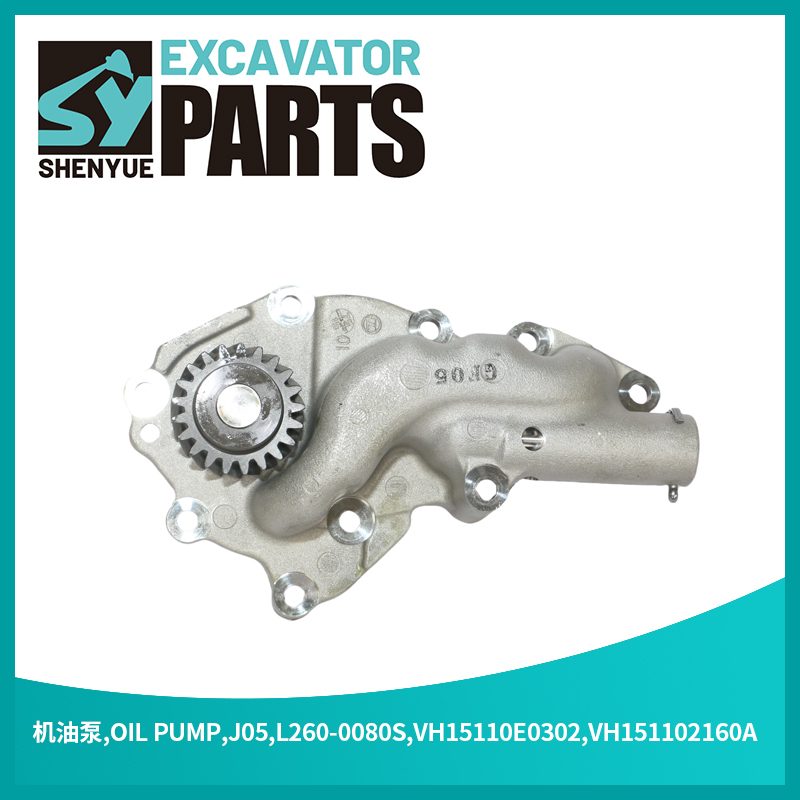
Our records quote the J05E oil pump as L260-0080S / VH15110E0302 / VH151102160A — three references for one assembly, so any of them will find it. Two symptoms justify replacement: pressure that falls steadily as oil temperature rises with everything upstream ruled out, and scoring or step wear on the gear faces visible once the pump is open. What does not justify replacement is a single low reading taken with a dash gauge on a cold engine.
Dilution, and the filter that saves the engine
Rising oil level with falling pressure is fuel dilution. A leaking injector seat or a failed copper washer puts diesel into the sump, the oil thins, and the gauge drops long before any metal wears. Oil analysis with a flash point test confirms it in a day, and it is cheaper than the bearings it protects. On any engine with a low-pressure complaint, sending a sample and cutting the filter open should happen in the same week as the gauge test, not after the repair.
What to send with the enquiry. Model, serial, engine family (J05E, J08E or P11C), the mechanical gauge readings hot and cold, and a photograph of the sender and switch as fitted. Send them through the contact page. Guangzhou Shenyue Machinery Technology Co., Ltd. quotes genuine, OEM and aftermarket options separately, so the decision between a sensor and a pump is made on price and lead time rather than on a guess. Engine parts across the Hino range are listed under our engine parts section and mirrored in the all-brand range at corbayparts.com.
What this sequence saves
Four of the six checks cost nothing but an hour and a gauge. The fifth costs a filter. Only the sixth involves a pump, and by then the evidence is on paper. Hino's own service publications at hino-global.com remain the authority for J05E figures, and Guangzhou Shenyue Machinery Technology Co., Ltd. quotes against the engine serial rather than the model name. On a machine that earns its keep by the hour, that order is worth more than any single part number in this article.
Frequently Asked Questions
Why does my Kobelco oil light flicker only at hot idle?
A hot-idle flicker usually means pressure is marginal at low speed rather than absent. Verify with a mechanical gauge at operating temperature, then check oil grade, filter bypass and the suction O-ring before suspecting the pump. A failing sender produces the same symptom at no cost to the engine.
What is the J05E oil pump part number?
Our records quote it as L260-0080S / VH15110E0302 / VH151102160A for the J05E. The three references identify the same assembly, so any of them will locate the part. Always confirm against the engine serial, because the J05E was built in several variants.
How do I tell a sender fault from real low pressure?
Fit a mechanical gauge in the main gallery and compare with the dash reading at hot idle and rated speed. If the mechanical gauge is normal, the sender or its wiring is at fault. If both read low, the engine has a real pressure problem and the relief valve, suction side and pump need checking in that order.
Does fuel dilution cause low oil pressure?
Yes. A leaking injector seat or failed copper washer raises the sump level with diesel, thins the oil and drops pressure long before wear appears. Oil analysis with a flash point test confirms dilution, and Guangzhou Shenyue Machinery Technology Co., Ltd. treats it as an engine-protection issue rather than a pump issue.