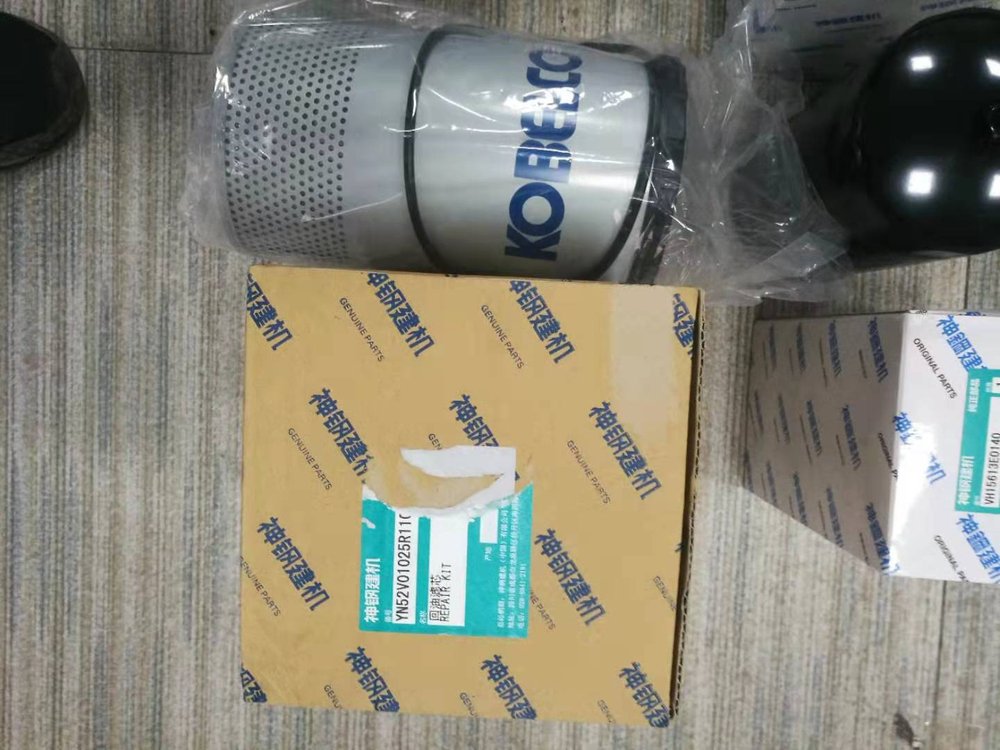
Companies that grow from one machine to a fleet across several countries meet the same problem in the second or third country: the machines are the same, but the parts lists are not. Each local supplier quotes their own equivalents, one site stocks a filter the other has never heard of, and the group office cannot compare costs because nothing is being compared like with like. Guangzhou Shenyue Machinery Technology Co., Ltd. ships Kobelco parts into multiple markets and has watched this problem build — and resolve — the same way each time.
Fix the numbers before you fix the suppliers
The standardisation job is a parts list job, not a purchasing job. For each machine, anchor the list to the serial number, not to the model name, because options and revisions follow the serial. A filter family is a good demonstration: our records carry the hydraulic return filters as YN52V01025R110 and YN52V01025R100 — the same element group with a packaging or revision difference. A fleet that fixes one number per line, with the related numbers recorded beside it, can buy in any country and still receive the same part.
Numbers that carry several identities need a decision recorded too. Bearings are the classic case: our records show PNUP309ET, 2441U474S123 and 2437U534S123 as one and the same bearing. A standard list should name one primary number and note the others, so three buyers never produce three quotes for one item.
What goes on the standard list
| Layer | Examples | Standardisation value |
|---|---|---|
| Consumables | Filters, separators, seal kits | Highest — one number, one shelf, every site |
| Platform parts | GM38VB travel motor group, pump families | Family-level — crosses inside one generation only |
| Machine-specific | Hoses, harnesses, brackets, glass | Lowest — quote by serial every time |
The platform layer is where multi-country fleets trip. A travel motor group such as the GM38VB covers the SK200-8 and SK210-8, but not the next generation's GM38VC — and a site that orders "the same motor" from a number list built for the wrong generation will receive a part that bolts on and behaves differently. The commonality discipline inside one generation is exactly what our SK-8 commonality guide describes; apply it across countries, not just across models.
One supplier per shipment, one inspection per arrival
Consolidation is the second half of the job. When every site orders separately, freight multiplies and nothing arrives together; when the group orders from one supplier, mixed orders travel in one packing list, labelled by machine and site. Guangzhou Shenyue Machinery Technology Co., Ltd. packs consolidated orders with machine-level labels so each site receives its own identifiable bundle, and we recommend the same receiving discipline at every arrival: check against the packing list before signing, because a discrepancy recorded on arrival day is recoverable and one recorded a month later usually is not. For high-value assemblies, the third-party inspection option gives every country the same evidence before the parts leave China.
Buyers who also source other brands through corbayparts.com or who need the wider international range through excavatorpartsglobal.com run into the same rule: the standard list travels with the fleet, not with the supplier.
Administering the list is the hard part
The list needs an owner. When one site's buyer changes a line "just this once", the fleet quietly returns to three lists. The working rules are few and simple: changes are recorded with a reason, supersessions are checked at the source rather than locally, and every quote is requested by the standard number so supplier responses can be compared. None of this is sophisticated, and that is the point — the fleets that standardise successfully treat the list like a document, not like a habit.
Where to start
Start with the consumable layer, because it is shared most and argued about least. The fleet spare parts plan gives the stocking structure, the third-party inspection guide covers the evidence layer, and the export packing guide closes the loop from our floor to each site's door. Send the fleet's models and serials to Guangzhou Shenyue Machinery Technology Co., Ltd. through the contact page and the first consolidated list can be built against records rather than assumptions.
Frequently Asked Questions
Why does the same Kobelco model need different part numbers in different countries?
Usually it does not — the difference comes from suppliers quoting local equivalents rather than from the machines differing. Fixing one master list per serial number, with related numbers recorded, keeps every country buying the same part. Guangzhou Shenyue Machinery Technology Co., Ltd. builds and holds such lists against records.
What belongs on a standardised fleet parts list first?
Consumables: filters, separators and seal kits. They are shared across machines and sites, so they deliver the largest saving and the fewest arguments. Platform parts such as the GM38VB travel motor group follow, and machine-specific items stay quoted by serial.
How do we handle a part that carries several numbers?
Record one primary number and note the alternatives. Our records show PNUP309ET, 2441U474S123 and 2437U534S123 as the same bearing; a list that names all three prevents three buyers from producing three different quotes for one item.
Is consolidated shipping from one supplier actually cheaper?
For a multi-site fleet, almost always: freight is paid once instead of per site, mixed orders travel under one packing list, and arrival checks are done against one document. Guangzhou Shenyue Machinery Technology Co., Ltd. labels consolidated orders by machine and site so each country receives an identifiable bundle.