An excavator does not know what it is lifting. That was acceptable while trucks were loaded by eye and a few hundred kilos either way went unnoticed. It stops being acceptable when a weighbridge fine arrives, or when a stockpile is invoiced on tonnage that nobody can reconcile. A payload system gives the operator a number in the cab, and like every number it has a range where it is useful and a range where it is fiction. Guangzhou Shenyue Machinery Technology Co., Ltd. supplies the sensors and displays behind these systems, and the questions we get are mostly about accuracy.
Why operators fit a payload system
Three reasons, in order of frequency. Overloaded trucks attract penalties and damage roads, and a scale in the cab lets the operator stop at the right bucket. Stock reconciliation needs a tonnage figure per shift, not a guess. And contract work increasingly asks for proof of what was moved. None of these require legal-for-trade accuracy; they require consistency, so that ten trucks loaded today weigh the same as ten trucks loaded last week.
Two ways to weigh a bucket
The first is pressure-based. Sensors read the boom and arm cylinder pressures, an angle sensor reports boom and arm position, and the controller calculates the load from the geometry and the pressure difference. It is cheaper, needs no modification to the pin joints, and is what most retrofit kits use. The second is a load pin, a strain-gauged pin that replaces the boom foot or bucket pin and measures the actual force through it. It is more direct, more expensive, and needs the correct pin diameter and rating.
What is in a retrofit kit
| Part | Function | Notes |
|---|---|---|
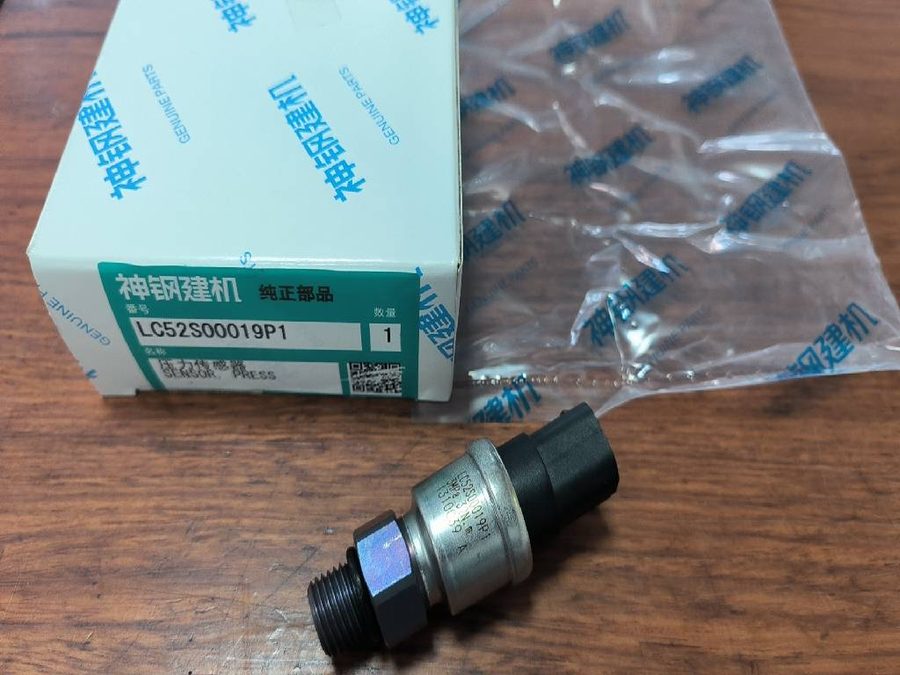
| Pressure sensors | Read boom and arm cylinder pressure | Two sensors, rated for the circuit; low pressure family LC52S00019P1 / YW52S00002P1 / LC52S00011P1 is commonly quoted |
| Angle sensor | Reports boom and arm geometry | YR52S00016P1 is the family we quote most |
| Display | Shows bucket load and truck total | Monitor gauge assemblies YN59S00021F3 / YN59E00017F1 show the style of unit |
| Harness and brackets | Connects sensors to display | Routing matters more than the parts; heat and vibration kill both |
Calibration is the product
A payload kit is only as good as its calibration. The procedure is always the same: lift a known load at a known radius, on level ground, and tell the system what it is holding. Do it at two or three weights across the range rather than one, because a single-point calibration fits one point and guesses the rest. Redo it after any change to bucket, counterweight or front, and record the date in the cab.
Where the number goes wrong
Cylinder friction is the first source. A worn gland or a dry rod adds friction that the pressure sensors read as load, which is why a system calibrated on a new machine drifts as it ages. Temperature is the second: oil viscosity changes with heat, so a reading taken in the first ten minutes of a shift is not the reading taken after four hours. Dynamics are the third: a load swung fast, stopped abruptly or lifted on a slope is momentarily wrong, and systems that average over a lift handle this better than systems that sample instantly. Finally, geometry: change the bucket, add a quick coupler or fit a longer arm, and every calculation behind the display uses the wrong lever.
Buying decisions that matter more than the brand
Ask whether the kit needs a specific monitor or runs standalone, whether it can export totals, and whether its sensors are the family already fitted. A kit that taps existing pressure ports is easier to install and service than one adding a second set to the same circuit. Ask about calibration support, because a system nobody can recalibrate locally becomes a decoration within a year.
Keeping it working
Sensors fail slowly and quietly. A display that reads a little low every month is usually a drifting sensor, and it gets blamed on the operator long before the part. Check readings against a known load each season, keep connectors dry, and route the harness away from the exhaust and boom pivot. The lift mode and load chart guide covers the structural side of the same question, and the receiving inspection protocol is worth applying to a kit with this many small parts.
Confirm sensor numbers against the serial with the part number search, then send the machine model, serial, bucket and front configuration through the contact page. Guangzhou Shenyue Machinery Technology Co., Ltd. holds three thousand part types on the shelf and over one hundred thousand part numbers available to order through original supply channels, each marked genuine, OEM or aftermarket. For multi-brand fleets, excavatorpartsglobal.com lists whole-machine configurations alongside our Kobelco range. Machine specifications for each model are published by the manufacturer at kobelco.co.jp.
Guangzhou Shenyue Machinery Technology Co., Ltd. is an independent supplier of Kobelco parts, not affiliated with Kobelco Construction Machinery Co., Ltd. Genuine parts are supplied through original channels alongside quality OEM and aftermarket alternatives at distributor-level prices.
Frequently Asked Questions
How accurate is an excavator payload weighing system?
Accurate enough to load a truck consistently, not enough to replace a weighbridge. Quoted figures assume a calibrated machine, a static or smooth lift, level ground and a load within range. Cylinder friction, oil temperature and geometry all move the number.
Pressure sensors or a load pin, which is better?
A load pin measures force directly and is less affected by cylinder friction; a pressure kit is cheaper, needs no pin change and suits retrofit. Where consistency matters more than absolute accuracy, a well-calibrated pressure kit is enough.
Why does my payload reading drift over time?
Usually a sensor, sometimes cylinder friction. High and low pressure sensors drift with age, and a worn gland adds friction the system reads as load. Recalibrate against a known load before replacing parts, and check connectors for corrosion.
What parts are needed to retrofit a payload system?
Two pressure sensors, an angle sensor, a display, a harness and brackets. Common families are low pressure sensor LC52S00019P1 / YW52S00002P1 / LC52S00011P1 and angle sensor YR52S00016P1, with monitor gauge assemblies YN59S00021F3 or YN59E00017F1. Guangzhou Shenyue Machinery Technology Co., Ltd. quotes against the serial.