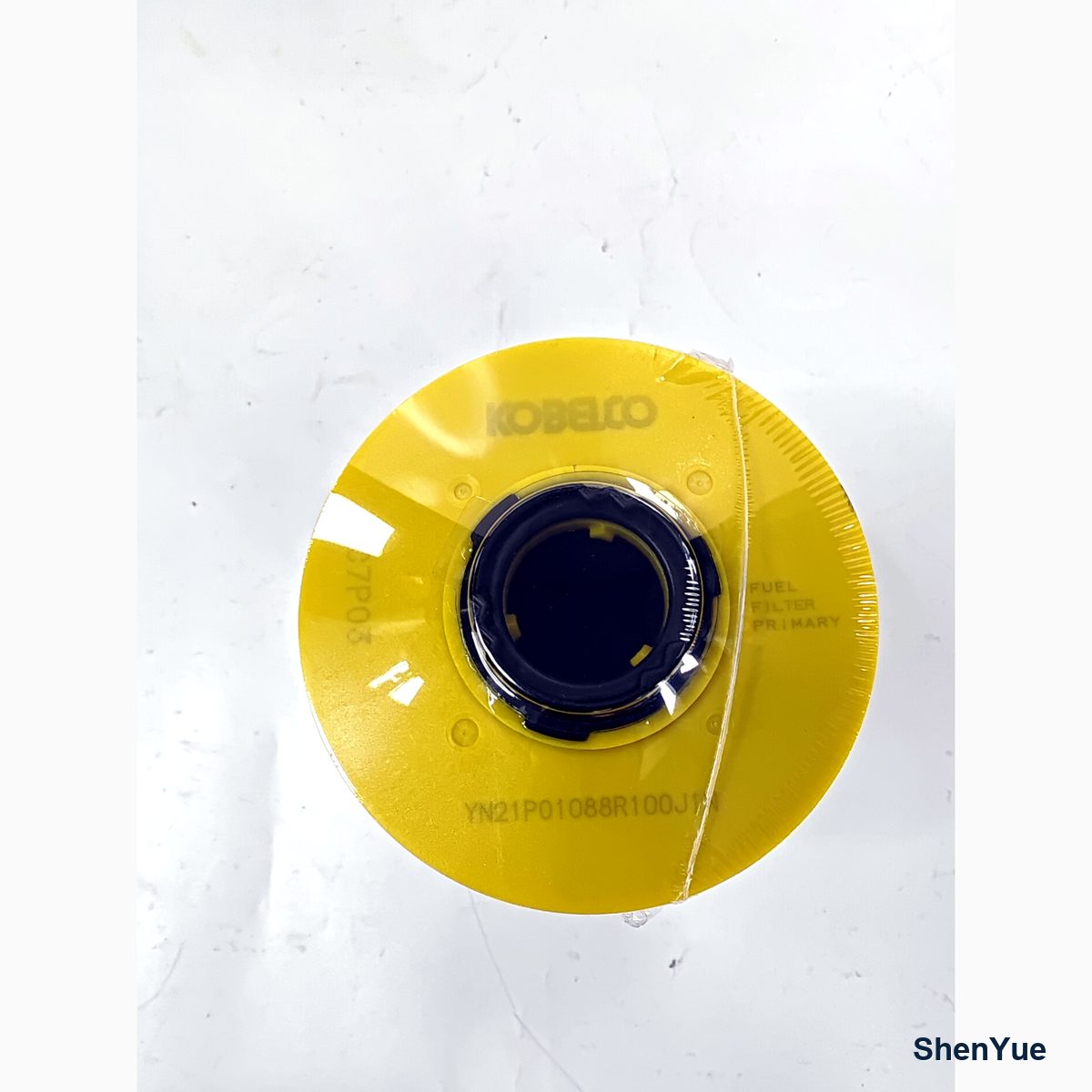
Every Kobelco hydraulic tank has a filtration story with two halves. The return filters get attention because they are on the outside, cheap to change and printed on every service schedule. The suction strainer sits inside or under the tank on the pump inlet, never appears on a dashboard, and gets serviced roughly never. Guangzhou Shenyue Machinery Technology Co., Ltd. supplies the full filtration set for Kobelco machines, and this guide explains what the strainer does, how a blocked one presents, and how to service it without making things worse. Machines that work in dusty quarries or wet ground, where the tank breathes hard every cycle, reach the strainer problem sooner than clean-yard machines ever will.
What the strainer does and where it sits
The suction strainer is a coarse mesh screen at the entrance of the pump's suction line, inside or at the bottom of the hydraulic tank. Its job is narrow but critical: stop the last fragments of debris, gasket paper and seal rubber from being drawn straight into the pump. Because it sits on the inlet side, it works under vacuum rather than pressure, which shapes both its failure mode and its symptoms. It is also the filter with the weakest early warning system on the machine, since nothing on the monitor reports strainer restriction. Our guide to the tank breather and return filter covers the other two filtration points on the same tank.
How a blocked strainer presents
A restricted suction strainer starves the pump, and the symptoms arrive in a recognisable order. First, noise: a whining or rattling pump at cold start that quiets as oil warms and thins. Second, slow or weak function response, especially boom raise and track, because the pump is short of oil rather than short of pressure. Third, visible cavitation signs if the restriction persists. Our guide to cavitation signs explains the damage mechanism in detail. The classic trap is blaming the pump: a new pump fitted to a blocked strainer inherits the same starvation and the same noise within days.
Servicing it properly
Access varies by model: some tanks carry the strainer on a removable cover, others on a serviceable insert, and the drain-and-access procedure follows the manual for the serial. Three rules apply everywhere. Clean or replace the strainer with the tank as clean as possible, never leave mesh debris behind, and inspect what the screen actually holds, because the catch tells you what is failing upstream: gasket paper points at a recent tank opening, seal rubber points at a failing cylinder or pump seal, metal glitter points at a component already damaged. Our guide to the system flush after pump failure covers what to do when the catch is more than incidental. Strainer references follow the serial, and we quote them as commonly quoted items checked against the parts book rather than as one-size listings.
| What you find | What it suggests | Next step |
|---|---|---|
| Grey gasket paper | Tank opened without care | Find the leak source |
| Black seal rubber | Failing seal upstream | Check cylinders and pump |
| Metal glitter | Component damage already | Oil sample, then flush plan |
| Sticky varnish film | Oil aged or overheated | Oil change and cooler check |
Buying filtration as a set
Guangzhou Shenyue Machinery Technology Co., Ltd. supplies suction strainers, return filter elements and breather assemblies for the Kobelco range, with 3,000+ part types on the shelf and 100,000+ part numbers available to order. Every item is marked genuine, OEM or aftermarket at quotation, with genuine parts supplied through original channels alongside quality alternatives at distributor-level prices. You can confirm references through the contact page with the model and serial, and Kobelco's own machine documentation at kobelco.co.jp remains the background authority for tank layouts across the range. The same filtration discipline applies to mixed fleets, where our sister sites excavatorpartsglobal.com and corbayparts.com cover multi-brand buyers, so the strainer never gets skipped on any machine in the yard. When you order, tell us what came off the old screen; a strainer quote that matches the catch is worth more than a parts-book guess.
Frequently Asked Questions
Where is the suction strainer on a Kobelco excavator?
It sits inside or at the bottom of the hydraulic tank on the pump inlet line, ahead of the pump suction. Access follows the manual for the serial. Guangzhou Shenyue Machinery Technology Co., Ltd. supplies strainers checked against the parts book.
What are the symptoms of a blocked hydraulic suction strainer?
Pump whine at cold start, slow or weak boom and track response, and cavitation signs under load. The symptoms mimic pump failure, so the strainer should be checked before any pump is replaced.
How often should the tank strainer be serviced?
Follow the manual for the serial, but treat any pump replacement or major tank opening as a mandatory strainer service. Restriction is not reported on the monitor, so inspection intervals do the monitoring instead.
Do you stock strainers and return filters together?
Yes. Guangzhou Shenyue Machinery Technology Co., Ltd. supplies suction strainers, return elements and breathers as a set, with every item marked genuine, OEM or aftermarket at quotation, backed by 3,000+ part types on the shelf.