Swamp reclamation, riverbank work, paddy conversion and soft landfill all share one property: the machine floats on a layer that gives way, and the undercarriage pays the bill. On firm ground a Kobelco undercarriage is a predictable wear system; in silt and standing water it becomes the fastest-consuming part of the machine, ahead of the engine and the hydraulics. Planning parts for soft-ground work is therefore less about a special parts list and more about accepting a different wear rate and a different inspection rhythm. Here is how Guangzhou Shenyue Machinery Technology Co., Ltd. advises customers preparing a Kobelco machine for a soft-ground season.
Shoes first: floatation is a parts decision
The standard shoe width that suits a SK200-8 on compacted ground can sink it in peat. Low-ground-pressure and swamp shoe options — wider plates, and in the wettest applications long or specially groused shoes — exist precisely for this work, and they are commonly quoted against the machine serial and the track frame rather than as a universal catalogue number, because shoe pitch and fixing pattern follow the generation of the undercarriage. The serial plate decides the pitch; the nameplate is the authority. A customer who sends us the serial and photographs of one existing shoe gets a shoe answer, not a shoe guess.
Wider shoes change the tension game
Fitting swamp shoes is not a bolt-on afternoon. Wider shoes carry more material, which changes the track sag you should expect, and mud packs between the shoe and the sprocket in a way that pretends the track has stretched. The tension system then gets over-tightened to chase a false reading, and the extra load eats bushings, pins and the recoil spring. Our track tension guide covers the correct sag measurement, and on soft ground the measurement must be taken with the mud cleaned out — a tension check on a filthy track reads fiction. The recoil spring assembly is a stocked item, and a machine that has spent a season over-tightened should have it inspected.
| Soft-ground effect | What accelerates | Parts response |
|---|---|---|
| Silt packs the running gear | Roller and idler seal wear; seized rollers | Track rollers and idlers stocked by serial; seals inspected at every interval |
| False stretch from packed mud | Over-tightened track; bushing and pin wear | Correct sag measurement; recoil spring inspection |
| Standing water | Final drive and reduction oil contamination | Oil changes shortened; seals checked at each service |
| Constant steering correction | Sprocket and bushing wear at the ends | Sprocket section wear measured, not guessed |
Seals are the real currency in silt
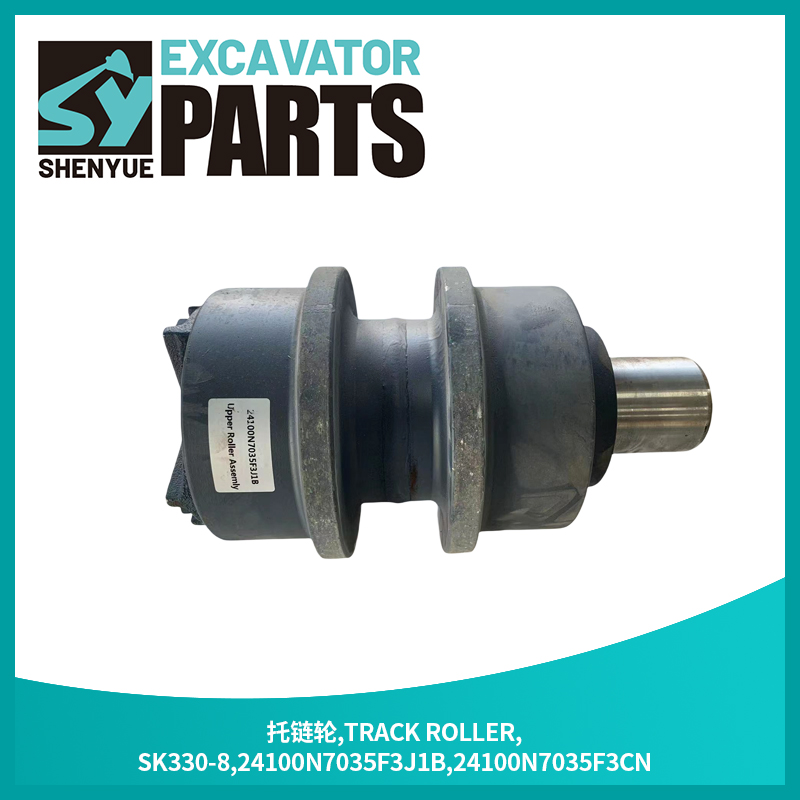
In swamp work the components that fail first are rarely the big castings — they are the seals that keep silt out of the rollers, idlers and final drives. A roller seal that would survive a year on dry ground can be gone in a season of submerged work, and a seized roller then flats-spots the chain that runs over it. The economics favour early intervention: replacing a roller before it seizes costs a roller; replacing it after costs a roller and a chain section. Our undercarriage guide covers the roller and frame layout by machine, and rollers are stocked against confirmed serials — the SK330-8 roller 24100N7035F3J1B shown above is an example of the level of numbering we quote.
Stocking plan for a soft-ground season
The spare-parts basket for a swamp season looks different from a city basket: more undercarriage, more filtration for the water-contaminated oils, and fewer engine internals. Filters go up in priority because water finds its way into final drive and hydraulic systems faster when the machine works submerged, and seal kits stop being emergency items and become planned consumables. For fleets that also run other makes on the same site, our colleagues at excavatorpartsglobal.com handle the full-brand side of the same planning, while this site stays Kobelco-deep. Machine-level specifications remain with Kobelco, where the undercarriage options for your serial are documented; Guangzhou Shenyue Machinery Technology Co., Ltd. is an independent supplier, not a Kobelco dealer.
Start from the track tension and recoil spring guide to set the baseline, then the track frame and rollers guide for the component layout, and use the part number search to check what is on the shelf for your serial before the season starts.
Frequently Asked Questions
Can I fit wider swamp shoes to any Kobelco excavator?
Shoe width options exist for most classes, but the shoe pitch and fixing pattern follow the undercarriage generation, so swamp shoes are commonly quoted against the machine serial rather than as a universal item. Guangzhou Shenyue Machinery Technology Co., Ltd. confirms from the serial and a photograph of an existing shoe.
Why does my track feel loose after working in mud?
Packed mud between the shoes and sprocket mimics a stretched track and often leads to over-tensioning, which accelerates bushing and recoil spring wear. Measure sag with the mud cleaned out, following the tension procedure, and inspect the recoil spring at the end of the season.
Which parts fail first in swamp conditions?
Seals — on track rollers, idlers and final drives — fail long before the castings do, because silt and standing water attack the sealing surfaces. Guangzhou Shenyue Machinery Technology Co., Ltd. recommends shortening oil-change intervals and treating roller seal checks as planned maintenance, not emergency work.
Do you stock track rollers for machines working in soft ground?
Yes. Rollers and idlers are stocked against confirmed serials — for example the SK330-8 track roller 24100N7035F3J1B — with genuine, OEM or aftermarket condition stated on every line. Send the serial and photographs and we confirm what is on the shelf.