Work lights are the first thing an operator touches in the morning and the last thing at night, and they live in the worst environment on the machine: high off the ground, in dust, rain and constant vibration. When a light fails, the temptation is to order a lamp. On the machines we support at Guangzhou Shenyue Machinery Technology Co., Ltd., the fault sits in the switch, the relay or a connector far more often than in the lamp itself, and an hour of diagnosis saves a wasted part.
The circuit in plain terms
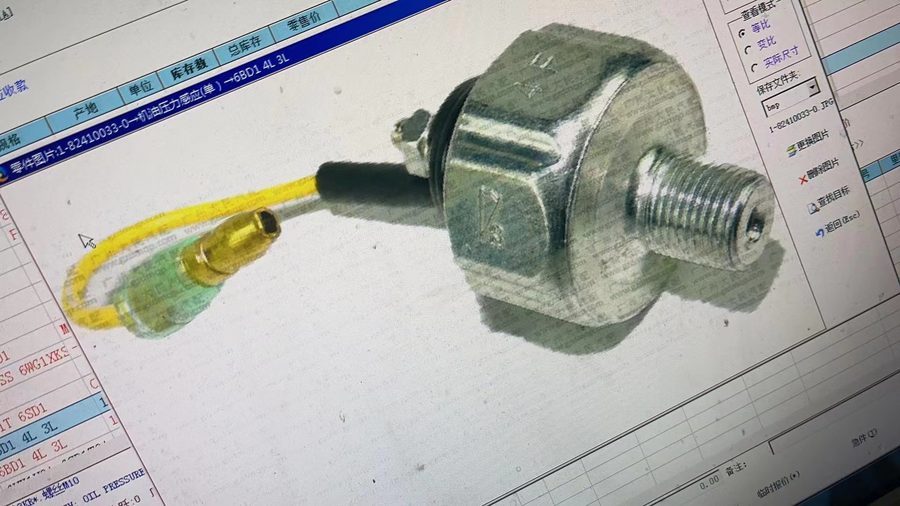
A Kobelco work light circuit is simple: battery supply, a fuse, a relay, a switch on the console that controls the relay coil, and the lamps. The switch the operator actually touches is the small part of that chain, but it is the part that wears, because it carries the relay coil current every single cycle of its life. Our records quote the working switch as YN50S00040D1, and switch hardware under VI1824100330 and VI1824100082; the relay that actually carries the lamp current belongs to the relay family covered elsewhere on this site. The separation matters: a switch that clicks but does nothing has probably not failed, the relay or its supply has.
Why lights die young on an excavator
Three environmental forces work against the circuit at once. Vibration loosens everything that is screwed, from bulb filaments to terminal screws. Water and dust find every connector that was never sealed properly, and each wash-down pushes them further in. And the mounting points on the boom and cab roof flex, which works the harness where it enters the lamp housing. That combination is why the diagnosis order matters: the part that fails is whichever one of the five sits in the wettest, most flexed position, and that changes from machine to machine.
Diagnose in this order
Start with the split that costs nothing. If both lights are dead, suspect the shared path: the fuse, the relay or the switch. If only one light is dead, the shared components are fine, and the fault is downstream of the relay, which means the lamp, its connector or its ground. Then work the shared path in the order of likelihood. Pull and inspect the fuse; corrosion at the fuse legs is common on machines that wash down poorly. Swap the light relay with an identical one from a circuit that works. Test the switch with a meter set to continuity: a switch that reads open when pressed is done. Only after all of that, look at the lamps and their connectors, where green corrosion on the terminals is the classic night-shift killer.
| Fault | First suspect | Test |
|---|---|---|
| Both lights dead | Fuse, relay or working switch | Fuse inspection, relay swap, continuity test |
| One light dead | Lamp, connector or ground | Voltage at lamp connector, ground strap check |
| Lights flicker over bumps | Connector or ground corrosion | Wiggle test with the light on |
| Switch clicks, nothing happens | Relay or relay supply | Listen for relay operation, check coil supply |
Fix the connector, not just the lamp. Guangzhou Shenyue Machinery Technology Co., Ltd. supplies switches, relays, lamp connectors and lamps for the SK200 to SK550 classes. Every electrical part we quote is graded genuine, OEM or aftermarket, and switch hardware is confirmed against the machine's nameplate before dispatch.
Replacing lamps: three things to specify
When lamps do need replacing, specify three things rather than just a wattage. First, the connector type, because lamp connectors vary across machine generations and an adapter in a wet location is a future failure. Second, the vibration rating: a lamp built for a truck cab will not survive a season on the boom of a 25 tonne excavator. Third, decide deliberately between halogen and LED. LED units draw less current and survive vibration better, and we supply them, but the honest advice is to check the circuit first: older harnesses and switches were sized for halogen loads, and some LED units behave differently with the relay coil current. If you retrofit LED across the machine, note it on the service record so the next diagnosis starts from reality. Kobelco's lighting specifications per model are published at kobelco.co.jp.
Where to start
The relay logic above assumes the rest of the machine's electrics are healthy; if the battery or charging side is suspect, read the battery and charging guide first. The relay family and its part numbers are laid out in the relay family guide, and connector repair practice in the wiring harness and connector guide. For switch hardware confirmed to your machine, send the nameplate through the contact page and the quote comes back with grades and lead times for each line.
Frequently Asked Questions
Both work lights failed at once on my Kobelco. Where do I start?
Check the shared path, not the lamps: fuse, relay, then the working switch. On most machines the working switch is quoted as YN50S00040D1 and the relay belongs to the standard relay family. Guangzhou Shenyue Machinery Technology Co., Ltd. supplies all three, confirmed against the nameplate.
Can I replace halogen work lights with LED on an excavator?
Yes, and LEDs handle vibration better, but check the existing harness and relay sizing first, because older circuits were designed for halogen loads and some LED units behave differently with relay coil currents. Note any retrofit on the service record so future diagnosis starts from the actual hardware.
Why does only one work light fail repeatedly?
One light failing points downstream of the shared relay: that lamp's connector or its ground. Green terminal corrosion is the usual cause on machines with poor wash-down practice. Clean the connector and ground before replacing the lamp again.
What switch parts does Guangzhou Shenyue Machinery Technology Co., Ltd. stock?
Our records quote the working switch YN50S00040D1 and switch hardware VI1824100330 and VI1824100082, alongside the key switch YN50S00026F1 and YN50S00002F1, each itemised as genuine, OEM or aftermarket on the quote.